
Finding & Reburying Richard
Updates

Identification
At an historic press conference on the morning of 4th February, the University of Leicester revealed evidence from the Greyfriars dig and confirmed that the human remains of King Richard III had been positively identified. They revealed a range of supporting evidence, including DNA analysis, radiocarbon dating and skeletal examination – proving the identity of the skeleton. Key points are:
- DNA from skeleton matches two of Richard III’s maternal line relatives. Leicester genealogist verifies living relatives of Richard III’s family
- Individual likely to have been killed by one of two fatal injuries to the skull – one possibly from a sword and one possibly from a halberd
- Ten wounds discovered on skeleton – Richard III killed by trauma to the back of the head. Part of the skull sliced off
- Radiocarbon dating reveals individual had a high protein diet – including significant amounts of seafood – meaning he was likely to be of high status
- Radiocarbon dating reveals individual died in the second half of the 15th or in the early 16th century – consistent with Richard’s death in 1485
- Skeleton reveals severe scoliosis – onset believed to have occurred at the time of puberty
- Although around 5 feet 8 inches tall (1.72m), condition meant King Richard III would have stood significantly shorter and his right shoulder may have been higher than the left
- Feet were truncated at an unknown point in the past, but a significant time after the burial
- Corpse was subjected to ‘humiliation injuries’ – including a sword through the right buttock
- Individual had unusually slender, almost feminine, build for a man – in keeping with contemporaneous accounts
- No evidence for ‘withered arm’ – as portrayed by Shakespeare – found
- Possibility that the individual’s hands were tied
- Grave was hastily dug, was not big enough and there was no shroud or coffin.
Richard Buckley, the lead archaeologist for the Search for Richard III project said: ‘It is the academic conclusion of the University of Leicester that the individual exhumed at the Greyfriars in August 2012 is indeed King Richard III, the last Plantagenet King of England.’
For more information visit the University’s website.
4th February Press Release
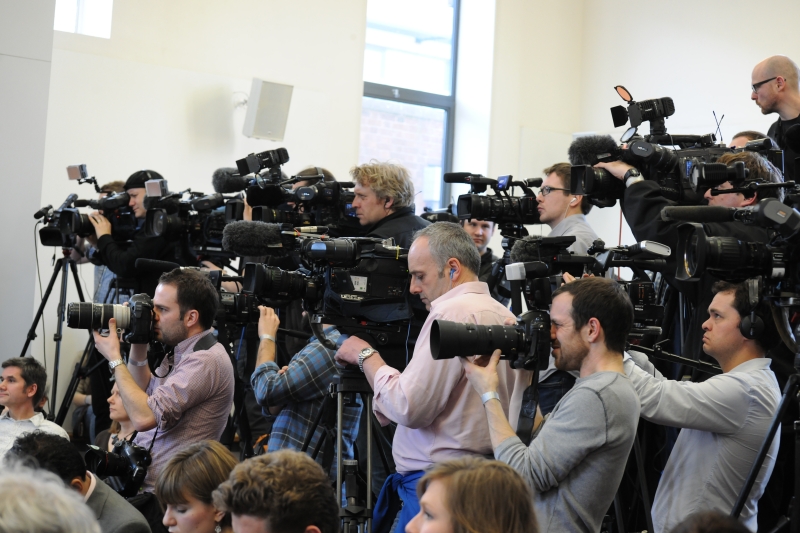
Press Conference, 4th February 2013
Philippa's speech
“Today marks the culmination of an extraordinary journey of discovery. When I embarked on the Looking for Richard Project four years ago – the quest to find a king in a car park – almost everyone thought I was mad. Let’s face it, it’s not the easiest pitch in the world – to look for a king under a council car park – but luckily the Richard III Society, Leicester City Council, and the University, as well as Channel 4 and Darlow Smithson Productions, partners with vision, came on board.
“But, as we got ready to look for Richard, at the 11th hour one of our funding bodies pulled. The dig was to be cancelled so, together with writer Annette Carson we launched an international appeal. The search for Richard was saved by donations from around the world, but they also gave the project its mandate when they said – search for him – find him – honour him.
“Strange thing to say for Richard III – honour him…?
“Richard III gave us the system of bail, and opened up the printing industry, giving us books and the freedom of information. He also initiated, and applied, the legal principles of the Presumption of Innocence and Blind Justice. It is ironic then that Richard is still presumed guilty of the murder of his nephews, until proven innocent, even though there is no evidence that points to him having killed them.
“The Richard III Society was founded on a simple principle, that truth is more powerful than lies. It also considers that, when investigating someone, if you have two sources, those who knew him and those who didn’t, your primary source must always be those who knew him.
“After Richard’s death at Bosworth the men of the north who had known Richard, man and boy, described him thus: The most famous Prince of blessed memory.
“In the intervening centuries since King Richard’s death, many have told his story, not least Shakespeare and the Tudor writers. But now, here today, it is Richard who has finally been able to reveal himself. When Richard’s body was stripped naked at Bosworth his physical condition, his scoliosis, became known, and it was used to insult and degrade him. Today we know that a physical abnormality is not a sign of evil. We find this idea abhorrent. We are no longer in the Tudor-mindset.
“On Channel 4 this evening, and tomorrow morning at the Richard III Society conference, you will see Richard’s face for the very first time through the facial reconstruction by Professor Caroline Wilkinson of the University of Dundee. The two-dimensional caricature promoted by the Tudors, will be no more.
“In September 2010, the Looking For Richard Project commissioned the design of a tomb based upon Richard’s life and what was important and meaningful to him. Undertaken by a team of Ricardians, it has been welcomed by the Cathedral, Council and Richard III Society and will be revealed in the next few weeks. The first donation of £10,000 has already been received.
“The discovery of King Richard is an historic moment when the history books will be rewritten. A wind of change is blowing, one that will now seek out the truth about the real Richard III.
“And as regards our mandate from those around the world: We have searched for Richard, and we have found him – it is now time to honour him.
“The text on the screen is the Act of Parliament that settled the crown upon King Richard, and his heirs – all copies of which Henry Tudor tried to destroy:
‘Be it pronounced, decreed, and declared, that our said Sovereign Lord, the King was, and is, very and undoubted King of England.’ Titulus Regis 1484.

Philippa Langley speaking at the Press Conference
King Revealed
The Richard III Society today unveiled the world’s only facial reconstruction of the human remains found at the Greyfriars in Leicester, yesterday confirmed as belonging to Richard III. The reconstruction project, led by Caroline Wilkinson, Professor of Craniofacial Identification at the University of Dundee, was commissioned and funded by the Richard III Society,
To those who have seen as many portrayals of Richard III with contorted body and facial features, this calm and apparently thoughtful face could be a shock. After his death, many portraits deliberately added narrowed eyes and mean lines. We have already discovered he had no kyphosis or withered arm – now we know he had a warm face, young, earnest and rather serious. How many scales will drop from how many eyes! This likeness is so real, it is a remarkable tribute to Professor Wilkinson and her reconstruction team.
Congratulations and thanks are in order, but these words somehow don’t seem adequate to recognise such art, skill and loving craftsmanship.
Dr. Phil Stone, Richard III Society Chairman, said: “It’s an interesting face, younger and fuller than we have been used to seeing, less careworn and with the hint of a smile. When I first saw it, I thought there is enough of the portraits about it for it to be King Richard, but not enough to suggest they have been copied. I think people will like it. He’s a man who lived. Indeed, when I looked him in the eye, ‘Good King Richard’ seemed alive and about to speak. At last, it seems, we have the true image of Richard III – is this the face that launched a thousand myths?”
5th February Press Release
All images courtesy of Colin G Brooks and Philippa Langley unless otherwise stated.

©Getty

©Getty