
Finding & Reburying Richard
Background

Death & Burial
In 1485 King Richard III, fighting courageously to defend his crown, was defeated and killed by Henry Tudor’s invading forces at the Battle of Bosworth. Following his death, Richard’s body was stripped, despoiled, and brought to nearby Leicester to be put on display to show that he was dead.
At this point the intrigue begins. There is some evidence that his body was placed in the Newarke at Leicester, i.e. the Church of the Annunciation of Mary the Virgin. There is an eighteenth century tradition that the Franciscans – the Greyfriars – asked for permission to bury the late king in their friary church, where he was afforded a place of honour in the choir, i.e. the area before the holy altar.
The church at the Newarke had long standing Lancastrian associations. So perhaps the new king Henry VII (who considered himself a member of the House of Lancaster) moved Richard’s body because he thought it an inappropriate place for a member of England’s ruling House of York. Certainly it was at the Greyfriars, ten years later, that Henry VII decided to have a tomb erected marking Richard’s burial site.
In 1538, the Tudor king’s son, Henry VIII decreed the Dissolution of the Monasteries. England’s beautiful abbeys and other religious houses were destroyed, among them the Leicester Greyfriars.
Their valuable sites were sold off to swell the royal revenues, and in due course the Greyfriars site now named Beaumanor, came into the hands of Alderman Robert Herrick. A reliable account by the father of the architect Christopher Wren in 1612 records that Herrick had a handsome stone pillar in his garden, marking the spot where the body of King Richard III lay.
All this was pieced together and published by Ricardians over the years, demonstrating that although Richard’s memorial tomb had obviously disappeared by then, Alderman Herrick’s garden still contained a commemoration of his grave site. This garden (quite a large one) was to be seen on old maps of Leicester, and indeed it lay within the general area still known as The Greyfriars.
By great good fortune, only parts of this area had actually been built on over the years. Three separate sections of what was once Herrick’s garden had now been covered in tarmac and were used by the city council (and two private owners) as large parking areas. It was in the council car park that Philippa commissioned the archaeological dig to be concentrated.
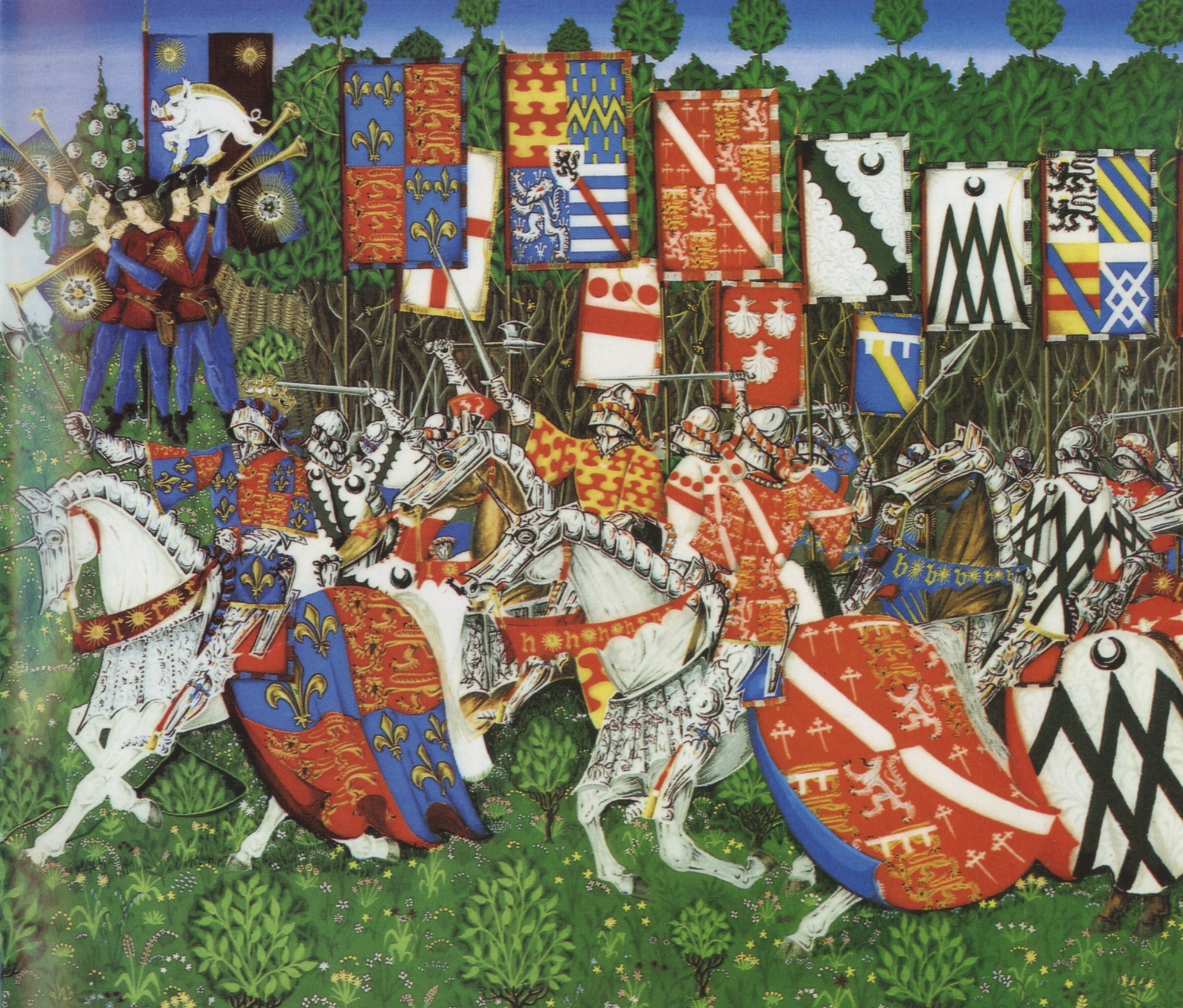
Richard's Army at Bosworth by Andrew Jamieson

Historical Re-enactor Andreas Wenzel. Image by kind permission of Annette Carson

Richard III at Bosworth by Graham Turner. Reproduced by kind permission of the artist - www.studio88.co.uk
Where to Look
The University of Leicester Archaeological Services (ULAS), the leading archaeological team in Leicester, had already done some excavation work nearby. This was during the demolition of a small single storey 1950s extension in the nearby street of Grey Friars, which was examined owing to the historical significance of the area. For Philippa this produced great excitement – not by what this excavation found, but by what it failed to find. Contrary to expectations, there was no evidence of the medieval church having been obliterated by later buildings: they recovered only a fragment of a stone coffin lid in a post medieval drain. This meant that for Philippa there were valid grounds for seeking the church elsewhere and her research locally was pointing to the northern end of the Social Services car park.
Philippa and Dr John Ashdown-Hill finally met in February 2009 when their research dovetailed and John agreed with her assessment that the church of the Greyfriars could be in the northern end of the Social Services car park. John now undertook research into comparable medieval religious houses and in the summer of 2011 was able to assert with some confidence, that the church of the Greyfriars was more than likely situated to the north of the site of Herrick’s garden, rather than to the south which was a possibility entertained by local archaeologists. This was good news for the search, as the northern side was largely free of subsequent building work.

The remains of Richard III were found beside the letter 'R'. Picture taken on 28th August 2011 as Philippa undertook the GPR survey. Image courtesy of Annette Carson
Richard III's DNA
Whilst Philippa was pursuing her goal of locating Richard III’s burial site, John Ashdown-Hill made a most remarkable discovery. He had traced an all-female line of direct descent from Richard’s sister, Anne of York, which meant that Joy Ibsen, a retired journalist living in Canada, and her son Michael, living in England, possessed King Richard III’s mitrochondrial DNA (mtDNA). This represented a strong argument for Philippa when enlisting support for the search, because if remains were found which were fragmentary or inconclusive, it might come down to DNA matching when trying to identify them. Michael was incredibly supportive and offered his help unreservedly.

Dr John Ashdown-Hill
Discoveries
On the first day of the dig, 25th August 2012, with the first trench being carefully excavated down to medieval levels, work suddenly came to a halt. Human remains had been encountered. This meant that until an exhumation licence was obtained, no further action could be taken other than to protect them. The remains were located in the northern end of the car park, and appeared to be a burial.
Meanwhile other areas were explored, and after a fortnight the church of the Greyfriars had certainly been uncovered. A third trench, cut into another, separate car park next door, now confirmed that the church was indeed in the northern end of the site. By now Philippa had convinced the archaeologists to exhume this grave as she had £800 remaining from the international appeal, and she would use it. Those human remains, now safely and respectfully removed, had been found in a grave in the choir, a place of singular honour which one would expect to be accorded to a king.
This was such a breakthrough that the dig was extended into a third week. With the excavation of the third trench now well under way, more materials from the church were found, such as floor tiles and tracery, and the position of the altar was identified.
Evidence of a garden was also discovered here – the lost garden of Robert Herrick – wherein, historically there stood a memorial to Richard III. The later history of Herrick’s mansion house was that his descendants sold the property in 1711, after which is passed through various owners until the house was eventually pulled down some time in the 1870s, and municipal buildings were erected. However, Herrick’s garden seems to have remained a garden, or wasteland, up until the 1930s-1940s, when parts of it were surfaced in tarmac to become two distinct car parks separated by a wall.
It was the greatest of good fortune that Alderman Herrick had left what remained of the ruined Greyfriars Church virtually undisturbed when he laid out his garden, and in later years the choir had never been built over.
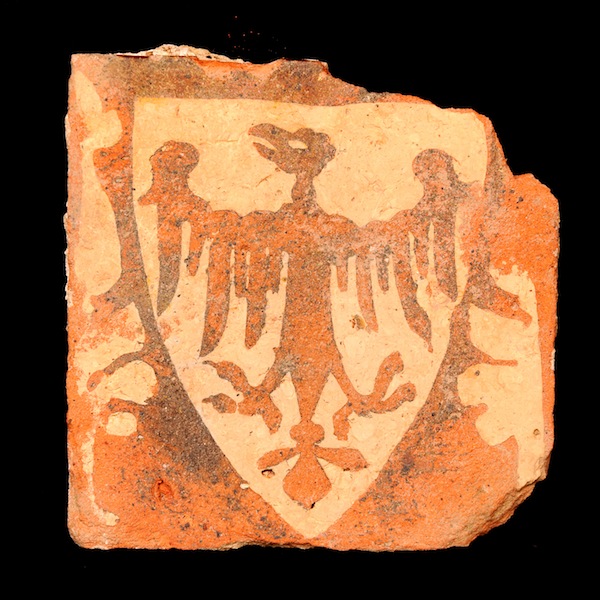
Medieval floor tile from the friary
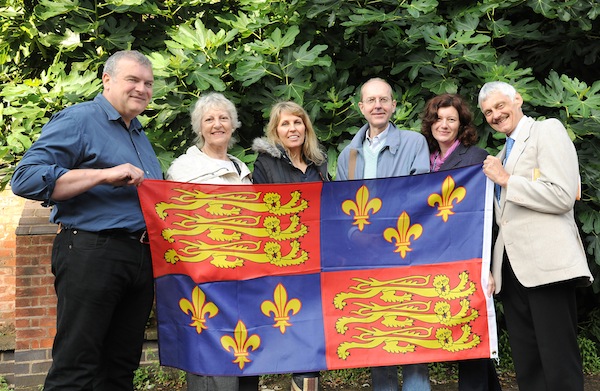
Some members of the 'Tomb Team'. From left to right: Richard Buckley, Annette Carson, Philippa Langley, Michael Ibsen, Turi King and John Ashdown-Hill
The Mortal Remains of Richard III
By 12th September a preliminary examination had been made, and at last the discovery of human remains could be announced to the world.
It was early days yet, and much testing still remained to be done. But there was circumstantial evidence from obvious battle wounds and a curvature of the spine known as scoliosis. This differs from kyphosis, a form of curvature, nastily described as ‘hunchbacked’ which Tudor sources attributed to Richard III, along with a ‘withered arm’. These latter deformities were not in the least apparent in the remains. Although a positive identification was not yet possible, many points of significant interest were noted:
- The remains appeared to be of an adult male.
- The choir of the church where he was found, was known to be the area stated in the historical record as the burial place of King Richard III. The priest John Rous wrote that Richard ‘at last was buried in the choir of the Friars Minor at Leicester.’
- The skeleton, on initial examination, appeared to have suffered significant peri-mortem trauma to the skull which could be consistent with an injury received in battle. A bladed implement appeared to have cleaved part of the rear of the skull.
- A barbed iron arrowhead was found between vertebrae of the skeleton’s upper back.
- The skeleton found in the choir area had spinal abnormalities, indicative of the individual having had severe scoliosis – a form of spinal curvature which would have made his right shoulder appear higher than the left shoulder.
In this context it was remarked that ‘contemporary accounts of Richard’s appearance’ had noted this disparity in shoulder height, but of course Ricardians know this is not true. It was only after his death that stories of Richard III began to be embroidered with descriptions of disfigurements. Now, from this evidence, far from being a distorted monster his only physical problem appeared to be unequal shoulders. Intriguingly, our reigning monarch, Queen Elizabeth II has the same.
All images courtesy of Colin G Brooks and Philippa Langley unless otherwise stated.
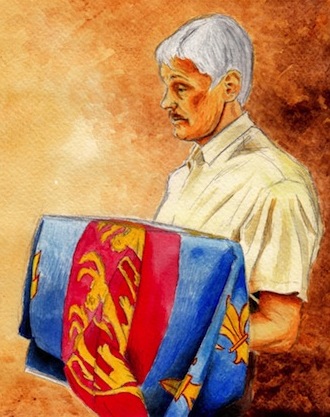
A depiction, by Finnish artist Riikka Nikko, of the removal of the mortal remains of King Richard from the Greyfriars site. John Ashdown-Hill had the honour of carrying him.