
Reputation
The Princes
The ‘Princes in the Tower’ were the two sons of King Edward IV of England. The elder of the two succeeded to the throne as Edward V on the death of his father in April 1483. Nearly three months later, Richard, Duke of Gloucester, uncle of the two boys, was proclaimed king as Richard III. His nephews were at that time living in the royal apartments in the Tower of London where they were seen sporadically until about mid-July 1483. After this they disappeared from view. Rumours about the disappearance of the princes and their uncle’s part in it soon began to circulate on the continent, where those who were disaffected by the current regime had taken refuge. However, it was only after Richard’s own death that the accusations became more substantive and they continued to be popularly believed.
The few facts that are known do not, however, support the traditional story, which was made popular by Shakespeare – that they had been smothered by Sir James Tyrell, Master of the Horse and Henchmen to Richard III, with the help of two men, Miles Forest and John Dighton and that their bodies were then buried at the foot of a flight of stairs in the Tower. This story is well known from Shakespeare’s play The Tragedy of King Richard III and from his major source for this story, Thomas More’s The History of King Richard III. But see here for new evidence based on recent discoveries.
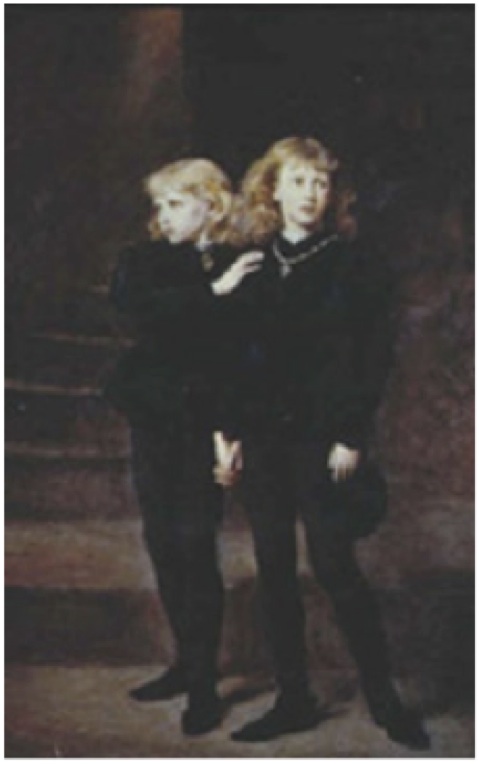
The Two Princes Edward and Richard in the Tower by John Everett Millais
The Bones from the Tower
This story is often said to have been confirmed by the discovery of the bones of two children within the foundations of a staircase within the Tower of London in 1674. In 1678 some bones, said to be the same ones, were interred in an urn in Westminster Abbey as the bones of the princes by order of Charles II. In 1933 they were exhumed and, after examination, were declared to be the bones of two children of the right age and thus assumed to be the bones of the princes. Neither sex nor century of death could be determined, however.
With the advance of knowledge and with new techniques available, the conclusions of the 1933 examination are now disputed. The categorical statements made in the report which followed the examination would not now be made by modern forensic scientists, who would stress the uncertainties in the determination of age, sex, family relationship, date of death and so on. To take just one example, modern forensic techniques show that the ages arrived at for the two skeletons are highly disputable and they may both be younger than they would be if they were the princes. Furthermore, the age gap between the two children appears to be less than the three years that separate the births of Edward and Richard, the two Princes. Assigning a date to the bones could not be done at all in 1933. Using radiocarbon dating, it would now be possible to at least assign a century to whichever bones were to be tested, and indeed probably come as close as a date within 70 years with a margin of error of plus or minus about 15 years. This would at least enable us to know whether we were talking about late medieval bones or Roman bones, for example. It is likely that in the future even more accurate dating will be possible.
Another major deficiency in 1933 was the lack of a reliable relationship between the two bodies. In the report a relationship was largely assumed, and unreliable techniques then applied to prove it. No attempt was made to determine their sex. With such young children this is difficult, but new techniques being developed will soon make it possible. More reliable methods have been developed since 1933, particularly DNA testing. With this powerful new technique it is possible to determine whether the bones tested were male or female, to show if a relationship existed between them and whether they were both descended from the same person. For this test to work a comparison between the mitochondrial DNA (mtDNA) in the bones and that in a person descended in an unbroken female line from Elizabeth Woodville, the mother of the princes, or her mother, Jacquettta Woodville, must be made. This is because only mtDNA descends unchanged, through the female line, through the generations. Thanks to recent work by Glen Moran this mtDNA sequence has now been discovered, making a comparison possible if the ancient DNA can be extracted.
It is therefore conceivable that a further examination of these bones could tell us much more than could be determined in 1933. However, in a few years it may be possible to find out even more and it is not desirable to disinter bodies just to satisfy our curiosity now. The Society will, however, welcome a re-examination if and when the authorities are prepared to give permission. We have to be content to wait for that and when scientific advances will have made the results much more meaningful.
Read Helen Maurer’s articles ‘Bones in the Tower: A Discussion of Time, Place and Circumstance’ part 1 and part 2 first published in The Ricardian. See also new evidence here based on recent discoveries about the so-called ‘Princes in the Tower’.

The Tower of London
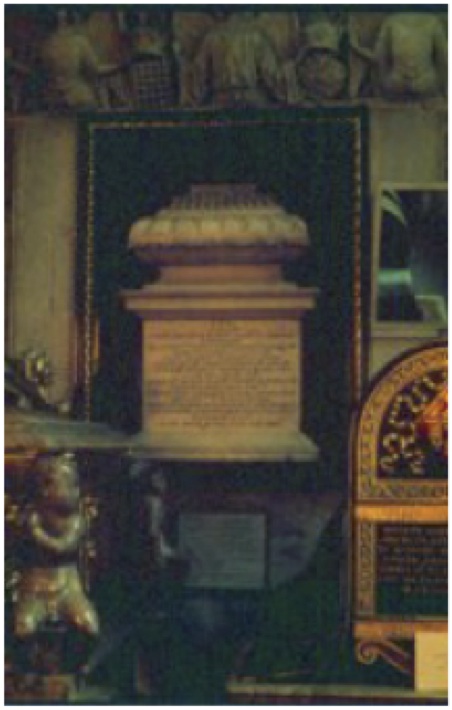
The urn containing the bones in Westminster Abbey
Further Reading
- Recent investigations regarding the fate of the Princes in the Tower by L. E. Tanner and William Wright (Archaeologica, Vol. 84, 1934)
- Richard III by Paul Murray Kendall, London, 1955 (Appendix 1: Who Murdered the ‘Little Princes’?)
- The Mystery of the Princes by Audrey Williamson, Gloucester, 1986
- Richard III and the Princes in the Tower by A. J. Pollard, Gloucester, 1991)
- The Princes in the Tower by Alison Weir, 1992
- Royal Blood by Bertram Fields, Stroud, 2000