
His Life & Death
The Perfect Prince
The ‘how to…’ handbooks, so popular in our own time, which cover a vast array of skills, behaviours, activities, etc. are not new. In the fifteenth century, books abounded advising rulers on what was expected of them, such as ‘mirrors’ of princes or histories that gave shining examples of how a prince should behave. Richard III owned a number of such books and it appears he accepted the writers’ teachings.
In a paper presented by Anne Sutton at the Society’s symposium held in 1984 at Jesus College, Cambridge (and subsequently published in Richard III, Loyalty, Lordship and Law) she puts forward a very strong case that Richard, both as duke and king, followed the principles laid down for a prince and that he can be viewed as ‘a perfect prince’. The following is a brief summary of some of those arguments.
First, what were the requisite virtues?
From The Declamation of Noblesse ‘…to be a curious searcer for our weal publyque merry at home, laborious outward, besy to atteyne science, pyteous of them which has necessyte, namely to my fader, moder & kynne, welbyloued of my neyghbours, true to my frendes, obeysaunt and devoute in thynges relygious.’
In De Regimine Principum by Aegidius Colonna, a pupil of St Thomas Aquinas, Colonna’s prince should be ‘…prudent, dignified, but sympathtic, truthful, energetic, just but tempered with mercy, courageous but not rash, moderate in all things, magnanimous and munificent in his undertakings, a generous but careful rewarder of the deserving, he should love honour, be humble and friendly while commanding respect, have an equal as his wife with whom he shares secrets and above all love the common good and the welfare of the state.’
John Gower summed up the virtues as ‘…truth, largesse, love of justice, pity, and chastity in marriage.’
William Langland, in The Vision of Piers Plowman, presents ‘a compelling image of a harmonious society bound together by law, loyalty and love’. Loyalty was a virtue that Richard embraced enthusiastically and included in his personal motto ‘loyalte me lie’.
The theme in all of these works is the personal virtue of the prince. In the middle ages, public morality was the extension of private morality. ‘The king’s will had to be controlled by a desire to serve the good of the community, the “common weal”, and by obedience to the rule of natural law.’ In the coronation oath the ideals of good rule are reduced to four basic clauses ‘maintain the church, administer justice, uphold the laws of England, and defend your subjects’. The oath was translated into English for the first time at King Richard’s coronation.

Richard III. Image reproduced by kind permission of the Society of Antiquaries
The Church
Through the medium of sermons the church encouraged the rich to fulfil their obligations and help the poor. Richard’s good intentions in this area are well documented. He promoted the court that became the Court of Requests, where the poor could present their suits at Westminster. In Glamorgan, where he held considerable land, Richard attempted to reform the administration system within his lordship, and T.B. Pugh commented Richard ‘had a genuine concern for the welfare of its inhabitants.’
Of Richard’s personal piety a little can be gleaned from his library, which included a Bible and his own Book of Hours. There is also evidence of devotion to the saints and he presented a jewelled calvary containing relics of St Peter to York Minster. As a prince Richard was obliged to make an outward show of piety and he created a great number of religious foundations, such as the collegiate church at Middleham.
The education of the clergy was also an interest and in 1477 Richard made a grant to Queens’ College, Cambridge to support four priests studying theology. The priests were charged to pray for Richard and his family, and rather poignantly, friends and associates who had died at the battles of Barnet and Tewkesbury. Richard appears to have had a genuine interest in learned clergy and in education.
During his royal progress following his coronation he stayed at Magdalen College, Oxford, and listened to learned disputations. Richard was surrounded by senior clergy whose reputations stood high, such as Bishop Thomas Langton and John Russell, Bishop of Lincoln, was his chancellor.
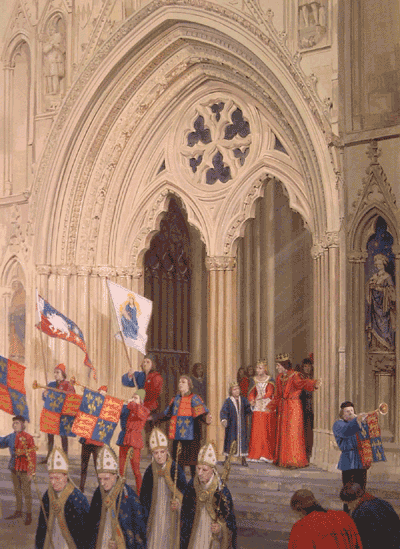
'Investiture in York' by Graham Turner. Reproduced by kind permission of the artist (www.studio88.co.uk)
The Knight
The chivalric code encompassed the ideals of protecting the weak, fighting for justice, keeping the peace, serving the common weal and rejected evil behaviour. Handbooks and romances, like those for princes, were in circulation, such as De Re Militari, a copy of which Richard commissioned, and Ramon Lull’s Order of Chivalry dedicated by William Caxton to Richard. Preparing for knighthood was part of Richard’s education and from a young age he held the chivalric post of constable of England. As constable he had his own court of law which included the overseeing of the heralds, and ordinances for their good behaviour have been attributed to Richard. He obviously had a keen interest in their work, and as king he founded the College of Arms.
A practical demonstration of Richard’s military leadership, where he displayed the qualities of discipline and moderation, can be found in the Scottish campaign of 1482, described by Dr Norman MacDougall as a ‘competent campaign’. Richard was granted money to pay for an army of 20,000 for only four weeks and for 1,700 men for a further two weeks. He succeeded in capturing Berwick, marching to Edinburgh, which he occupied, controlled his army so they did not sack the city and returned to England within the time frame.
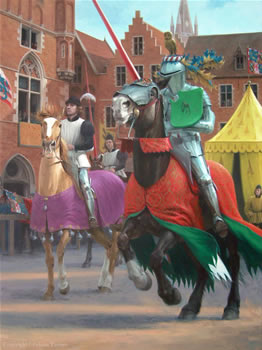
'Joust' by Graham Turner. Reproduced by kind permission of the artist (www.studio88.co.uk)
The Law
As both a magnate and administrator the law played an important role in Richard’s affairs. As king it was to assume the greatest significance. Social harmony was the ultimate goal of the ‘perfect prince’, and the right and fair regulation of society by a recognition of mutual obligations between the different sections of the community, such ‘as rich and poor, buyer and seller, citizen and foreigner, lord and liegeman’ was enforced by law. As his brother’s representative in the north, Richard’s ducal council became a source of arbitration and Richard showed concern for peaceful arbitration and judicial solutions. When he left the north and appointed his nephew, the earl of Lincoln, as his successor, the ducal council became the Council of the North and its responsibilities and conduct were the subject of a set of articles. As an administrative institution it survived into the seventeenth century which perhaps bears testament to Richard’s skill and foresight as an administrator.
Richard’s parliament of 1484, apart from attending to the business of the king’s title and the October rebellion, passed legislation which led Sir Francis Bacon in the sixteenth century to describe Richard as ‘a good lawmaker for the ease and solace of the common people’. For example, Richard was concerned with the problem of corrupt and lazy officials and some of the statutes dealt with this problem. Richard’s policy throughout his career was to set standards whereby officials were educated and sufficiently wealthy in order for them to be less vulnerable to corruption. At a session in the Star Chamber Richard personally brought to the attention of his justices connivance at altering a court record, the reporter of the session states that Richard was ‘perturbed’ that such cases should arise.
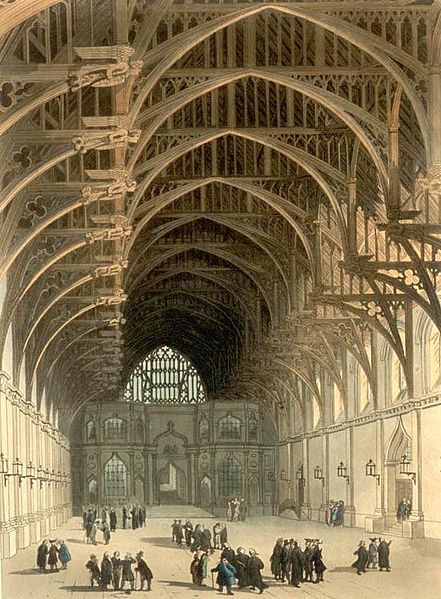
Westminster Hall
Marriage
A stable private life was acknowledged as desirable by the mentors of princes and indeed the problems surrounding King Edward IV’s marital arrangements were directly responsible for Richard’s elevation to kingship. They provided Richard with a moral claim to the throne. Although little is known about the relationship between Richard and his wife, Anne Neville, their mutual grief at the loss of their son in 1484 and the fact that his two illegitimate children appear to have been begotten before his marriage, perhaps indicate the stability of Richard’s own marriage.
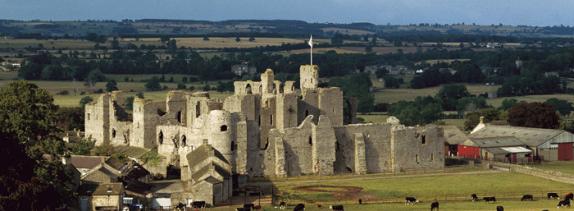
'Middleham' by Graham Turner. Reproduced by kind permission of the artist (www.studio88.co.uk)
Conclusion
Dr Sutton concludes her paper with three contemporary comments on Richard’s policy as Duke and as King by Dominic Mancini, Thomas Langton, Bishop of St David’s, and Von Poppelau, a German knight, which can be found on the Contemporary Views page.
Further Reading
- A curious searcher for our weal public: Richard III, Piety, Chivalry and the concept of the ‘Good Prince’ by Anne F. Sutton
- Richard III, Loyalty, Lordship and Law edited by P.W. Hammond, London 1985. Revised edition 2000 and published by the Richard III and Yorkist History Trust. These are the proceedings of the 1983 Symposium.
- Richard III’s Books by Anne F. Sutton and Livia Visser-Fuchs. Gloucester 1997
- The Hours of Richard III by Anne F. Sutton and Livia Visser-Fuchs. Gloucester 1990
- Glamorgan County History: Volume 3 The Middle Ages edited by T.B. Pugh. Cardiff 1971 p. 203
- Richard III and James III by Norman MacDougall, Richard III, Loyalty, Lordship and Law edited by P.W.Hammond as above.