
Edward of Middleham (Son)
Edward of Middleham from primary sources
by Annette Carson
Considering how scarce the references are in primary sources, it’s a wonder that we can find much to say about Richard III’s son and heir. However, Ricardians have never overlooked little Edward of Middleham, and quite an amount of research has been devoted to him as well as to his parents.
His personal story began with his birth, of course, but his birth date is unknown, Nevertheless we have one well-informed source that refers to his age in September 1483 as a little over seven years old at his investiture as Prince of Wales. This source was the Warwickshire priest John Rous in his Latin ‘History of Kings of England’.1 This will be discussed in context later, but it seems a good idea to lay this out as a marker against which to compare some of the other, wilder speculations as to his date of birth.
Edward was born against a background of turmoil in his mother’s life, from which she eventually emerged painfully from under the control of her menfolk. Lady Anne Neville was the younger of two daughters born to Richard, Earl of Warwick and Salisbury (known to history as Warwick the Kingmaker) and his wife Anne Beauchamp, Countess of Warwick, through whom he acquired the Warwick earldom de jure uxoris (granted by right of marriage with the heiress). It was said in chronicles that Warwick harboured a long-held desire to marry his two daughters, Isabel and Anne, to the two younger brothers of King Edward IV – namely George, Duke of Clarence and Richard, Duke of Gloucester – but that the king refused to hear of it. The pairing would have seemed natural, for their ages were similar, their lineage was noble, and the enormous Warwick wealth was entirely commensurate with the expectations of any royal prince. Nor were marriages of two sisters with two brothers frowned upon by the Church; they were certainly not incestuous under the laws that governed permissions to marry one’s relatives. It was not until very recently that the chronicle report of Warwick’s ambitions for his daughters took on the appearance of credibility.
Disaster entered Lady Anne’s life in the year 1469 when her father grew discontented with King Edward and began a hostility that ended with his breaking from his allegiance. Like it or not, his womenfolk had no option but to accompany Warwick as he fled the realm in 1470 to join forces with England’s enemy, King Louis XI of France. The Duke of Clarence also joined him in his treachery, having cemented their alliance by marrying Lady Anne’s sister, Warwick’s elder daughter Lady Isabel in July 1469.
Warwick had been a long-time supporter of the royal house of York, currently personified by Edward IV; they had dispossessed the house of Lancaster whose King Henry VI had lost the crown to York in 1460/61. But now, Warwick was willing to espouse the Lancastrian cause. And Henry VI had an heir (Edward of Westminster, the dispossessed Lancastrian Prince of Wales) who was residing with his mother in France enjoying the hospitality of Louis XI.
At the age of 14, Anne had no choice but to become the wife of 17-year-old Edward of Westminster: they married in December 1470, and the full story may be read here. Meanwhile Warwick would invade England and reinstate Henry VI on the throne; whereupon Anne’s husband would be reinstated as Prince of Wales. They could scarcely have spent more than a few weeks in each other’s company before the newly-married Edward took ship to England to participate – and die – in the decisive battle of Tewkesbury.
Meanwhile Clarence had been induced to turn his coat again and reconcile with his brothers Edward IV and Richard of Gloucester; together at Tewkesbury in May 1471 they conclusively smashed the Lancastrian insurgence. Anne now found herself without husband or father, the widow and daughter of Edward IV’s enemies. It was logical for her to join her sister in the Clarence household, but George then designated himself as arbiter of her fate and the fate of her fortune.
There followed a twelvemonth of mourning, during which Anne would have been carefully watched for signs of pregnancy. This is where we meet one of the many speculations about Edward of Middleham, i.e. that he was the son of her late husband, the Lancastrian Prince of Wales. This would place the birth date between, say, June 1471 and February 1472. Leaving aside all other considerations, this falls at the first hurdle, making him a wholly unlikely 11½- 12 years old in September 1483 when our well -informed source gave his age as a little over seven.
We have no space here to recount the twists and turns of Richard of Gloucester’s bid for Anne’s hand in marriage, which can be followed here. But to reduce the tale to its essentials, our first glimpse of his determination to make her his wife comes in mid February 1472 when the three brothers were together at Sheen, and Clarence consented for Richard to marry Anne provided that the whole of both sisters’ inheritance remained with himself via his wife Isabel.2 By now Richard had overcome his brother the king’s former objections, to the extent that Edward IV was now willing to bargain with Clarence to support a financial settlement between them, wherein Clarence was granted the earldom of Warwick de jure uxoris and the earldom of Salisbury in a new creation. Despite this Clarence was never anything other than unwilling, but at least they now reached the point where a marriage dispensation could be sought from Rome. It was issued in April 1472, when Richard was 19½; Anne would be 16 in June.
This dispensation addressed only the issue of affinity between the couple, which had arisen solely via Anne’s previous husband. It totally ignored the dispensation needed for the far more concerning matter of consanguinity (blood relationship between their two families, which was so glaringly evident and publicly known that Rome could never have overlooked it. The obvious conclusion is that this impediment must have been addressed previously, which takes us back to the rumour about the ambitions of Warwick for Isabel and Anne to marry the younger York brothers. In retrospect this takes on the appearance of accuracy: although Vatican records have not yet come to light, it would see that Warwick had applied for the necessary marriage dispensations for consanguinity at a much earlier date, even against the king’s wishes.
The path to marriage should now have been clear, had it not been for the hostility and sheer awkwardness of Clarence, who continued to raise objections and renege on agreements. However, the king was still firmly in Richard’s corner, and some time later that year, with his duties for Edward discharged, Richard’s thoughts returned to tying the knot. But he had reckoned without Clarence’s latest ploy, which was to sequester Anne physically away from Richard’s access. The Crowland chronicle reported that ‘he had the girl hidden away so that his brother would not know where she was…’ but that the duke ‘discovered the girl dressed as a kitchen maid in London.’3 In such an extraordinary circumstance, with Anne emerging into Richard’s care disguised as a menial, rather than from the bosom of her family, his solution was to take her to St Martins Sanctuary so that the correct proprieties could be preserved in this ongoing battleground between brothers. Their marriage followed after a short interval. We know that Anne was referred to as Richard’s duchess in the proceedings of Parliament by the time it rose in April 1473, and for reasons given in the article linked above, it seems likely they would have married in January/February 1473.
As to whether Anne was happy to marry Richard, it’s well known that they had been children together at Middleham Castle, her family home, where Richard had spent some of his childhood under training in her father’s household; indeed, she may well have grown up knowing of that long-held ambition for the two sisters to marry the two brothers. Did a fondness grow between the children from those times? We cannot tell, but we do know that, unlike many marriages undergone by women of the day, a match with Richard gave her a husband she had known a long time, whose reputation was high, and who could protect her interests. The couple made Middleham, in North Yorkshire, their principal home, and Anne’s mother soon joined them there in May of that year.
For a long time it was confidently thought their son Edward was born in 1473, but we have nothing more reliable than Tudor chronicles to thank for this.4 The first official reference to Edward seems to be in April 1477, when prayers were to be said for ‘the king and his consort and the kings brother Richard, Duke of Gloucester and Anne his consort and Edward their son.5 But we also have a previous clue in an entry in a Tewkesbury Abbey document recording his birth at Middleham castle in 1476.6 The only problem here is that it gives his name as ‘George’; however the name was later added to the document in different ink, so most historians accept this as recording Edward’s year of birth. And it fits neatly with the words of John Rous mentioned earlier, stating that Edward’s age was a little over seven in September 1483.
If we therefore accept that his birth date fell shortly before September 1476, then our calculations are aided by limits on the window available for his conception in 1475, as this was the year Richard accompanied Edward IV in his expedition to wage war on France. Taking this into account, it appears likely that he was conceived on Richard’s return in October, which gives him a birth date falling in July or August 1476. For more details see the article here.
It was at Middleham castle that Anne gave birth to their only surviving son,7 christened Edward after his godfather the king. The beautiful Middleham Jewel, discovered in the precincts of Middleham castle, may have been a gift to Anne to invoke protection for her health in pregnancy.8 The Prince’s Tower in the south-west corner is sometimes known as the Nursery Tower and there were spacious apartments nearby in the south range where the upper floor was known as the Lady Chamber. The nursery itself, on the other side of the Prince’s Tower, was situated above the bakehouse; we may imagine Edward growing up enjoying the homely smells of fresh-baked bread.
Some of Edward’s attendants are known by name, for example, his wet nurse was Isabel Burgh; others were Jane Collins and Agnes Cooper, and his chaplain was Thomas Brownlees. On a lighter note, the little prince was entertained by ‘Martin the Fool’. An important personage in his life would have been the mistress of his nursery, Anne Idley, whose late husband Peter had produced a book of manners in two volumes for the rearing of boys, called Instructions to his Son.9 The value they placed on Anne is shown by Richard stepping in to help her retrieve an annuity she was owed.10
Tragedy still stalked Edward IV’s family, and within a year of the little boys’ birth his uncle, the Duke of Clarence, had been arrested by the king and sent to the Tower. He was convicted of high treason and put to death privately on 18th February 1478, reportedly by drowning in a butt of wine.11 With Clarence being attainted as a result of his treason, this meant that his offspring were forbidden to inherit from him and forfeited their place in succession to the throne. Isabel’s son Edward was confirmed as Earl of Warwick, and the earldom of Salisbury was bestowed on Edward of Middleham as great-grandson of the last Neville earl.
We know very little of Edward’s life in the following years, but historians have generally formed the opinion that he was a delicate child – some even say ‘sickly’ – perhaps because he seldom seemed to travel far, and when he did, his household records mention a carriage or ‘chariot’. However, those records also show that he certainly travelled locally, and visited shrines.
In April 1483 Edward’s life was changed by a momentous event, when his uncle Edward IV suddenly died, apparently without making concrete plans for his succession beyond a few codicils to an existing will.12 Richard, ignorant of his brothers wishes, needed to make his way urgently to London, learning of developments as he travelled. Among these were attempts by the late king’s widow and her Woodville family to usurp Richard’s long-held national offices in charge of military matters by land and sea, and to deprive him of his crucial role in defence of the realm as designated in Edward IV’s will, whose full title was Protector and Defender of the Realm and Church in England and Chief Adviser to the King.13 On arrival he was duly appointed to this office by the King’s Council, and in the months of May and June he steadied the ship of state.
However, another crisis then arose which had far-reaching consequences for Richard and his 6 year old son. Information emerged that called into question the eligibility of Edward IV’s son, Edward V, to inherit the crown, because the late king’s marriage to the boy’s Woodville mother had been invalid in the eyes of the Church.14 This crisis entailed enquiries and discussions until the Council eventually remitted the final decision on inheritance to the representatives of Parliament (who referred to themselves as the ‘Three Estates of this realm’) currently gathering in London for the projected sitting of Parliament on 25th June. The members present grappled with the question as to Edward V’s status and decided he could not succeed to the throne. Their solution was to draw up a petition offering the crown to Richard as the senor legitimate heir, which was presented to him and accepted the following day.
Edward of Middleham’s father was now King Richard III of England, and Edward was heir apparent to the throne. He automatically became Duke of Cornwall, and would soon be invested as Prince of Wales. On 19th July at Westminster the new king created his little son Lord Lieutenant of Ireland, in which role his first official grant was to make the Earl of Kildare his deputy. Meanwhile Edward’s importance was recognised nearer home, by the City of York: in a City Council minute we see that the Mayor, Aldermen and Councillors were to ride to Middleham ‘to my Lord the Prince’ with gifts including red and white wine, poultry, two dozen rabbits, and fine white bread.15
His mother, Queen Anne, came to London to be crowned with Richard in their splendid double coronation on 6th July, but we have no record of Edward joining them. It would have been a long expedition for him, and London was not a healthy place; nor was it a particularly safe place with the Woodvilles and their supporters known to be whipping up rebellion. It would be altogether four months before the family was reunited.
Setting out from London in July on a progress to visit many parts of his kingdom, Richard next made plans for his sons investiture to take place in the historic city of York. He called 19 knights and 52 gentlemen to gather at Pontefract on 27th August, and for his son to rendezvous with him there, so that they would then travel the last twenty-odd miles from Pontefract together, making their Royal Entry into York surrounded by pageantry on 29th August. According to the household accounts16 Edward made the journey to Pontefract by carriage, via York, bringing in his entourage three wagons which doubtless contained goods required by his father. So he wasn’t too frail to be able to make this round trip of around 50 miles. Plus we learn that his horse was taken to York for him to ride while there, so this suggests an overnight stay.
We also see from the accounts that the Middleham Receiver, Geoffrey Franke, travelled personally to London and lay there for eight days – returning with something mysteriously described as ‘the Jewelles’ – with which a a payment of £10 seems to be associated. Many other preparations are recorded, including purchases of cloth for the prince, and making it up into garments, totalling £8. 5s. 9d, with expensive velvet and fustian to the tune of over £5. 10s. A whole five shillings are recorded as spent for the purchase of a feather which, from the cost, may well have been a single white ostrich feather, the badge of the Prince of Wales.
There has been much speculation about any pre-existing Prince of Wales regalia, though this appears unlikely, especially as Edward IV at the end of his reign had been reduced to pawning the crown jewels.17 Nor is there a record of any full scale ceremonial investiture of the previous Prince of Wales. This is germane when considering that in the procession for Edward of Middleham’s investiture a great Sword of State was carried before him, which is presently on display in the British Museum. This ceremonial sword measured an impressive 5ft 8in and had been converted from a German-made sword, embellished with little Edward’s enamelled heraldic arms. Presumably the Prince’s crown had already been prepared at the time of his parents’ coronation, so perhaps it was work on this sword that Geoffrey Franke oversaw during his eight days in London, at a cost of £10.
Richard’s official charter18 creating the new Prince of Wales had already been prepared in advance on 24th August while he was at Nottingham Castle, in which he spoke of his great pride and high hopes for his son: the full wording of the charter may be read here.
We therefore, following the footsteps of our ancestors…have determined to honour our dearest first born son Edward, whose outstanding qualities, with which he is singularly endowed for his age, give great and, by the favour of God, undoubted hope of future uprightness as prince and earl, with grants prerogatives and insignia.
The day of the investiture, 8th September, started with a grand procession. The ceremonies began in the Minster, where Mass was celebrated by the Bishop of Durham. Then the King and Queen, preceded by the clergy, emerged with their son from the west door of the cathedral to depart for the investiture, for which the ceremony was held in the palace of the Archbishop of York. The description in Hall’s Chronicle says:19
The whole clergy assembled…went about the city in procession, after whom followed the King with his Crown and Sceptre, apparelled in his surcoat robe royal, accompanied with no small number of the nobility of the realm; after whom marched in order Queen Anne, his wife, likewise crowned, leading in her left hand Prince Edward her son, he having on his head a demi-crown appointed for the degree of a Prince. The king had in that triumph in such honour, and common people of the north so rejoiced, that they extolled and praised him far above the stars.
Another account is given in the York Minster records,20 which includes the following words: the full account may be read here.
And there in the Hall, before the whole Company, Prince Edward was created Prince of Wales by the Lord King. He girded on the sword, presented him with the golden rod and ring, and placed a garland on his head, insignia of his rank.
After this another ceremony took place, where Richard created Edward a knight, along with Clarence’s son, the 8-year-old Earl of Warwick, and also his earlier illegitimate son, John of Gloucester, who was probably in his teens by then.
The Crowland Chronicle summarised the occasion:21 ‘He presented his only son Edward, whom that same day he had created Prince of Wales with the insignia of the golden wand and the wreath; and he arranged splendid and highly expensive feasts and entertainments to attract to himself the affection of many people.’
All of these events are described in the splendid commemorative vellum which was donated to York Minster by the Richard III Society in 1996.
The next we hear of Prince Edward is that he was summoned to Parliament for the session in January 1484, but there is no record that he was present when the formal Act of Succession was passed, known as Titulus Regius, in which he was confirmed as heir apparent. To be doubly sure, the following month the King gathered together a large number of Lords Spiritual and Temporal and other notables in a room at Westminster Palace, and had them personally swear an oath, to the effect that if anything happened to him they would take Edward in his place.
It may well have been these auspicious occasions that prompted the Warwickshire priest, John Rous, to create his first armorial roll-chronicle in honour of his patrons, the earls of Warwick, for presentation to Queen Anne Neville. In this he praised Richard’s just and benevolent rule:22
The most mighty Prince Richard…all avarice set aside ruled his subjects in his realm full commendably, punishing offenders of his laws, especially extortioners and oppressors of his commons, and cherishing those that were virtuous, by the which discreet guiding he got great thank of God and love of all his subjects, rich and poor, and great laud of the people of all other lands about him.
Of their son the roll’s inscription read as follows:23
The noble and mighty Prince Edward, Prince of Wales, Duke also of Cornwall and Earl of Chester. Son and heir to the most high and excellent prince King Richard the Third, and his most noble lady and wife Queen Anne, inheritor to both royal possessions, he was born in the castle of Middleham in the north country.
Sadly, only a matter of two months later all such hopes were dashed when Edward died without reaching his eighth birthday. Again we turn to the virtually contemporary Crowland Chronicle for the report:24
On the following April, on a day not far off King Edward’s anniversary…(he) died after a short illness, in 1484 and in the first year of King Richard’s reign, You might have seen the father and mother, after hearing the news at Nottingham where they were staying, almost out of their minds for a long time when faced with the sudden grief.
Too many historians have taken the words ‘on a day not far off King Edward’s anniversary’ to mean exactly 9th April, the date the previous year when the late King’s death was, apparently, publicly recorded. However, considerable doubt surrounds the late King’s exact date of death in 1483, not least because the news of it was received at York on 6th April,25 which tends to suggest he had died by around 3rd April.26
An alternative source may be found in the ‘History of English Kings’ penned by John Rous, who made it his business to record details that pertained to the Queen’s Neville family. Writing some time within four or five years of the Prince’s death, Rous recorded that Prince Edward died ‘at Eastertide’.27 For more details see the article here. Rous’s memory did not stretch to indicating the date itself, so we have no way of pinning it down, but it certainly chimes with what we know of Edward IV’s death which occurred within a few days of Easter Sunday, 30th March 1483. However, Easter is always a movable feast and in 1484 Easter Sunday fell much later: on 18th April to be precise. Men of the Church calculated dates by reference to the nearest holy day, so it would be natural for the clerical author of the Crowland Chronicle to remember the coincidence that the two deaths fell around Easter, thus conforming with Rous’s recollection. Also, bearing in mind that in 1484 the important anniversary of St George’s Day (23rd April) fell five days after Easter, it may be thought that if Edward of Middleham had died on or after, say, 22nd April, Rous’s mnemonic would have associated the date with the feast of St George rather than Easter.
The boy’s parents were at Nottingham castle when the news arrived, and the Crowland description of their grief speaks volumes, saying they were ‘almost out of their minds for a long time’. This also provides another indication that a long period of time elapsed between hearing the news and departing from Nottingham on 27th April. It appears from Richard III’s itinerary28 that when he departed from Nottingham he headed for York via Doncaster; the delay probably caused by a combination of factors, including the Church’s ban on travel during Easter week. The Queen’s movements are not recorded, nor is she reported by Niclas von Popplau as being present during his visit to the King in York. It is very likely that she and her ladies, now in mourning, would have made their separate way directly to Middleham.29
Even more mystery surrounds Prince Edward’s burial place, though we know from the well informed John Rous that he was buried at Middleham:
‘the child died before his parents and is committed honourably to burial at Middleham.’30
Rous wrote this soon after 1485, in the caption to his sketch of Edward in his second roll-chronicle, which he wrote in Latin, and which he hastened to modify to demote Richard III after Henry Tudor came to the throne. Other than this, there is no clue as to his last place of rest and all ideas that he may lie elsewhere are merely speculative. It may be that Edward was embalmed and enclosed in the usual lead-lined coffin soon after death, and laid to rest in a place of religion local to his home, amid constant prayer, intended perhaps to be temporary while awaiting arrangements for his removal to a more illustrious resting place.
But Edward has not been forgotten, despite his very short life. He has been depicted in a beautiful commemorative stained glass window at the church of St Mary & St Alkelda in Middleham, which was donated by the Richard III Society in 1934.
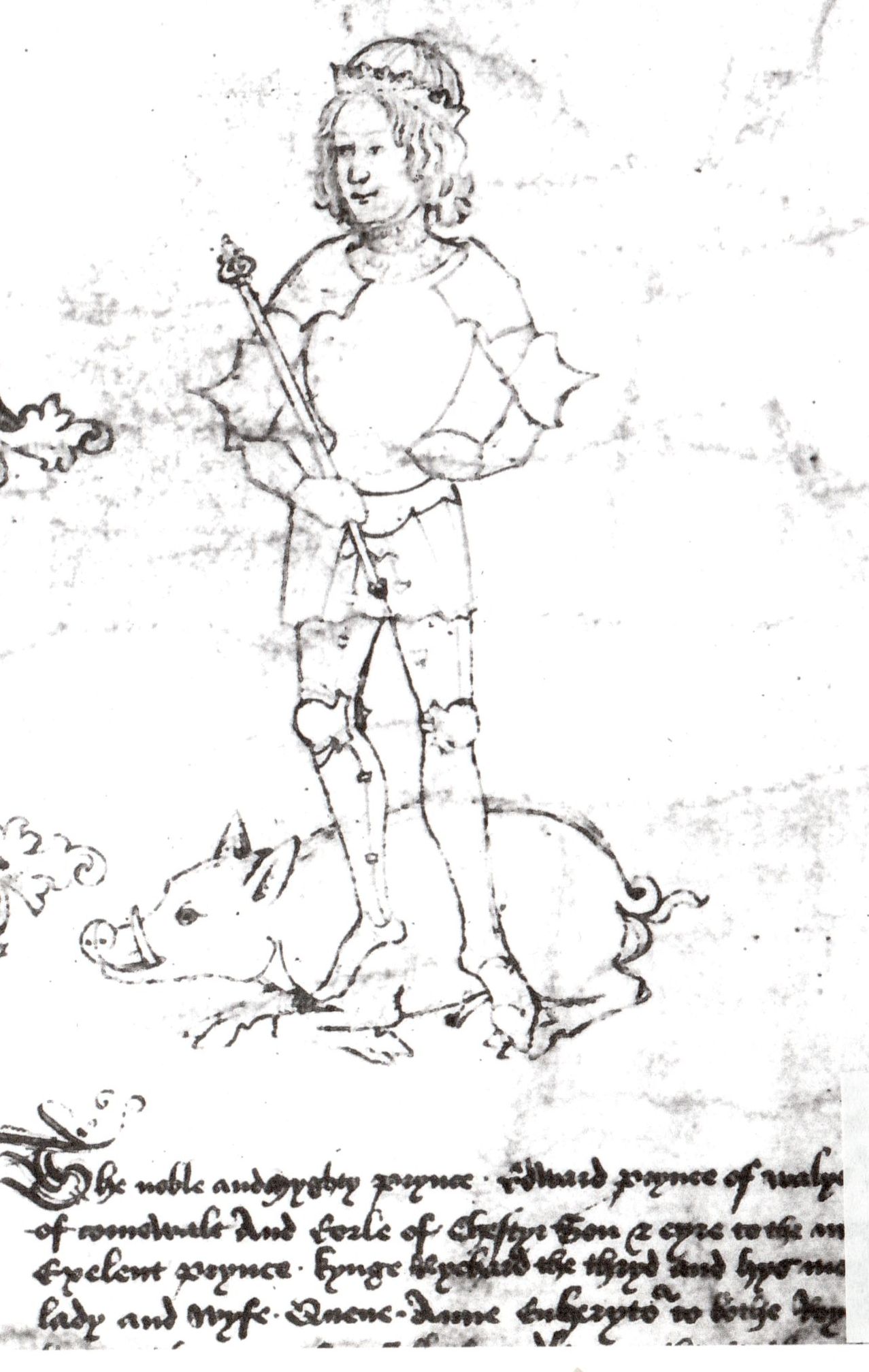
Edward of Middleham from the Rous Roll.

Edward of Middleham from Beauchamp Pageant.

Prince of Wales Investiture Sword. Now on display in the British Museum.

The Middleham Jewel
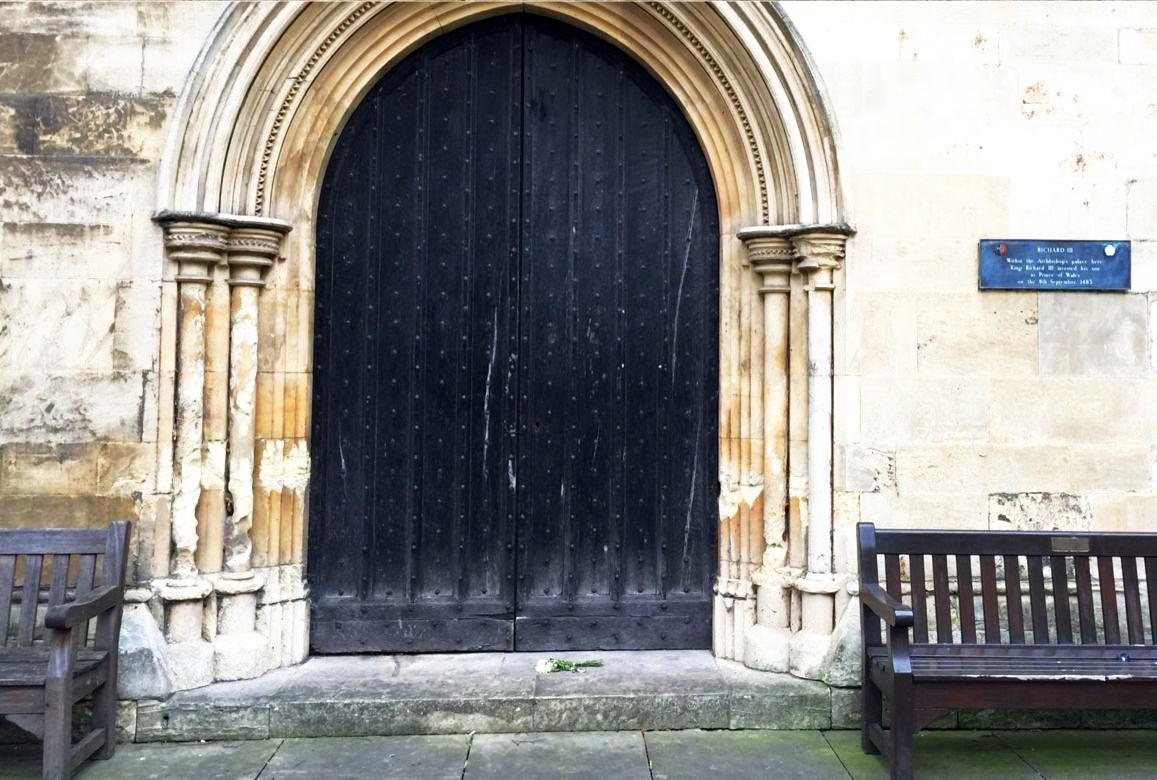
Archbishop's Palace, York

The Princes' Tower, Middleham Castle (photo courtesy of Amanda Geary)

Richard III and Edward of Middleham stained glass window, St Mary & St Alkelda's Church, Middleham (photo courtesy of Philippa Langley)
References
1. ‘Aged seven and a little more’ (aetatis septem annorum et parum ultra), T Heame (ed.), Joannis Rossi Antiquarii Warwicensis Historia Regum Angliae (2nd edition, Oxford, 1745), p. 217; extract trans. Alison Hanham in Richard III and his Early Historians 1483-1535 (Clarendon Press, 1975), p. 122.
2. 6th February 1472: ‘…the Kyng, the Qween, my Lordes of Claraunce and Glowcester, wente to Scheen to pardon; men sey, nott a in cheryte…The Kynge entretyth my Lord of Claraunce for my Lorde of Glowcester; and, as itt is seyde, he answerythe that he may weell have my Ladye hys suster-in-lawe, butt they schall parte no lyvelode, as he seythe…’ J. Gairdner, The Paston Letters (London, 1904), Vol 5, pp. 135-6.
3. The Crowland Chronicle Continuations, 1459-1486 ed. N Pronay and J Cox (London, 1986), pp. 132-3.
4. Perhaps from Polydore Vergil who stated he was about 9 years old at his investiture in 1483: Vergil, Anglica Historia ed. H. Ellis (J. B. Nichols, 1846) XXV, p. 190.
5. Calendar of Patent Rolls 1476-85, p. 34, cited by P. W. Hammond in ‘Edward of Middleham’ (Research Notes and Queries), The Ricardian, Vol. 11, No. 146, September 1999, pp. 564-5.
6. Founders’ and Benefactors’ Book of Tewkesbury Abbey, Bodleian MS Top. Glouc. d. 2, f. 40v. Insertion of name ‘George’ may be seen in final plate of facsimile publication The Founders’ Book, ed. Luxton et al (Shaun Tyas, 2021).
7. English Rous Roll, British Library Add MS 48976; transcribed by William Courthope, Somerset Herald (William Pickering, 1859, repr. Gloucester 1980), item 63. ‘Thys rol was laburd and finishid by Master John Rows of Warrewyk’.
8. ‘Together with the sapphire, the inscription on the jewel suggests that the wearer was worried about matters of health and looked upon it as a protection against illness or death.’ John Cherry, The Middleham Jewel and Ring (The Yorkshire Museum, 1994), pp. 24-5.
9. https://library.missouri.edu/specialcollections/exhibits/show/fragments-manuscripta/authors/peter-idley
10. C L Kingsford The Stonor Letters & Papers, 1290-1483 (Camden Third Series, Vol. II, 1919, No. 243), pp. 81-2 (1479 or 1480).
11. Domenico Mancini de occupatione regni Anglie ed. Annette Carson (Imprints Imprimatur, 2021) pp. 44-5 and n. 31.
12. Crowland Chronicle, pp. 152-3.
13. Regni Anglie et Ecclesie Anglicane Protector et Defensor ac Consiliarius Principalis domini Regis: Annette Carson, Richard, Duke of Gloucester as Lord Protector and High Constable of England (Imprimis Imprimatur, 2015) p. 16.
14. R. Helmholz, ‘The Sons of Edward IV: A Canonical Assessment of the Claim that they were Illegitimate’, Richard III: Loyalty, Lordship and Law, ed P W Hammond, pp. 91-103.
15. Extracts from Municipal Records of the City of York, ed. Robert Davies (London, 1843), p. 158.
16. R. Horrox and P W Hammond (eds) British Library Harleian Manuscripts 433 (Upminster, 1979-82), vol. 2 p. 25.
17. Rosemary Horrox, ‘Financial Memoranda of the Reign of Edward V: Longleat Miscellaneous Manuscript Book II’, Camden Fourth Series Miscellany XXIX, vol 34 (Royal Historical Society, 1987), p. 203. If some kind of chain worn by Edward IV’s son ended up in the possession of the money-lender Sir William Capell, as claimed by Prof. Tim Thornton (Channel 5 TV, Princes in the Tower: A Damning Discovery, 3rd December 2024), it might be illuminating to consider whether the late king had pawned this too, rather than leaping to the conclusion that it was nefariously acquired by Sir James Tyrell.
18. British Library Harley MS 433 f. 26v, translation from the Latin printed in Horrox and Hammond (eds) British Library Harleian Manuscript 433 vol. 1 p. 83.
19. Edward Hall, The Union of the Two Noble and Illustre Famelies of Lancastre and Yorke (1548), p. 380.
20. York Minster Library, Vicars Choral Statute Book, p. 48.
21. Op cit., p. 161.
22. ‘The noble and myghty prynce Edward prynce of Walys duke also of cornewale and Eorle of Chestyr Son & eyre to the most hye & excelent prynce kynge Rychard the thryd and hys moost noble lady and wyfe Quene Anne enherytour to bothe Royall possessions he was borne yn the castell of mydlam in the north cuntre’: BL Add MS 48976, transcribed Courthope, item 63.
23. Ibid., Courthope item 64.
24. Crowland Chronicle, pp. 170-1.
25. Extracts from Municipal Records of the City of York, ed. Davies, pp. 142-3.
26. See also Philippa Langley, The Princes in the Tower: How History’s Greatest Cold Case Was Solved (The History Press, 2025), pp. 45-6, 233.
27. Rous, Historia Regum Angliae: ‘morte in fausta tenpore Paschali’: extract trans. Hanham in Richard III and his Early Historians, p. 123. ‘Easter-tide had a strict liturgical meaning of Easter Eve to Pentecost; in this context we are looking at a period from the night of 17th April until some time before 27th April.
28. Rhoda Edwards, The Itinerary of King Richard III 1483-1485 (Richard III Society, 1995), p. 18.
29. Philippa Langley and Doris Schneider-Coutandin, ‘Niclas von Popplau: Lost in Translation? (Part Two)’, Ricardian Bulletin, March 2021, p. 42.
30. College of Arms, Warwick Roll: ‘ante parentes infans obijt et apud Midleham honorifice sepulture traditur’. This record comprehensively refutes many speculative theories, among them the long-held idea that a small tomb in the church of St Helen and Holy Cross at Sheriff Hutton might have been Edward’s, which experts have in any case attributed to a much earlier date in the 15th century.