
Reputation
‘Our poor subject Katherine Bassingbourne’
by Dr David Johnson
In September 1484 Richard III laid before the mayor and aldermen of York a ‘grievous complaint’ on behalf of ‘our poor subject’ Katherine Bassingbourne’. The king directed the city corporation to consider Katherine’s grievance in ‘due and mature examination’, and to ensure the ‘administration of justice whereunto we be professed.’
Richard’s concern for the law will, of course, come as little surprise to Ricardians. Importantly, however, the relative obscurity of the Katherine Bassingbourne case provides additional significant evidence of the king’s determination to secure justice for all – regardless of wealth, rank, or social condition. The surviving details of Katherine’s suit show how ordinary people, when legal remedies were seemingly beyond them, enjoyed free recourse to their king. And, just as important, how Richard himself supported their supplications, going to considerable lengths to procure justice without favour or undue delay. Here, in the joint action of king and commoner, the documentary evidence speaks very clearly indeed, revealing, on the one hand, Katherine’s desperate struggle for justice, and, on the other, Richard’s good character and honourable intentions.
To date it would appear that only Paul Murray Kendall in 1955 and Anne Sutton in 1976 have drawn attention to Katherine Bassingbourne.1 Kendall cited the case in order to illuminate Richard’s larger policy of redress for the poor:
To the lower classes – peasants, yeomen, urban artisans – Richard sought to give the protection of justice, not only under his law, and through his officers, but by making himself accessible to appeal, particularly through the medium of his council. Sometimes the council took action; sometimes it referred the case to an appropriate court; sometimes it requested local authorities to investigate. This latter course it took, for example, in the case of a woman of York, about whom the king despatched a communication to the Mayor in September 1484.2
Kendall’s ‘woman of York’ is, of course, Katherine Bassingbourne, and, although her first appeal to King Richard was made in September 1484, records show that Richard was still actively involved in the dispute as late as 12th March 1485. While his wife, Queen Anne, lay on her deathbed, Richard still found the will to intercede for a second time. The only benefit Richard could possibly derive from his support of Katherine Bassingbourne was the personal satisfaction of playing a not-inconsiderable part in the pursuit of justice. The York records do not contain precise details of the dispute, but with the aid of family wills3 and other unpublished records it is now possible to reconstruct the outlines of Katherine’s case. She was the daughter of Thomas Worcester, a dyer of York who had died in January 1453 having, according to Katherine, made a will in which he had left her a house in North Street of which Henry Faucet, a young sherman of the city, was a trustee. Despite the alleged will, after Thomas’s death Katherine’s stepmother Ellen had obtained a grant of administration of his estate as an intestate, and Henry Faucet had eventually obtained possession of the house. Katherine and her then husband, John Turnbull, had petitioned the Lord Chancellor for redress against Henry Faucet as far back as 1475.4 Whether that petition had been successful is unknown, but Henry Faucet died in early August 1484 and now his widow and executrix, Isabel, was laying claim to the house for herself and her son. The documentary evidence for Richard’s interventions in the Bassingbourne case appear in four separate entries in the municipal records of the city of York.5 It is proposed to discuss each entry chronologically, thereby establishing the origin and subsequent development of proceedings.
First, we have a letter written by Richard III and received by Thomas Wrangwish, Mayor of the City of York, on 18th September 1484, ordering impartial adjudication in the dispute. Richard enclosed a petition from ‘our poor subject’ Katherine Bassingbourne, setting out a ‘grievous complaint’ about the ‘injury . . . done unto her by . . .Henry Faucet’. It is immediately apparent that Katherine had appealed directly to the King and that Richard had responded accordingly, handing down a firm directive to Mayor Wrangwish to dispense justice in accordance with ‘our laws and good conscience’. Richard commanded the relevant parties to be brought before the Mayor, Aldermen, and common council, which, we are promptly informed, duly took place. It is also apparent that Katherine had by this time been married and widowed at least twice, as she was now surnamed Bassingbourne although no Master Bassingbourne was petitioning alongside her, which would have been necessary if he were still living.
The second and third entries in the municipal records reveal that the September hearing was adjourned and subsequently reconvened on 11th October 1484, when additional evidence was presented to the Mayor. This new information consisted of three witness statements from persons who had heard the dying Thomas Worcester dictate his last wishes to his parish priest. On his deathbed Thomas Worcester had bequeathed:
my said house (in North Street) unto Ellyn my wife to hold to her after my decease during the term of her natural life, and after her decease I will and bequeath my said house unto my daughter Katherine and unto the heirs of her body lawfully begotten, and if she decease without heir of her body lawfully begotten then I will and bequeath the same house unto the said church of St John for evermore, to pray for my soul and the souls of all Christians.6
It is at once striking that more than 30 years after Thomas Worcester’s death the Mayor and council summoned witnesses to confirm the details of his will. If, as seems likely, Katherine had children of her own, the clause that the property in North Street would descend to ‘my daughter Katherine and unto the heirs of her body lawfully begotten’ would have provided an additional impetus to uphold her late father’s wishes. The fourth and final entry provides further significant evidence, shedding fresh light on the case and emphasising the importance Richard attached to Katherine’s fight for justice.
On 12th March 1485, following a dramatic second intervention by King Richard, the respective parties once more assembled before the Mayor, Isabel Faucet appearing in person to represent herself. Katherine, it seems, had yet to receive satisfaction, despite the witness statements of 11th October 1484 certifying her entitlement to the property in North Street. Katherine, in her dire need, felt no compunction in approaching Richard once again, proving, if proof were necessary, Richard’s well attested reputation, for justice. And, such was Richard’s determination to assist Katherine, that he appointed a royal official, ‘John Lewes, sergeant at arms unto the king’s highness’, to represent Katherine at this second hearing. As a widow, perhaps with children to provide for, Katherine would have been particularly desperate to secure the house in North Street – both for her old age and ‘the heirs of her body lawfully begotten’. No further information is provided and the entry concludes by setting a future date on which it would appear a final judgement was anticipated.
Although, frustratingly, the mayor’s verdict is not recorded in these municipal records, a later Chancery petition suggests that, with the indefatigable support of her influential royal advocate, she may have proved the legitimacy of her father’s will and her lawful entitlement to the property in North Street but, perhaps as a result of Richard’s death at Bosworth five months later, Isabel Faucet failed to honour the judgement and hung on to the title deeds. More generally, however, Katherine Bassingbourne’s struggle provides irrefutable evidence of Richard’s genuine and energetic concern for the ‘administration of justice whereunto we be professed.’ As far as Richard was concerned, the law was the law, and justice would be made available to the highest and the lowest in the land. Katherine’s lengthy legal travail adds considerable weight to the testimony of Dr Thomas Langton, Bishop of St David’s and later of Salisbury, who accompanied Richard III on his royal progress in the late summer of 1483 (English modernised):
(King Richard) contents the people wherever he goes better than any other prince; for many a poor man that has suffered wrong many days has been relieved and helped by him…God has sent him to us for the benefit of us all.7
This is an updated version of an article that appeared in The Ricardian Bulletin in June 2017.
Notes
(1) P.M. Kendall, Richard III (London, 1973 edn), p.310; A. Sutton, ‘The Administration of Justice Whereunto We Be Professed’, The Ricardian, iv (1976), p. 4. Later amended and reprinted in Richard III: Crown and People, ed. J Petre, (Richard III Society, 1985), pp. 359-70.
(2) Kendall, p. 310.
(3) Borthwick Institute, Prerogative Court of York Probate Registers 2 to 5.
(4) TNA, C 1/48/266.
(5) L. C. Attreed (ed.), The York House Books 1461-1490, (Stroud, 1991), vol. I, pp. 336, 338, 356-7.
(6) Attreed (ed.), York House Books, p. 338
(7) A. Hanham, Richard III and his Early Historians, (Oxford, 1975), p. 50.
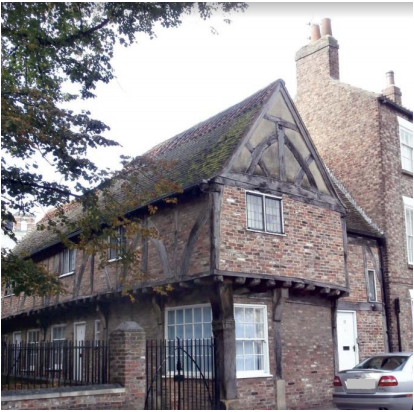
All Saints Chantry House. This fifteenth century house in North Street, York, may be similar to the disputed property at the centre of Katherine Bassingbourne's legal struggle. Photo courtesy of David Johnson.
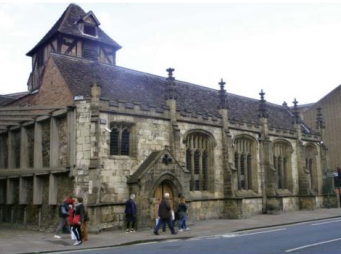
St John's Ouse Bridge End, situated at the junction of Micklegate and North Street, was the parish church of Katherine's father, Thomas Worcester. Photo courtesy of David Johnson.