
Illegitimate Children
Richard Plantagenet
by Peter Hammond
Richard Plantagenet – or Richard of Eastwell – is a mysterious figure who may, or more probably may not, have been a son of Richard III. The facts in this case are even more scanty than for John and Katherine and consist of an entry in the parish register of Eastwell, a hamlet three miles north of Ashford in Kent. The entry reads ‘Rychard Plantagenet was buryed the xxij daye of Desember, Anno ut supra, and appears under the year 1550. This entry is the foundation of all the stories about Richard Plantagenet. It appears to be genuine. The register is in fact a copy made in 1598 by the then vicar, Josias Nicholls, in accordance with an order made in that year that all existing paper registers be copied into vellum books but we have no reason to suppose that it is not an accurate copy of an entry made in 1550. It has been suggested that the entry is a pedantic translation of the common name ‘Broom’, but the extant register is not in Latin, nor are the existing bishop’s transcripts. Of course no one knows if the deceased believed himself to be a Plantagenet, or whether Sir Thomas Moyle, the owner of Eastwell, so believed, or both. Sir Thomas must already certainly have known of the entry in the register when it was made.
It has been said that the register entry has a mark against it which only appears against the names of those of noble blood. This story was started in 1767 by Philip Parsons, the then Vicar of Eastwell. It is true that there is a mark of sorts against the name Richard Plantagenet, and that there are other (different) marks against other names (not all noble), but the explanation of these seems to be that they were made by a member of the Finch family, later owners of Eastwell, to mark off entries interesting to himself, which he then copied out.
One other piece of evidence is sometimes cited for the existence of Richard Plantagenet, namely his ‘tomb’. This is still in Eastwell Church, which is now a ruin, being damaged in the war. In form it is an altar tomb, with indents for brasses, and was formerly on the north side of the chancel. It is almost certainly the tomb of Sir Walter Moyle, who died in 1480; the form of the brass indents shows that it originally housed at least two bodies, one male and one female, the latter apparently wearing a head-dress of circa 1480-1490. There are also indents for two groups, one for two sons and one for three daughters, below the two main figures. The tomb could certainly not have belonged to Richard Plantagenet.
The other details of the story as often told apparently stem from a letter by a Dr Brett published in 1735. This states, with much circumstantial detail, that Richard was acknowledged by his father Richard III on the eve of Bosworth, but only privately, and that he lived in obscurity after the battle as a stonemason at Eastwell. Sir Thomas Moyle, the owner of Eastwell Place, is said to have discovered his identity and given him a cottage to live in, where he remained until his death at about the age of eighty-one. It seems very likely that Dr Brett believed the story he related in his letter to be true, and that this story reflects a genuine tradition in the Finch family, owners of Eastwell Place in 1733. However there is apparently no reference in print to Richard Plantagenet between the date of the burial entry in 1550 and 1773, which may be regarded as suspicious, although Dr Samuel Pegge confirmed that the traditional story existed in the Eastwell area in the middle of the eighteenth century while he was vicar of neighbouring Godmersham.
Articles with named authors reflect the views of the author and do not necessarily reflect the views of the Richard III Society.
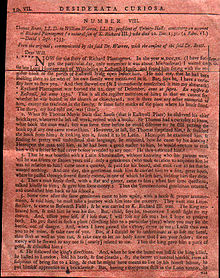
Page from Desiderata Curiosa, a source for the story of Richard of Eastwell.

Tomb at Eastwell, often said to be of Richard of Eastwell. Courtesy of Amanda Geary.