
His Life & Death
Portraiture
Earliest Portraiture of Richard III
by Frederick Hepburn
Anyone approaching the subject of Richard III’s portraiture for the first time could be forgiven for thinking that he was inordinately vain. At least two dozen painted portraits of him are known to have survived to the present day, and the number is still being added to as further examples appear from time to time in the salerooms. But this initial impression is deceptive. By far the majority of these paintings date from over a century after Richard’s death and owe their existence to a fashion in the decoration of great houses in Elizabethan and Jacobean times. During the years between about 1590 and about 1620 many owners of such houses decided to enliven the blank walls of their Long Gallery – and at the same time demonstrate their allegiance to the monarchy – by commissioning a set of portraits of kings and queens. Some of these series stretched back as far as William the Conqueror, using completely fictitious images for the kings earlier than Edward III (reigned 1327-77). For most of the monarchs from Edward III onwards authentic likenesses, in the form of either tomb effigies or paintings, were available to be copied. When it came to Richard III, the painters evidently went to the most authoritative source, a portrait in the Royal Collection. A tracing would have been made, and this, no doubt along with further tracings copied from the first one, served as the basis for Richard’s image. With greater or lesser degrees of care and artistic licence, the image was then reproduced in various London painters’ workshops.
Royal Collection
Amazingly enough, the painting of Richard III in the Royal Collection which ultimately lies behind all of these commercially-produced copies still exists. It is not contemporary with Richard, but seems to have been painted sometime during the years around 1515-20. (This time-frame has been proposed on the basis of dendrochronology, the science which enables oak panels to be dated from the sequence of growth rings visible at their edges). It does, however, almost certainly, reflect the appearance of a lost portrait that would have been painted during Richard’s reign, most probably soon after its beginning in June 1483. The image shows the king dressed in a gown made of costly black velvet and lined and trimmed with spotted lynx fur. Round his neck is a large and elaborately worked gold collar studded with diamonds, rubies and pearls, an object of astonishing opulence which would have been designed, quite deliberately, to evoke wonder in all who saw it. This is complemented by another rich jewel on his hat, a brooch which, being in the form of a Greek cross, would in addition have been intended as a sign of the king’s personal faith in Christ crucified. Above his head, meanwhile, in the upper corners of the portrait, are gilt spandrels each containing a small profile head enclosed within a quatrefoil-shaped frame. These heads have been shown to be based on Ancient Roman medallions representing the Emperor Constantine and his mother St Helena. Constantine was acclaimed emperor in AD 306 by the troops stationed in York and became famous as Rome’s first Christian emperor; his mother, traditionally believed to have been a British princess, found her own fame in legend as the discoverer of the True Cross and the Holy Sepulchre in Jerusalem. The presence of such heads in a portrait of this kind is highly unusual, and we must presume that it was Richard himself who had asked for them to be included in his portrait image. The intended message would seem to have been that these important British figures in the early history of Christianity were, in a sense, role-models for him – and his enthusiasm for the crusading cause is well known.
Richard’s face, however, seems oddly inconsistent within this otherwise extremely positive image emphasising wealth and piety. The eyes are narrowed into what looks like a malevolent glare, the mouth thin-lipped and the jaw grimly clenched. Thus, Richard is made to look like a villainous character. The portrait therefore gives out a mixed message, and this surely cannot be right. How is the incongruity to be understood? An X-ray, taken in the 1970s, had already raised the possibility that the nearer eye was initially painted ‘in a less slit-like fashion’ (Pamela Tudor-Craig’s words); and when the portrait underwent further examination in 2016, this time by infrared reflectography, it became clear that the whole face had in fact been considerably altered. The technique of infrared reflectography (IRR) allows us to see through the paint surface to the carbon-black lines with which the artist first drew the design on the panel. From this it was evident, not only that the form of the nearer eye had been changed, but also that from the base of the nose downwards the face had been made shorter. The base of the nose, the mouth and the chin had all been moved to a higher position. Moreover, the mouth as initially drawn did not have the compressed and mean-looking appearance of that in the finished painting.
In moving the lower part of the face upwards, the artist evidently realised that he would also need to raise the level of both shoulders (otherwise the neck would have been too long); and after doing this he added a little more height to Richard’s proper right shoulder, deliberately making the shoulders uneven. The finished painting therefore shows the king with both a villainous expression and a slightly deformed body.
What was the reason for these alterations? Close examination of the paint surface revealed that the artist had not only drawn the features but also at least begun to paint them in their initial positions before making the changes. On the evidence that we have, therefore, is seems reasonable to suppose that the artist began by making an accurate copy of the original work and was then required to alter it. Presumably his painting would have needed to meet the approval of officials at court, and we might imagine that it was some person in authority within the royal household who asked for the image of Richard to be modified. The officially held view of Richard III at the Tudor court was that he had been an evil usurper, deformed in body and mind, and it is interesting to note that it was at just about the same time as the portrait was painted that this idea received powerful endorsement in the work of the historian Polydore Vergil. Vergil is known to have completed the first draft of his great work, the Historia Anglica, in 1513, and although it was not to appear in print until much later it is quite possible that it was circulating at court in manuscript form during the later 1510s. Vergil’s description of Richard’s appearance chimes uncannily well with the altered portrait:
He was puny in stature and deformed of body, with one shoulder higher than the other; he had a short face with an expression that was harsh and cruel…

Infrared reflectography of the Royal Collection portrait. Photo: TSR (Tager Stonor Richardson) Imaging

Infrared reflectography of the Royal Collection portrait. Photo: TSR (Tager Stonor Richardson) Imaging
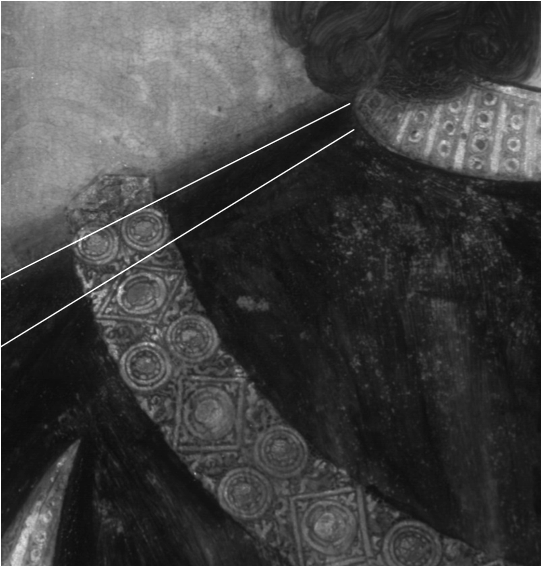
Infrared reflectography of the Royal Collection portrait - right hand shoulder. Photo: TSR (Tager Stonor Richardson) Imaging
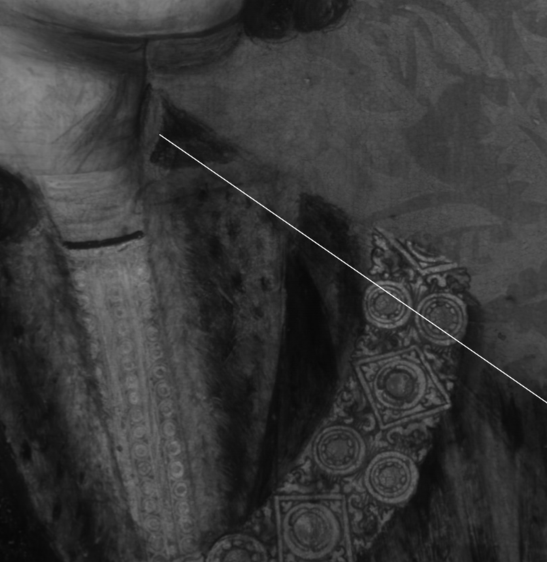
Infrared reflectography of the Royal Collection portrait - left hand shoulder. Photo: TSR (Tager Stonor Richardson) Imaging
Society of Antiquaries of London
A second early portrait of Richard exists in the collection of the Society of Antiquaries of London. This has in fact been dated (again by dendrochronology) to the same decade as the Royal Collection portrait, and like the latter it almost certainly reflects a lost contemporary original. It is related to the Royal Collection portrait in that it is essentially another version of the same image, reversed so that Richard faces towards his right rather than his left and showing him dressed this time in a splendid gown of patterned cloth-of-gold. It is remarkable that the eyes in this painting are recognisably the same as those that appear in the infrared reflectogram of the Royal Collection portrait. Also, the proportions of the face are demonstrably the same as those in the Royal Collection portrait would have been before it was altered, Here, then, one would have hoped, is an image that can be relied on. Indeed, this is almost the case. When the portrait was cleaned and restored in 2006-7, it became clear that it had been subjected to some alteration. What had evidently happened is that, at some unspecifiable date after the painting was finished, the central horizontal line of the king’s mouth was moved to a slightly higher position. This had the effect of making the jaw look more tightly set, and presumably, it was done with the aim of bringing the likeness more into line with other portraits of the king: through the many copies that were based on the Royal Collection portrait, the look of thin-lipped unscrupulousness seems to have become accepted as a standard feature in Richard’s portraiture. The alteration has now been removed and the mouth repainted with the central horizontal line in its original position. In other respects, however, the mouth includes an element of informed guesswork on the part of the restorer, and it is to the infrared reflectogram image that we must turn in order to see how Richard’s mouth would originally have looked.
Between the Royal Collection portrait and its infrared reflectogram and the restored Antiquaries portrait, then, we can form a reasonable idea of the intended appearance of Richard’s image. This was, it must be remembered, a public image: it would have been devised by Richard himself in collaboration with his chosen painter (whose name, sadly, remains unknown) and its purpose would have been to present a particular view of the king to those important officials and visitors who would see the portrait displayed in a royal palace. As has already been said, the image was certainly designed to show Richard as both wealthy and pious, Was the depiction of his face also meant to convey a message about him? Although it is impossible to be certain, I would suggest that this may well have been so. If one compares Richard’s facial expression with that of his elder brother and predecessor, Edward IV, as it appears in a portrait which also belongs to the Society of Antiquaries, one cannot fail to observe a strong contrast between the two. It has been shown that this portrait of Edward is painted on a panel cut from the same tree as the portrait of Richard, and in all probability they were painted together as copies of a lost original pair. The two kings are very similarly dressed, Edward being shown in a cloth-of-gold gown that closely resembles his brother’s. In fact the two images share the same colour scheme altogether – a striking combination of gold, black and magenta against a blue background, But although they are positioned like mirror-images of each other, the two faces have very different expressions. While Edward appears bland and complacent, Richard’s much thinner features are alert and determined. This combination of similarity and contrast seems to parallel the situation at the time of Richard’s accession: on the one hand he needed to gain acceptance as Edward’s rightful successor, but on the other he was extremely critical of his brother’s regime. There is no space here to quote at length from the document entitled Titulus Regius in which Richard’s claim to the throne was set out. Suffice it to say that it includes a scathing retrospective attack on Edward’s government, describing those who ruled the land as ‘delighting in adulation and flattery and led by sensuality and concupiscence’. At the same time Richard, the ‘true inheritor’, is praised as a model of all the kingly virtues. The implied pledge that he would eradicate the corruption that had prevailed at his brother’s court was therefore a crucial aspect of Richard’s public persona, and it is surely not too fanciful to see this reflected in his portrait image.
A note on Richard's skull and the facial reconstruction
The discovery of Richard’s remains in 2012 made it possible to add a further fascinating point about his portrait image. On examining the skull, the forensic anthropologist Caroline Wilkinson found a strikingly close correspondence between its contours and those of Richard’s face as shown in the Antiquaries portrait and in the well-known, though much later, portrait in the National Portrait Gallery. (See the Ricardian Bulletin, September 2013), Figure 8, showing images of the skull superimposed on both portraits). Hence the skull provided some unexpected confirmation of the accuracy of the painted portrait image in terms of the contours of the face and the placing of the features. The facial reconstruction which Professor Wilkinson subsequently made on the basis of the skull is also of great value. As a scientific object it shows the structure and proportions of Richard’s features, and this again tends to confirm the accuracy of the portrait image. There is nevertheless a certain danger in viewing the reconstructed head itself as a portrait. As Toni Mount has pointed out in a very salutary letter (‘Let’s keep our perspective’, Ricardian Bulletin, June 2013, p. 69), the musculature, percentage of fatty tissue, skin texture and elasticity of the face are all based on those of an ‘average’ male of 30+ years of age; Richard’s face may therefore have been different in any of all of these respects. Nor does the skull tell us anything about Richard’s habitual facial expression. The evidence from the earliest painted portraits therefore remains paramount: reflecting an image which would have been produced with the king’s approval, it brings us as close as we can get to seeing Richard as he wished to look, in the eyes both of his contemporaries and of posterity.
For a detailed account and discussion of the investigation of the Royal Collection portrait by infrared reflectography, see F. Hepburn, ‘The Portrait of Richard III at Windsor’, The Ricardian, XXVIII (2018), pp. 1-13; and for the Society of Antiquaries portrait, see J. Franklin, B. Nurse and P. Tudor-Craig, Catalogue of Paintings in the Collection of the Society of Antiquaries of London, Turnhout 2015, pp. 62-66, No. 6 (entry by P. Tudor-Craig and J. Franklin).