
His Life & Death
Parliament
by Dr Anne Sutton
‘A good lawmaker for the ease and solace of the common people,’ wrote Lord Chancellor Sir Francis Bacon of Richard III; Bacon was a man who knew his acts of parliament. The high percentage of acts passed by Richard’s parliament that tried to improve conditions for ordinary people reveals the reason for Bacon’s good opinion. Richard III’s only parliament was opened on 23rd January 1484, having been postponed from 6th November 1483 as a result of Buckingham’s rebellion. It was opened by a speech from Chancellor Russell on the theme of peace; several versions of this speech survive, the first clearly made when Edward V was still king and Richard of Gloucester protector; that is, Russell had prepared it for the first parliament which Edward would hold. The main matters before the assembly in 1484 were the ratification of the new king’s title, which was accomplished by the act which is known as the Titulus Regis, and the attainder of the rebels with the formal forfeiture and seizure of their lands into the formal king’s hands. The king also needed money as he had been ruling for half a year and put down a rebellion without any special grant from parliament or enjoyment of the usual customs duties on goods going out or coming into the realm which were granted to each king in his first parliament. The financial situation was acknowledged by the unprecedented grant to Richard of the customs for his life in his first parliament. Apart from these all important acts there were twenty one private acts, that is acts which benefitted particular individuals such as Lord Lovell, or settled the descent of particular lands such as those of the duchy of Exeter.

Westminster Hall
Use and Fine
The long delay before Richard could hold his first parliament may have given him and his council time to formulate several acts which would benefit the country and were especially favoured by the new chancellor, John Russell – undoubtedly a key figure throughout the parliament – or the king himself. Probably the most important of these were the acts that concerned the legal instruments of the use and the fine, both of which aimed to ease the processes of proving title to land and remove prevalent frauds. As regards the use, the chancellor may have been keen to stop the flood of cases before him in the court of chancery that concerned dishonest feoffees (trustees) who held to the use of the owner of land. The fine was a form of conveyance and the new act ordered their immediate publication, secrecy having encouraged fraud.
Anti-Corruption
The protection of the lower orders from corrupt officials was the subject of three acts directed at the activities of JPs, the courts of sheriffs and piepowder courts. Bail was to be allowed for persons imprisoned on suspicion of felony and their possessions were to be protected until they had been formally tried and found guilty; this act generally encouraged JPs to inquire more carefully into all arrests of persons on mere suspicion. The standard of juries empanelled for sheriffs’ tourns was raised by decreeing that jurymen should be worth 20s or over a year – it was generally believed that the more well to do were less open to bribery. The Lord Chancellor’s opening speech had referred specifically to the evil of corrupt empanelling. New penalties were introduced, and an earlier act reinforced, to correct dishonest officials at piepowder courts, which had jurisdiction over cases that arose during markets and fairs and required swift and reliable justice for the traders. Although these acts may have been promoted by members of Richard’s council, there is little doubt they reflected a particular interest of the king. Richard’s own experience of cases before his ducal council made him well aware of the damage that corrupt officials could inflict on the poorest of his subjects; it was also to be a theme of his pronouncements as king throughout his reign.
An act that earned instant popularity, and was also presumably promoted by the king and his council, was the abolition of the benevolence. The benevolence was a royal demand for money that had not been sanctioned by parliament, and had been used with great success by Edward IV to the increasing irritation of his subjects and especially Londoners.
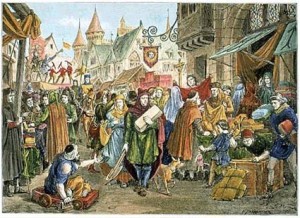
A Medieval Market
Trade Protection
Other acts concerned the cloth industry and the office of aulnager, ordered that ten bowstaves were to be imported with every butt of malmsey wine, decreed the size of butts for wine and oil, protected collectors of taxes on the clergy in the court of the exchequer. These were useful and all promoted by the men involved. Anti alien acts were persistent features of medieval parliaments and especially promoted by the citizens of London, a city with a history of anti alien riots and a substantial number of alien residents. Italian merchants and alien artisans were the main targets. Richard’s parliament re-enacted two anti alien acts of Edward IV’s first parliament and one new act that prohibited the import of a wide variety of small manufactured goods, ordered alien merchants to spend the profits of their sales on English goods, and limited aliens’ right to take non-English apprentices. This act was undoubtedly almost as popular with Londoners as the anti-benevolence act; partly a reward for London’s assistance during Richard’s accession. The Italians immediately entered negotiations to overturn the clauses hostile to them, while prosecution under other clauses always depended on the energy of locals. The conspicuous proviso to this legislation was that the book trade and its artisans should not be affected in any way – education and learning was protected. Although not mentioned specifically, printing was protected – the new skill was well established in England by this time, notably in London, and it is probable that Richard’s statutes were the first to be printed, and books printed abroad (in Latin and French) were already flooding into the country. Undoubtedly there were many clerics on the king’s council who would have supported this proviso, and Richard’s own surviving books testify to his interest.
Members of Parliament
We know little about the composition of the Commons, but William Catesby was chosen to be their speaker, a choice calculated to please the king as he had already found Catesby to be a useful and active servant. Other key figures included Dr Thomas Hutton, clerk of the parliament, and Thomas Barowe, a cleric in Richard’s service since 1471, who received petitions to the parliament and was the new master of the rolls.
Further Reading
- J. W. Bean, The Decline of English Feudalism 1215-1540 (Manchester, 1968)
- S. B. Chrimes, English Constitutional Ideas in the Fifteenth Century (Cambridge, 1936)
- P. W. Hammond, ed., Richard III: Loyalty, Lordship and Law (London repr. 2000)
- H. G. Hanbury, ‘The Legislation of Richard III’, American Journal of Legal History, Vol. 6 (1962)
- J. G. Nichols, Grants from the Crown during the Reign of Edward V, Camden Society (1854)
- James Petre, ed. Richard III, Crown and People (London 1985)
- C. Ross, Richard III (London 1981)
- Rolls of Parliament available on CD, as The Parliament Rolls of Medieval England, ed., C. Given-Wilson et al (2005)
- Statutes of the Realm, ed. A. Luders et al, Vol. 2 (London, 1810-28)
- A. F. Sutton, ‘The administration of justice wherunto we be professsed’, The Ricardian, Vol. 4 (1976)
- A. F. Sutton and L.Visser-Fuchs, Richard III’s Books (Stroud, 1997)