
His Life & Death
Contemporary views
Richard's Military Reputation
In 1471 King Edward was determined to regain his throne and he joined battle against his cousin and former ally, the Earl of Warwick, at Barnet. The vanguard was led by the eighteen year old Richard and his success was recorded in the poem On the Recovery of the Throne by Edward IV:
The duke of Glocetter, that nobil prynce,
Yonge of age and victorius in batayle,
To the honour of Ectour (Hector) that he myghte comens,
Grace hym folowith, fortune, and good spede.
In 1475 King Edward mounted an expedition to France but quarrelled with his ally and brother in law, the Duke of Burgundy, and made peace with the French king. Richard appeared to have hoped for a glorious campaign on the lines of Henry V’s in 1415 and it was recorded that Philippe de Commines wrote:
‘The King of England was accommodated by the King of France with whatever he wanted, even to the very torches and candles. The Duke of Gloucester the King of England’s brother, and some other persons of quality, were not present at this interview, as being averse to the treaty; but they recollected themselves afterwards, the Duke of Gloucester waited on the king our master at Amiens.’
Following Richard’s campaign to Scotland in 1482, his brother, King Edward IV, wrote to Pope Sixtus IV thus:
‘Have resolved to state what was achieved this summer in Scotland, that the truth may be known. Thank God, the giver all good gifts, for the support received from our most loving brother, whose success is so proven that he alone would suffice to chastise the whole kingdom of Scotland. This year we appointed our very dear brother Richard, Duke of Gloucester to command the same army which we ourselves intended to have led last year, had not adverse turmoil hindered us…The noble band of victors, however, spared the supplicant and prostrate citizens, the churches, and not only the widows, orphans, and minors, but all persons found there unarmed.’
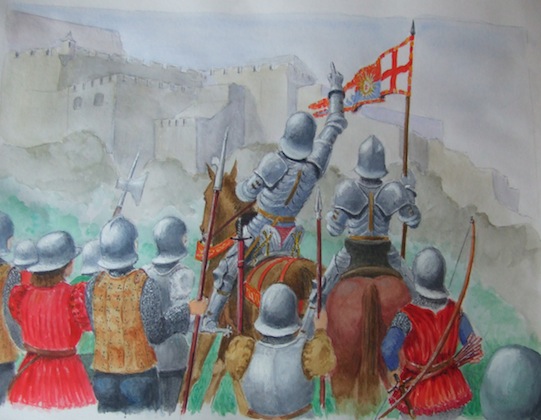
Original artwork by Gerry Hitch
Richard as 'Good Lord'
From the Mayor and the Council of the City of York (1476) for his support:
‘The saide day and tyme by the forsaide Maire and Counsale it was holie agreed and assented that the Duk of Gloucestre shall for his grete labour of now late made unto the kinges good grace for the conservation of the liberties of this Citie, that he shalbe presented at his commyng to the citie with vj swannes and vj pikes’.
In his role as a ‘good lord’ Richard would have been asked to act as an executor. One such example is found in the will of Sir John Pilkington who came from an influential northern family:
‘…Item I will that my son Edward beforwith after my dethe be had to my lorde of Gloucestre and my lorde Chambrelane, hertly beseaching thame as thy will in my name sesuch (beseech) the king is goode grace that myn executors may have the wardeshipp and mariege of my said son…I lowly and hertly besuche my lorde of Gloucestre and my lorde Chambrelaine, that they will, at the reverence of God, by myn excecutors…’
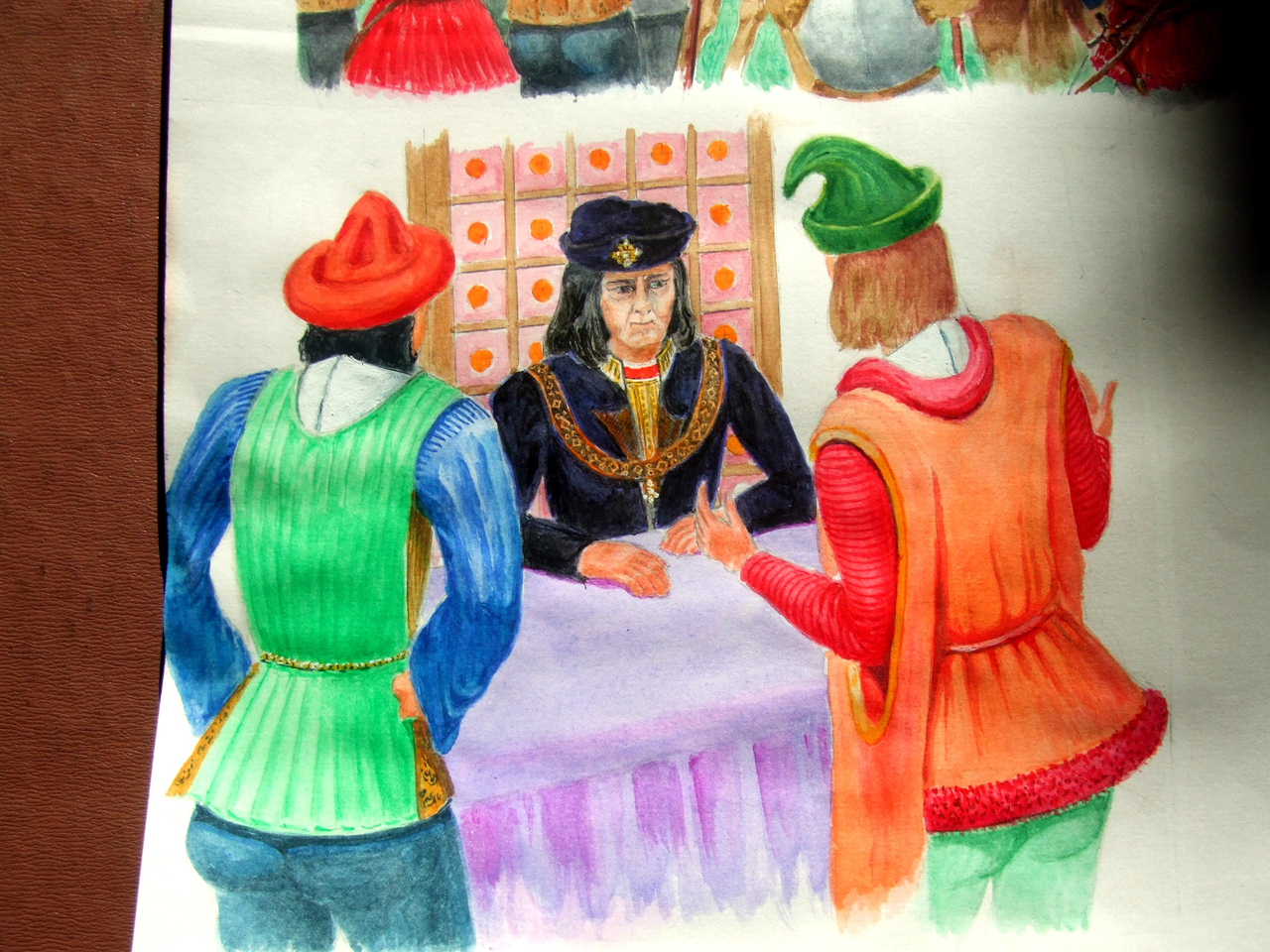
The King. Original artwork by Gerry Hitch
Richard's Reaction on the Death of George, Duke of Clarence
In 1478 Richard’s brother George, Duke of Clarence, was arrested by the king and tried for treason, found guilty and privately executed. Dominic Mancini, an Italian who visited England in 1483, wrote about Richard’s reaction:
‘At that time Richard, Duke of Gloucester, was so overcome with grief for his brother, that he could not dissimulate so well, but that he was overheard to say that he would one day avenge his brother’s death.’
Richard as Duke of Gloucester
In 1483, Dominic Mancini also recorded Richard’s reputation as Duke of Gloucester:
‘By his good offices and dispensing of justice he set himself to win the loyalty of his people, and outsiders he attracted in large measure by the high reputation of his private life and public activities. Such was his renown in warfare that whenever anything difficult and dangerous had to be done on behalf of the realm it would be entrusted to his judgement and his leadership.’
Richard as King
Following Richard’s royal progress after his coronation, on about 15th September 1483 at York Thomas Langton, Bishop of St David’s, wrote in a private letter to his friend, William Selling, Prior of Christ Church Cathedral, Canterbury:
‘I trust to God sune, by Michelmasse, the Kyng shal be at London.. He contents the people wher he goys best that ever did prince; for many a poor man that hath suffred wrong many days have be relevyd and helpyd by hym and his commands in his progresse. And in many grete citeis and townis wer grete summis of mony gif hyn which he hath refusyd. On my trouth I lykyd never the condicions of ony prince so wel as his; God hathe sent hym to us for the wele of us al…’
John Rous of Warwick recorded in the Rous Roll:
‘The most myghty prynce Rychard…all avarice set asydem rewled hys subiettys in hys realme ful commendabylly, poneschynge offenders of hys lawes, specially extorcioners and oppressors of hys comyns, and chereschynge tho that were vertues, by the whyche dyscrete guydynge he gat gret thank of God and love of all his subiettys ryche and pore and gret laud of the people of all othyr landys a bowt hym.’
Richard was concerned about justice, both for the individual and its administration. A Year Book reports one of his most famous acts, when he called together all his justices and posed three questions concerning specific cases. This record provides an idea of Richard’s comprehension of and commitment to his coronation oath to uphold the law and its proper procedures.
The second question was this. If some justice of the Peace had taken a bill of indictment which had not been found by the jury, and enrolled it among other indictments ‘well and truly found’ etc. shall there be any punishment thereupon for such justice so doing? And this question was carefully argued among the justices separately and among themselves,…And all being agreed, the justices gave the King in his Council in the Star Chamber their answer to his question in this wise: that above such defaults enquiry ought to be made by a commission of at least twelve jurors and thereupon the party, having been presented, accused and convicted, shall lose the office and pay fine to the King according to the degree of the misprision etc.’
On 12th September 1484, at Nottingham, Archibald Whitelaw, Archdeacon of the Lothians in Scotland, delivered a 30 minute speech to King Richard as part of peace negotiations between the two countries. The address was delivered in Richard’s presence:
‘Of all the sovereigns I have known you stand out as the greatest; the renown of your nobility; your celebrated reputation for the practice of every form of virtue which has reached into every corner of the world; the outstanding humanity of your innate benevolence, your clemency, your liberality, your good faith, your supreme justice and your incredible greatness of heart; your wisdom. You make yourself not simply at ease with important individuals but courteous to the common people too; your moral and heroic virtue; never before has nature dared to encase in a smaller body such spirit and such strength. Your mild and clement temper.’
William Caxton, the printer, dedicated his translation of Raymond Lull’s Order of Chivalry to King Richard:
‘…And thus thys lytyl book I presente to my redoubted, naturel and most dradde soverayne lord, kyng Rychard kyng of England and of Fraunce, to thende that he commaunde this book to be had and redde unto other yong lordes, knyghtes and gentylmen withinn this royame, that the noble ordre of chyvalrye be herafter better used & honoured than hit hath ben in late dayes passed. And herin he shalle do a noble & vertuouse dede. And I shalle pray almyghty God for his long lyf & prosperous welfare, & that he may have victory of al his enemyes, and after this short & transitory lyf to have everlasting lyf in heven where as is joy and blyssem world without ende, Amen.’
In June 1485, Niclas von Popplau, a Silesian envoy from Frederick III, the Holy Roman Emperor, wrote about King Richard in his private diary. Popplau visited King Richard and his court in York on 1st-5th May 1484:
‘The King had on a collar of gold that led over his left shoulder to his back and from their under his right arm. King Richard is a high-born Prince, three fingers taller, but a little slimmer and not so thickset as me, also much thinner. He has slender arms and thighs, also a big heart. To look into his majesty’s face and acknowledge all his renowned virtues. Oh dearest God, I recognised and found a truly magnanimous Lord in this King.’
During Richard’s reign, Pietro Carmeliano, a foreign poet living in London, dedicated a work to Richard, giving copies to the King and two governmental figures: Robert Brackenbury, Constable of the Tower of London, and John Russell, Bishop of Lincoln and Lord Chancellor of England:
‘I found no Prince more worthy than him, to whom my work might be dedicated. But lest I should seem to extol his majesty unreasonably, you personally, wisest of men, will be my witness, as to whether I speak the truth or falsehood.
If we look (for) religious devotion, what Prince is there in our time who shows a more genuine piety? If for justice, who can we reckon above him throughout the world? If we look for prudence in fostering peace and waging war, who shall we judge his equal? If we look for truth of soul, for wisdom, for loftiness of mind united with modesty, who stands before our King Richard? What Christian Emperor or Prince can be compared with him in good works and munificence? To whom are theft, rebellion, pollution, adultery, manslaughter, usury, heresy and other abominable crimes more hateful than to him? Clearly no one. Therefore, not without reason did I dedicate and present my brief work to his highness.’
Richard’s death was poignantly recorded in the minutes of the Council of York:
‘…king Richard late mercifully reigning upon us was thrugh grete treason of the duc of Northfolk (sic) and many other that turned ayenst hyme, with many other lordes and nobilles of this north parties was piteously slane murdred to the grete hevynesse of this citie…’
On 14th October 1485, with a new King, Henry VII, about to be crowned, the minutes of the Council of York recorded the late King Richard as:
‘the most famous Prince of blessed memory.’

The King. Original artwork by Gerry Hitch
A Posthumous Accolade
This accolade for Richard comes from an unexpected source. In 1513 Lord Dacre, Warden of the Western Marches, wrote a letter which was summarised in the Letters and Papers of Henry VIII. Dacre seemed to feel intimidated by the reputations of Richard and the Earl of Northumberland resulting from a raid they had made into Tevydale in the 1480s, which Dacre was expected to repeat. Nine years later, he is still concerned at their exploits in a letter to Wolsey who responds that, as they took effectual measures to punish and repress offenders, he hopes Dacre will obey his wholesome and friendly admonition and acquire, ‘as good a character as they did.’

Richard III. Original artwork by Gerry Hitch.
Further Reading
- Richard III: The Road to Bosworth Field by P.W. Hammond and Anne F. Sutton
- Domenico Mancini de occupatione regni Anglie by Annette Carson
- You can also view Philippa Langley’s short talk (27 minutes) ‘The Character and Personality of Richard III – from contemporary descriptions created during his lifetime as Duke and King’ https://www.youtube.com/watch?v=c3ZOOz-W5FI&t=280s. The presentation was given at the international launch of the A Voice for Richard project in York on 17th November 2024.