The Anglo-Scottish War 1482
Research Notes – Invasion
by Sandra Pendlington
Evidence is always partial. Facts are not truth, though they are part of it – information is not knowledge. And history is not the past – it is the method we have evolved of organising our ignorance of the past. It’s the record of what’s left on the record. (Hilary Mantel 2017)
The 1482 invasion of Scotland by an English army led by Richard, Duke of Gloucester, is a good example of what Mantel was talking about. There are scraps of contemporary evidence. Stitching those scraps together to make a coherent story that fits the terrain and considers what else was happening at the time is not easy. How do we ‘fill in the gaps’ in the evidence? The story you have just read is not proven fact – it never will be. I have travelled to the area, read about events in Scotland, England and France at the time and considered what 16th century chroniclers and modern historians have written. There are obvious omissions and errors in past accounts that are explained in the research notes but further than this there is only local knowledge of the terrain and logical treatment of possibilities.
These research notes cover:
1. Scottish and English sources.
2. Evidence of the terrain.
3. Timeline.
4. The routes taken by the English army into Scotland.
5. Campsites: Hutton Field and Polwarth.
6. Fitzhugh’s division.
7. How many settlements were attacked?
8. The dates of the knightings ceremonies.
9. Which routes did the two armies take to Edinburgh?
1. Sources
Scotland
The 1482 invasion is a complex event that was poorly recorded in Scotland at the time. One of the earliest known mentions is in a document called ‘An Italian life of Margaret of Scotland‘ written in 1492 by an unknown author in Bologna. Margaret, a Princess of Denmark, was the wife of James III. It does not mention the invasion but says that James III was imprisoned for a time after a period of unsatisfactory rule and released with the agreement of his wife and brother (Albany).
In the 16th century chroniclers wrote about events in 1482 but concentrated on Lauder and James III’s problems which were blamed for the uprising. There is rarely any mention of the English army close to Lauder. Abell was writing at Jedburgh in the 1530s and John Leslie wrote his ‘The Historie of Scotland’ in the late 1560s. In the 1570s Robert Lindsay of Pittscottie wrote his ‘Chronicles of Scotland’ a version of events that cannot be relied upon.
In the 21st century, Scottish historian Norman Macdougall, in his biography of James III gives more time and space to the invasion. In particular, he provides an excellent political background to the invasion which is essential in understanding Albany’s actions. Macdougall has an incorrect timeline of the invasion itself because he has confused the records of the knighting ceremonies.
England
There are contemporary English records of the military preparations and the money spent. The list of knights banneret and knights created on 24th July 1482 can be relied upon to be accurate because Garter King of Arms was with the invasion force. Edward IV’s letter to the Pope is a contemporary record, as are the documents of the Edinburgh agreements. Much of the rest comes from Hall’s account. He gives detailed information such as the order of march, numbers in the divisions and the list of burnings, but he does not give details of exact times and routes. Historians have been left to interpret these details from what evidence there is. These interpretations leave us with varied ideas about what happened. There is a surprising lack of connection between the events at Lauder (22nd July) and the knighting ceremony (24th July) and a lack of recognition of the political events in France and at Fotheringhay, and the importance of Albany’s presence with the invasion forces.
Most accounts are part of general histories or biographies of Richard III so give little space to the invasion, which is seen as a short episode in Richard’s life. Most take the same line as the highly critical Crowland Chronicle. English historian Michael Hicks, in his biography of Richard III, has given more time and space to the invasion but his timeline is inaccurate because he has relied on Metcalfe’s inaccurate dating of the 1480 knighting ceremonies. The historian who has made a significant input to this work is Marie Barnfield, a member of the Richard III Society Research Committee, who works only from contemporary records and has provided a detailed timeline. She was the first historian to correct the dating error in Metcalfe’s transcription of the 1480 knighting ceremonies.
2. The Evidence of the Terrain
An important piece of evidence is the terrain in south east Scotland. By looking at the terrain, it becomes possible to determine the various routes the armies used and how long it may have taken them. Although there are more settlements today, the landscape has remained the same. We can still see the remnants of some castles and bastilles.
The photograph of Edington Castle shows what is visible. It is situated just over a mile from Hutton Field in Berwickshire. The mound and defensive surrounds can just be seen. Hall named it correctly and it is shown on maps so was easy to find.
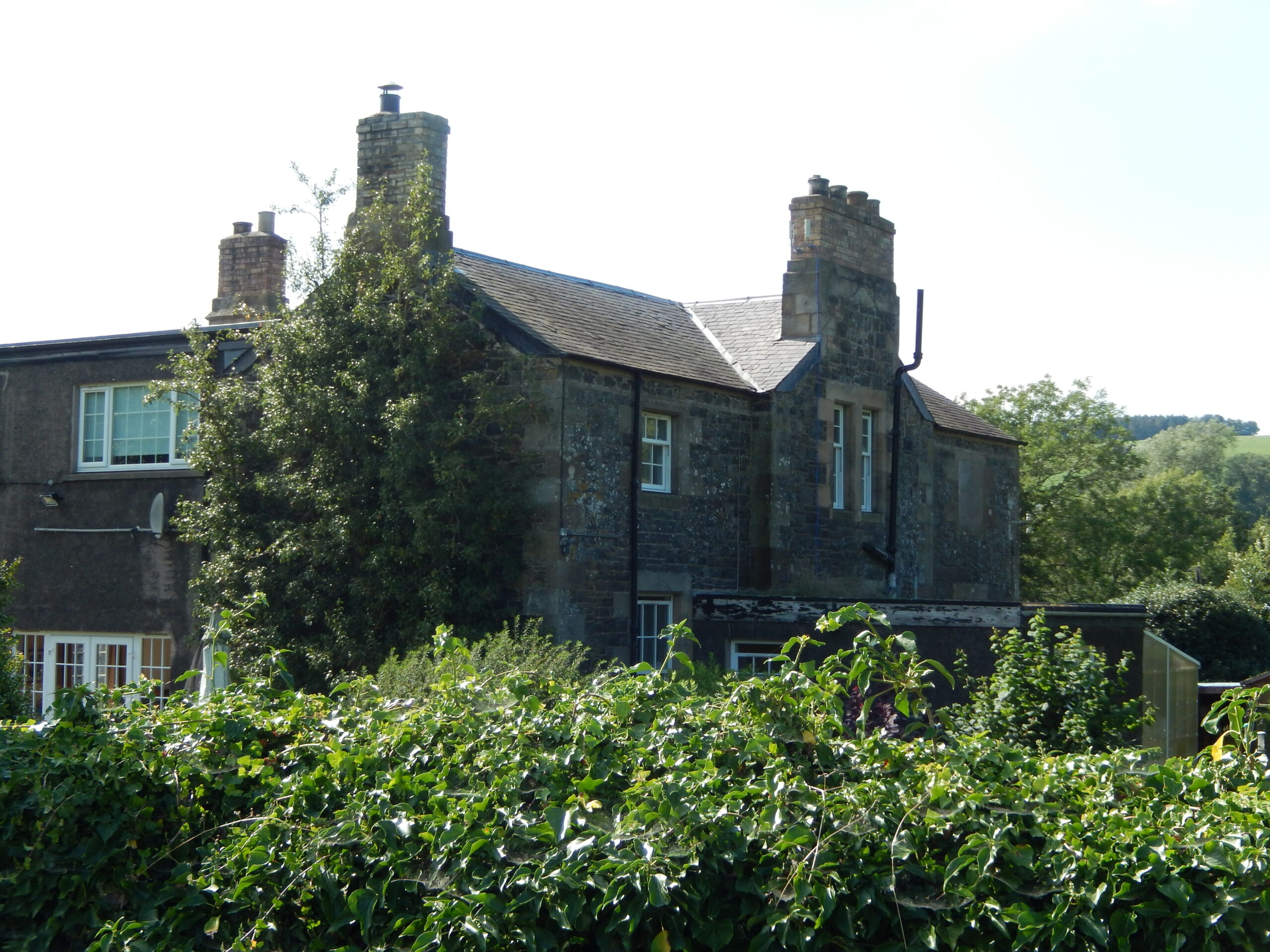
The photograph of Lochtower shows how a bastille has been added to and is now part of a farmhouse. Hall called it ‘Low Houses and the Bastell’. We worked out that we needed a bastille in a valley between Primsidemill and Cherrytrees. The only settlement on the OS map that fitted that description was Lochtower. A search of the area confirmed that it was Lochtower and the bastille could be seen as part of a large farmhouse.
This account by Scottish Branch researchers is the first to concentrate solely on the 1480-1482 war. The Branch researchers have the important advantage of living in the areas where the action took place and knowing the geography and history of the area. The account presents a different interpretation from any other.

Edington Castle (S Pendlington)
Lochtower (S Pendlington)
3. Timeline
These research notes cover the timeline (‘the when’) and the geography (‘the where’). They are interdependent. The invasion timeline has been compiled using the few definite dates we have (written in blue) and the probable movement of the English army from the mileage and terrain they had to travel.
| June | |
| 17 | York City Council meet to plan welcome for Richard and Albany. Richard and Albany arrive in York |
| July | |
| 15 | Richard and Albany leave York with the York contingent under John Brackenbury |
| 17 | Richard and Albany arrive in Alnwick. Fitzhugh’s division leave Newcastle to camp at Otterburn |
| 18 | Other divisions of English army leave Alnwick to camp close to Scottish Border (Stanley just south of Berwick, Richard & Neville close to Wark, Percy in the Bowmont Valley). Fitzhugh’s division moves from Otterburn into Redesdale. |
| 19 | INVASION Berwick town handed to Stanley’s division & siege of Berwick Castle began The four other English divisions cross the border Richard and Neville’s divisions riding through Berwickshire to camp at Hutton Field (16m). Earnslaw Bastille captured. Henry Percy riding through North Roxburghshire to camp at Polwarth (28m). Ednam and Crosshall Bastilles and Polwarth captured. Fitzhugh’s division riding through South Roxburghshire towards the campsite at Polwarth probably camped overnight after crossing the Tweed (18m after crossing the Border). Part of Caverton burnt. |
| 20 | Scots leave Edinburgh; Fitzhugh’s division joins Henry Percy’s division at Polwarth (17m). |
| 20-21 | Meeting of Hume, Huntley and Ogilvy at Redpath 7m south of Lauder Scots camp overnight on Soutra |
| 21 | Scots arrive at Lauder Hume, Huntley and Ogilvy bring news of English army to Albany supporters |
| 22 | LAUDER – meeting of dissidents, James III captured and taken north, common favourites hung News of events at Lauder reaches Henry Percy at Polwarth and Richard at Hutton Field |
| 22-24 | Scottish army returns home - northerners to Edinburgh over Soutra, some lords and troops over Soutra and then cross country to Haddington Blackadder Tower destroyed by Albany and his men |
| 24 | James III imprisoned in Edinburgh Castle Richard holds council of war and knightings ceremony at Hutton Field |
| 25 | Divisions at Hutton Field and Polwarth break camp and head to Ellemford (16 miles for Richard and Neville, 6 miles for Henry Percy and Fitzhugh) Stanley’s division continues siege of Berwick Castle |
| 26-27 | English army crosses the Lammermuir Hills arriving at Lethington Castle morning of 27th (20 miles). |
| 27-30 | Richard and Albany meet with Scottish nobles at Haddington – verbal agreement to pardon Albany and return his lands. |
| 31 July | English army, Albany and Scottish Lords travel to Edinburgh (19 miles). |
| August | |
| 2 | Albany agreement with Scottish nobles confirmed |
| 3 | Albany writes to Richard saying he will keep his promises to Edward IV. Richard negotiates with Edinburgh City Fathers. |
| 4 | Dowry agreement between Richard and City Fathers signed. |
| 5 | English army leave Edinburgh to camp overnight at Lethington Castle, Haddington. |
| 6-8 | English army cross Lammermuir Hills to Berwick via Cranshaws, Ellemford and Chirnside (39 miles) |
| 9 | English army arrive Berwick to join siege of Castle. Albany calls for Scots to muster at Cranshaws to relieve siege of Berwick Castle. |
| 11 | Large part of English army sent home because funds had run out. |
| 11-23 | Negotiations about Berwick Castle continue, Richard refuses all Scottish requests to end siege. Scots agree to surrender Berwick. Richard informs Edward IV. |
| 24 | Berwick Castle surrendered, Scottish troops occupying castle leave for Edinburgh |
| 25 | Edward IV writes to Pope. |
4. The routes taken by the English army into Scotland
Hall’s comment about the sudden arrival at Berwick ‘they came sodainly by the water side to the toune of Berwicke, and there, what with force, and what with feare of so great an armie, take and entered the toune’ had led historians to think that the whole army went to Berwick. One exception is Michael Hicks who gives the order of march and says that the army was ‘deployed as separate forces by the duke (Richard), the earl (Henry Percy) earl Rivers, and Lord Stanley as principal commanders (my emphasis)’. The mention of Earl Rivers, the eldest brother of Queen Elizabeth Woodville, is in error, he was not with the army.
Hall reported information that other contemporary chroniclers do not have, so interpretation of what he said is important in untangling what happened. He must either have spoken to someone who was there or seen some written evidence. Hall had details of the May call to arms, the journey to Alnwick and the arrangements of the divisions and the events at Berwick. He also knew the size of the divisions and names of lords who were with each division. He knew what happened at Berwick. The English appeared suddenly across the water (the River Tweed) and the town surrendered immediately. There was no need for the full army to enter Scotland via the old bridge at Berwick, Albany’s participation made certain that the bridge would be available for Stanley’s division to cross the Tweed without any problem. However, Sir Patrick Hepburn refused to surrender the castle so the siege began. (Hall names Hepburn as Bothwell but he was not given that title until 1488). The smaller number of troops than expected may have encouraged Hepburn and the defenders to stay where they were.
The problems come with what Hall said next, that the two dukes and all other soldiers, except Stanley’s division, left Berwick and went to Edinburgh and ‘in marching thitherward, he burnt and destroyed, these towns’ – the list of burnings follows. He then goes on to say that while this was happening King James volutarily imprisoned himself in the Castle of the Maidens (a name often used for Edinburgh Castle at the time). He then gives many details of what happened in Edinburgh and after the English army returned to Berwick. There is a gap in Hall’s knowledge. He did not know what happened at Lauder, or that the knighting ceremony had taken place, or how the English army got to Edinburgh. Hall’s informant may have been someone who knew the order of march and who was with Stanley’s division at Berwick but did not know the details of what the rest of the army was doing.
Hall was wrong about what happened at Lauder – the records state that James III was captured. He was also incorrect that the ‘burnings’ happened on the way to Edinburgh – tracking the settlements shows that the settlements were too far south of the road to Edinburgh and were bypassed on the way to their campsites at Polwarth and Hutton Field. There was neither time nor reason to go south to settlements like Chatto – a return trip of over 60 miles.
5. Campsites: Polwarth and Hutton Field
Hall does not say where the divisions camped. It is assumed that they camped at Berwick and then left for Edinburgh, burning as they went. The Scottish Branch account places Henry Percy and Fitzhugh’s divisions at Polwarth and Richard and Neville’s divisions at Hutton Field. It also strongly suggests that the English commanders knew where the Scots were, what had happened at Lauder and that the Scottish army were dispersing. There are two definite dates – the Lauder rebellion on 22nd July and the knighting ceremony on 24th July. It cannot be a coincidence that the knighting ceremony took place so close to the rebellion that changed the whole scheme of things.
Polwarth is the most northerly settlement in the line of Hall’s ‘burnings’ in Roxburghshire where Henry Percy and Fitzhugh’s divisions invaded. That indicates that they halted there. Hall also says that it was ‘delivered’, indicating that the village and tower was taken, not destroyed, and returned to Sir Patrick Hume, whose family had owned it until James III confiscated Hume’s property after he supported Albany.
The record of the knighting ceremony says that they took place ‘in Scotland near Berwick’. Some commentators presume that this was at Berwick. Hicks says that Richard camped outside Berwick, which agrees with the wording of the list of knights. This account places the campsite at Hutton Field which is close to Berwick and where the 1480 raid list of knights says he camped.
Commentors on these events rarely consider that both James III and Richard probably intended to engage in battle. James III needed to deal with Albany, who had been causing problems for several years. To make Albany King of Scots, James had to be defeated decisively. For both Richard and Albany, the most decisive way was for James to be killed in battle. No-one seems to have considered where that battle would have been fought but it is important in working out the campsites of the English army and their routes. One possible area for the battle would be the area between Polwarth and Lauder, perhaps near the village of Westruther. That area was reasonably flat moorland with some streams but avoided major rivers, boggy areas and forests.
6. Fitzhugh's Division
Fitzhugh’s division seems to be ignored by historians, but military strategy demanded that men were posted in the west to guard against the most likely place where the Scots would attack. Hall also places Fitzhugh and his 2000 troops on the west flank. It took the Scottish Branch researchers a long time to ‘find’ Fitzhugh’s division. It was found by Mhairi Macleod, who was researching the Battle of Otterburn. She discovered that the fleeing Scots used an old raiders road through Redesdale to get home. A check on an OS explorer map showed it labelled ‘course of old road.‘ This route for Fitzhugh and his men explains the presence of a line of settlements on Hall’s list of burnings, north of Redesdale – Chatto, Hownam, Howman Mains, Howman Grange, Morebattle, Linton, Caverton (where part was set alight) and Cessford. Fitzhugh’s men riding north between Cessford and Jedburgh would have seen the smoke from the settlements. It also explained the presence of three settlements on the list that seemed too far west – Crailing and East and West Nisbet. They were close to where Fitzhugh’s division probably forded the River Teviot. Old Roxburgh, also on the list, is west of Kelso not far from the ford where Fitzhugh and his men probably crossed the Tweed. It does not seem feasible that Henry Percy’s men who crossed the Tweed at the Sprouston fords, east of Kelso, would have seen the smoke from Roxburgh.
7. How many settlements were attacked?
Historians generally accept that 64 settlements in Berwickshire and Roxburghshire were burnt or ‘wonne’ during the invasion. This account disagrees and names just one settlement that was burnt, four bastilles that were captured or destroyed and one settlement that was returned to its previous owner. The lack of time to seek out settlements to burn, the lighting of bonfires used by the Scots to trick the English into by-passing settlements and, above all, the need to leave a land where Albany’s supporters lived unscathed is sufficient reason to believe that Hall’s list is accurate. He says that part of a settlement was burnt, four bastilles were captured and one settlement was delivered. The other 58 were left alone.
Goodman (p 202) describes two much later records about destruction of settlements in Berwickshire that may apply to this invasion. On the other hand, they may apply to the 1480 raid or other raids that were the general part of life for people living near the border. The first is definitely correct. In 1501, nearly 20 years after the invasion, Andrew Blackadder took three men – Adam Nisbet of that ilk, John Lumsden, laird of Blanerne and Patrick Steich, laird of Cumledge – to court. They were alleged to have ridden to Blackadder with Albany and some English soldiers from Richard’s army and destroyed Blackadder House and Tower. This agrees with the mention of Blackadder being ‘wonne‘ in Hall’s list.
A second reference from the 1486-7 Exchequer Rolls says that Graden, Hirsel and Birgham, settlements close to Coldstream and the River Tweed, had suffered light damage by the English and were mostly repaired by 1491. None are named on Hall’s list and they are not named in the Rolls for the year 1482-3 nor the next three years. These settlements were frequently attacked in cross border raiding. Graden was damaged in 1456, 1460, 1467 and 1497, Birgham in 1467 and 1497 and Hirsel in 1497. It is likely that the record referred to a 1486-7 raid not to the 1482 invasion.
8. The dates of the knightings
The records of the knighting ceremonies are important because they tell us where the army was in 1482 on a specific date.
John Writhe, Garter King of Arms, who was with the army, made the original copy. Copies of the original list were published in 1885 (Metcalfe) and 1906 (Shaw). Both accounts give identical lists of knights for both the 1480 raid and the 1482 invasion, who were raised to knight banneret and other men who were knighted. However, as explained in the research note for the 1480 raid, Metcalfe made a dating error for that raid, mistaking the 20th year of the reign of Edward IV as 1481 when in fact the 20th year was 1480. He has 22nd August 1481 for the raid and 24th July 1482 for the invasion.
Writhe recorded only one knighting ceremony during the invasion of 1482. Shaw has two, 24th July 1482 as the first knighting and 22nd August 1482 as the second knighting. This error has caused many problems for historians using Shaw’s list. Shaw was trying to make sense of a timetable and explained this by adding his own information (blue font).
Writhe
‘Bannerets made in Scotland the 24 day of July Anno Domini 1482, Anno 22 Edward IV, by the duke of Gloucester.’
‘Bannerets and knights made by Richard, duke of Gloucester in Scotland at Hoton Field beside Berwick, the 22 day of August Anno 20 Edward IV.’
Shaw
‘1482, July 24 (St James’s Eve)
Bannerets made in Scotland on the conclusion of the Treaty between the duke of Gloucester, the duke of Albany and Scottish nobles near Edinburgh.’
‘1482, Aug 22
Bannerets and knights made by Richard, duke of Gloucester in Scotland at Hoton Field beside Berwick (at the surrendering of Berwick to the English, which took place on 24th Aug 1482).‘
We know that the treaty mentioned was not signed until 2nd August in Edinburgh so Shaw’s comment about where the 24th July knighting ceremony took place must be wrong.
Finally, Shaw’s list for 24th July 1482 says that Richard raised 34 knights to knight banneret. They included ten men – James Danby, Thomas Malyverer, Thomas Tempest, John Everingham, John Aske. Rauf Wodrington, Piers Middelton, Christopher Warde, Stephen Hamerton, and Roger Thorneton. He also says the same ten men were knighted on 22nd August 1482. A banneret is senior to a knight, so it is impossible for the ten men to be knighted in August after being created banneret in July. Shaw’s date for their knighting must be wrong and the correct date was 22nd August 1480.
9. Which route did the two armies take to Edinburgh?
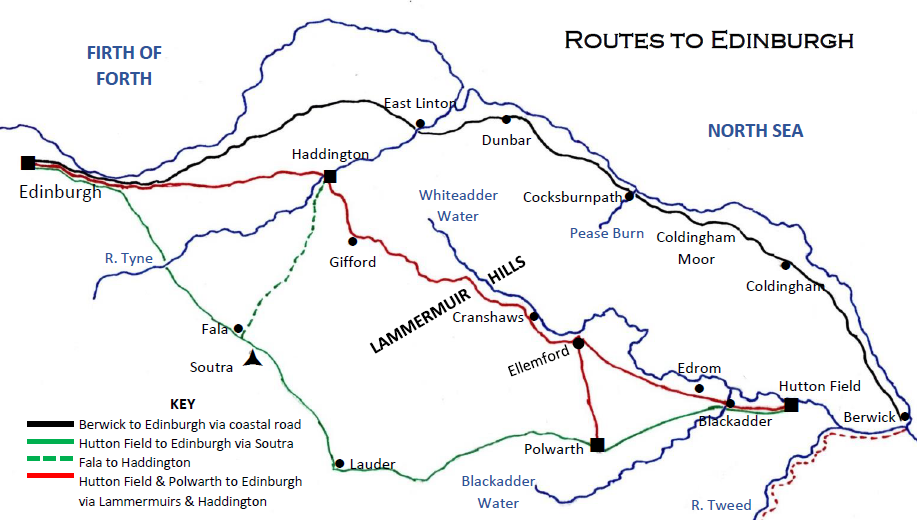
There were three possible routes that the English army could have taken. In the west, the Via Regis (the King’s highway, the current A68) that ran north from Lauder, over Soutra into Edinburgh. In the east, the coastal road that ran from Berwick (the current A1). In the centre, the road over the Lammermuir Hills to Haddington (the current B6355). This last one is named in Inglis’ work ‘The Roads to Edinburgh‘, which was discovered some time ago by Scottish Branch researchers as a route used by Scottish armies travelling south.
Routes to Edinburgh
Hall and most modern historians assume that the army went up the coast road but the terrain makes that very unlikely. Patricia F Payne described the tortuous route, across the River Eye an the desolate and windswept Coldingham Moor with no water available for the men and their horses. Inglis also described the problems of the route saying that the road over the moor was deliberately left in a state of disrepair in medieval times when at war with England. The delay to the invasion had given the Scots an extra year to prepare, plenty of time for the Moor to become even more difficult to cross.
After Coldingham Moor the route went down a steep slope to cross the Pease Burn near Cocksburnpath, Inglis said that the ‘deep defile of the River Pease created a formidable obstacle to the traffic between Coldingham and Dunbar’ (p 38). Even today the steep road down to the defile and the concrete ford is not easy and in 1482 it would have been treacherous. In addition, the Burn was guarded on the north side of Cocksburnpath Tower and a little further north by Dunglass Castle. Inglis notes that invading English armies avoided the route and used supply ships to carry supplies along the coast when that route was being used by the army. There is no evidence that this happened in 1482.
Sutton suggests that the English army went over Soutra and the Scots used the road over the Lammermuirs. However, it is highly unlikely that the Scots took the route over the Lammermuirs. Leaving Lauder on 22nd or 23rd July, that route took them close to Polwarth where Henry Percy and Fitzhugh’s divisions were still camped and the road over Soutra was the quickest way home. There are also pragmatic reasons. The Scots wanted to get home as safely and as quickly as possible and the road over Soutra is the quickest route north.
The position of the English camps at Polwarth and Hutton Field indicates that their route to Edinburgh was over the Lammermuirs. The timeline also indicates that they did not use the road over Soutra – they would have reached Edinburgh some days before they actually did on that route. We also have Goodman’s evidence that Blackadder Tower was destroyed by Albany and his men, which is confirmed by Hall as one of the settlements that was ‘wonne’. Blackadder Tower guarded the ford over Blackadder Water that had to be forded on the route from Hutton Field to Ellemford. Three other settlements on the ‘burnings’ list – Edrom, Whitemire and Broomhill – are also on that route. The route was controlled by men such as John Ellem, who were Albany’s supporters. Finally, the English army almost certainly used the route on their return to Berwick. Hall says they camped at Lethington Castle near Haddington on the return journey. Records also record that Albany ordered the Scots to muster at Cranshaws just north of Ellemford to follow the English army in an attempt to raise the siege at Berwick Castle.
Acknowledgements
The members of the Scottish Branch of the Richard III Society from the founding of the Branch in 1999 to the present, who have contributed in many ways to this work.
Research: the late Stuart Akers, Marilyn Garabet, A J Hibbard, Philippa Langley, Mhairi Macleod, Alan Pendlington, David Santiuste, Sue Scott-Buccleuch, Marjory Smith, and above all the late Patricia F Payne whose seminal work on Hall’s Chronicle and knowledge of the history and terrain of south east Scotland was essential to this work.
Photography: Dorothy Gormie, Mhairi Macleod, Sato Mannonen, Sandra Pendlington, Stephen Potts, David Santiuste, Rob Scott-Buccleuch, Sue Scott-Buccleuch.
Marie Barnfield of the Richard III Society for sharing her work on the timetable for these years and making many suggestions about the research.
Amanda Geary, the Communications Manager of the Richard III Society, who did the website work.
Peter Hammond of the Richard III Society, who proofread the account.
References
Chandler, S. B., ‘An Italian life of Margaret of Scotland’ in Scottish Historical Review, vol. 32 no.113 part 1 (April 1953), pp.52–57, by Giovanni Sabadino degli Arienti
Cunningham, S. (1967). ‘The Yorkists at War: Military Leadership in the English War with Scotland 1480 – 82’ in ‘The Yorkist Age: proceedings of the 2011 Harlaxton Symposium’ Ed Kleine, H. & Steer, C. (Harlaxton Mediӕval Studies 23.) Yorkist Trust 2013
Goodman, A.E. (2007) ‘Impact of Warfare on the Scottish Marches.’ In Carter, L. (ed.) Conflicts, consequences and the crown in the late Middle Ages. Pub. Brydell and Brewer: Martlesham, Suffolk
Hicks, M (2019), ‘Richard III’. Pub. Yale University Press: New Haven & London
Inglis, H.R.G. (1915-16) ‘The Roads that led to Edinburgh’. In The Society of Antiquaries of Scotland, 1915-1916, Vol, 50 pp 18-49. (Online: ADS Archaeology Data Service)
Leslie, John, The History of Scotland (Bannatyne Club, 1830), Dalyell, ed., Robert Lindsay’s: Chronicles of Scotland, vol.1 (Edinburgh, 1814),
Macdougall, N. (2016 ed.) ‘James III’. Pub. John Donald: Edinburgh
Ordnance Survey. Explorer series maps: scale 2½ inches to 1 mile: 345 (Lammermuir Hills), 346 (Berwick-upon-Tweed), 339 (Kelso, Coldstream & Lower Tweed Valley), OL16 (The Cheviot Hills). Ordnance Survey: Southampton
Payne, P.F. and Pendlington, S. (2015) ‘The 1482 Invasion of Scotland’. In S. Pendlington (Ed.) The Court Journal Vol. 17. pp. 19 – 35. Scottish Branch of the Richard III Society: Annan
Percy, Ralph, Duke of Northumberland (2019) ‘Lions of the North: The Percys and Alnwick Castle: A thousand years of history’. Pub. Scala Arts & Heritage Publishers Ltd: London
Pollard, A.J. (1996) ‘Richard III and Scotland’. In A. J. Pollard (ed.) The North of England in the age of Richard III. Pub. Sutton, Stroud, Gloucestershire
Rose, A. (2002) ‘Kings in the North: The House of Percy in British History’. Weidenfeld & Nicolson, London
Sutton, A. F. (2021) The King’s Work: The Defence of the North under the Yorkist kings 1471 – 1485. Pub. Richard III & Yorkist History Trust, Donnington
Online sources
Hall, E. (1809 edition) ‘Hall’s Chronicle: containing the History of England during the reign of Henry the fourth and the succeeding monarchs to the end of the reign of Henry the eighth in which are described the manners and customs of these periods’. Published in London collated with the editions of 1548 and 1550. https://archive.org/details/hallschronicleco00halluoft/page/331/mode/2up
‘History of Swinton Kirk’ www.swintonandfogokirks.co.uk
Metcalfe, W.C. (1885) ‘A Book of knights banneret, knights of the Bath and knights bachelor made between the fourth year of King Henry IV and King Charles II’. Mitchell & Hughes: London https://babel.hathitrust.org/cgi/pt?id=uc2.ark:/13960/t6348pw0q&view=1up&seq=19&skin=2021
Shaw, W.A. (1906) ‘The Knights of England: a complete record from the earliest time to the present day of knights in order of chivalry in England, Scotland and Ireland and of knights bachelor, incorporating a complete list of knights bachelor dubbed in Ireland’. Sherratt and Hughes: London https://archive.org/details/knightsofengland02shawuoft/page/n29/mode/2up
Tanner, R. (2001) ‘The Late Medieval Scottish Parliament: Politics and the Three Estates 1424-1488’ Kindle Edition used for this account.