
Reputation
The Bones in the Urn: From the Tower to the Abbey
by Annette Carson
The Tower of London estate has undergone repeated rebuilding and refurbishment ever since it was first built in the 11th century. As you see it today, there is a timber staircase ranged full-length across the south face of the main building (the keep, known as the White Tower). This replicates the original timber staircase that gave access to the keep’s sole entrance at the south-west corner.
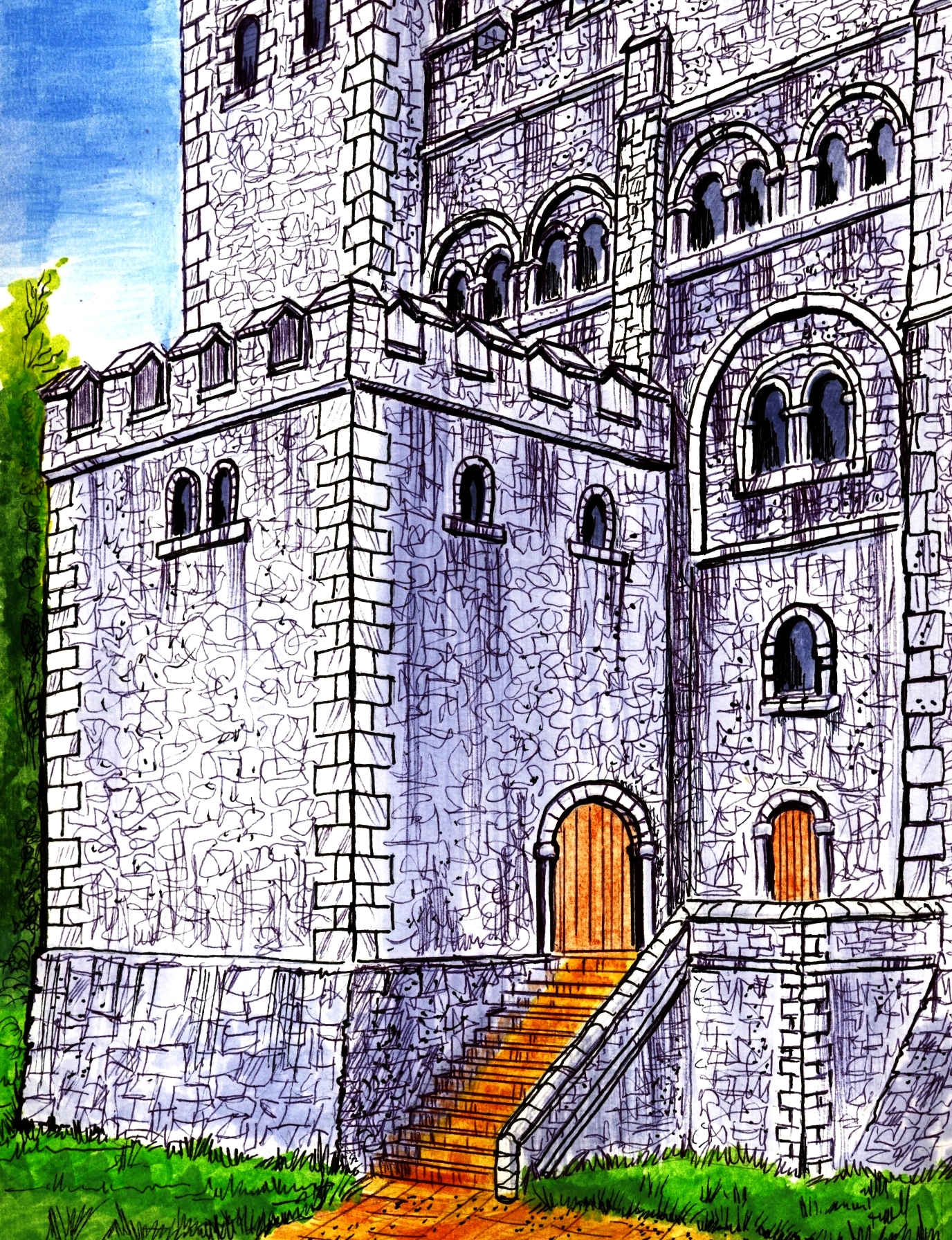
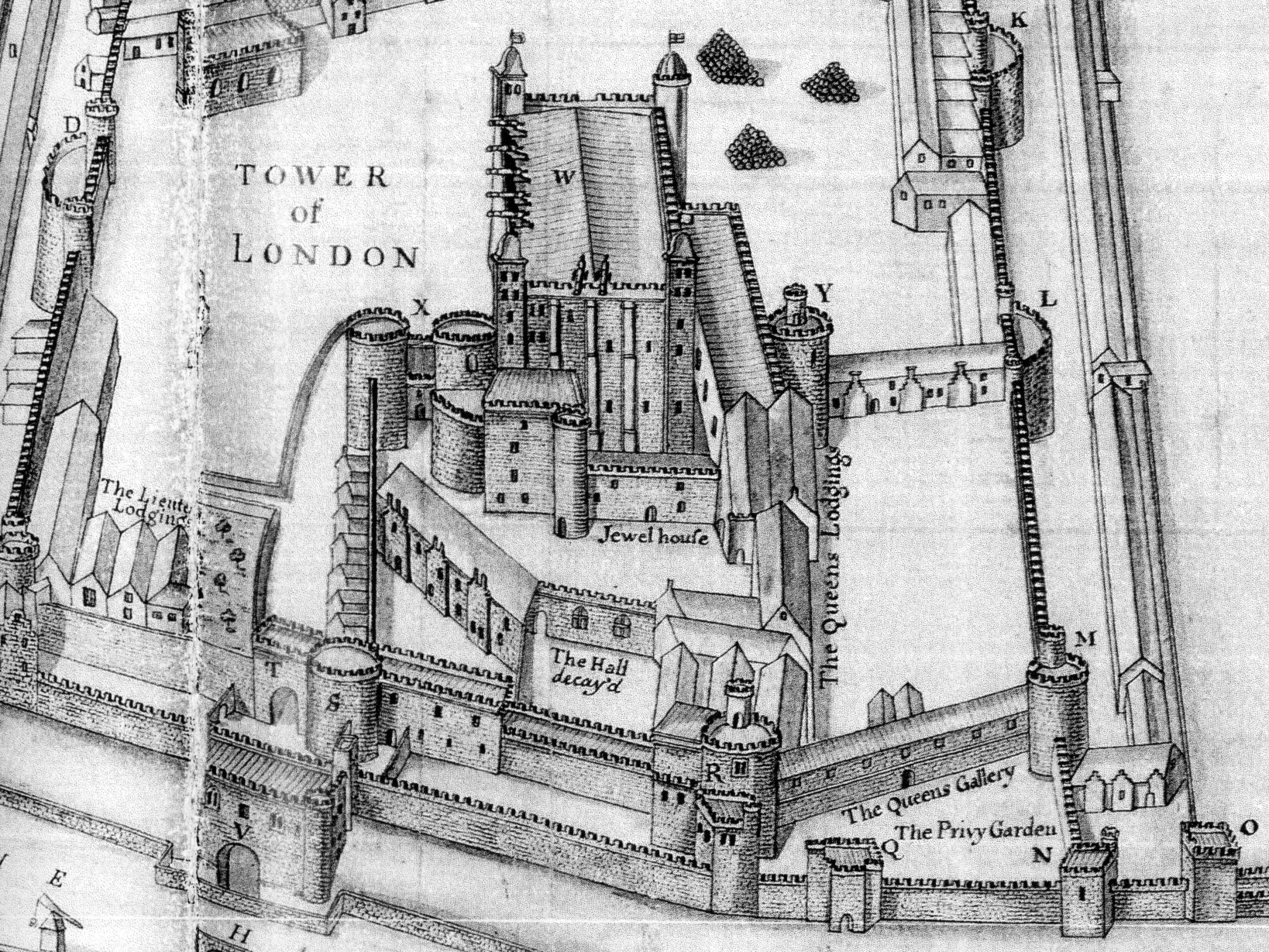
However, if we jump to around 1360, we see by now the timber staircase has gone and the main entrance is enclosed within a large square forebuilding tied to the south wall (see artist’s reconstruction). To the right of it, one of the windows has been newly converted into a small door which affords direct entry to the interior chapel. A stone staircase rises from ground level to give access to both entrances. The exact arrangement of the staircase is unknown, but we do know that over subsequent years several more edifices were attached to the south face to the right of the forebuilding, including a Jewel House and quarters for the officer known as the Lieutenant of the Tower. (These can still be seen in the well-known ground plan of the Tudor-era castle).
Jump forward again to the Restoration period, and in the 1670s King Charles II decided to demolish every edifice which had accreted to the south face of the White Tower, including the large forebuilding and its stone access staircase. This entailed digging down to foundation level, ten feet deep, and it was under these stairs that the remains of some children were found in 1674 ‘in (as it seemed) a wooden chest’.
This was confirmed in contemporary reports by John Knight, Principal Surgeon to Charles II, who recorded that ‘on the presumption’ that they were the remains of Edward V and his brother Richard of York, they were placed in an urn in Westminster Abbey ‘at my importunity’. A summary of Knight’s account appeared in Sandford’s Genealogical History of the Kings of England (1677), and may be read here.
The Latin inscription on the urn itself describes the remains as found ‘deeply buried’ under the rubble of the demolished stairs. Other accounts that recorded the discovery included those by the herald John Gibbon and the son of Sir Christopher Wren, the consensus being that they were found at a depth of ten feet while digging into the foundations. Wren summarised it thus: ‘about 10 feet deep in the ground…as the workmen were taking away the stairs, which led from the royal lodgings into the Chapel of the White-tower’. A compilation of accounts of the discovery may be seen in the journal Archaeologia.1
No formal written report to Charles II appears to exist, and there is no indication of the basis on which the presumed identification of the Princes was made, other than one part of the unsupported story written about Richard III by Sir Thomas More in the 16th century. This portion of his tale alleged that the two dead children were buried ‘at the stair foot, meetly deep in the ground, under a great heap of stones’, a story which More himself admitted he could not vouch for. It should also be remembered (as it clearly was not in 1674) that there was a second half to More’s story in which a priest ‘took up the bodies again and secretly interred them’ in a ‘better place’ which, owing to the death of the priest, ‘could never since come to light’.
There is also the interesting fact that it seems to have become something of a 17th-century obsession to claim the missing Princes had been found every time the Tower of London yielded discoveries of remains that were not actually adult humans (one, reported by Sir George Buc prior to 1619, turned out to be an ape escaped from the menagerie).2
* A claim recorded in 1647 by John Webb referred to two children found in ‘a little roome’ supposed to be aged six or eight but still ‘credibly believed’ to be the Princes. The dating of this find referred to some time between 1603-14.3
* The next discovery can be narrowed down to 1622, reported in the second edition of a book by Ralph Brooke, York Herald, referring to remains of two children found (again) in a room in the Tower: ‘which place…hath been mured up, and not known until of late, when as their dead carcases were then found, under a heape of stones and rubbish.’ The essence of this story seems to chime with Webb, thought not the date.4
* Yet another find, published in 1680, spoke of the Princes as two small carcases with halters around their necks, strangled by Richard III, found lying on a bed in (again) a walled-up room: this find was dated to the reign of Elizabeth I (<1603) who was said to be responsible for having the room walled-up once more. However, presumably knowing about the recent identification six years earlier the author of this tale added that the room had been opened again and the bodies transferred to Westminster Abbey.5
The reader must decide how much evidence underlay the above tales of discovery, and whether the identification of the Princes in 1674 was based on anything more substantial than a similar jumping to unwarranted conclusions.
Other versions of the 1674 discovery started circulating, and already in Kennet’s History of England (in 1719) the circumstances and location are misreported as occurring during the construction of new stairs when labourers were digging at the foot of the old stairs, ‘cover’d with an heap of stones’. On the contrary, although new stairs were indeed built later, it was not in the building of these that the find was made, but in digging out foundations while demolishing the entire row of edifices which had been attached to the White Tower during previous centuries.
Lawrence Tanner, Westminster Abbey historian and co-author of the report in Archaeologia, quotes the Lieutenant-Governor of the Tower who wrote in 1866 that Charles II had ordered a mulberry tree to be planted where the bones were found, but that another stairway was thoughtlessly built up against the wall which rapidly killed the tree, of which the stump was remembered as ‘still embedded in the landing of the (new) stairs.’ This refutes another common misrepresentation: it clearly indicates that the bones had not been found at the foot of the internal staircase where the Tower of London’s old plaque remains affixed, i.e. a staircase hewn out of a 13ft-thick wall. The demolition of buildings, in Tanner’s words, meant that ‘The place of burial would thereby become open ground’.
Tanner’s account continues by saying, ‘…it would appear that the bones remained for a few months in the custody of Sir William Chicheley.’ On 18th February 1675 (seven months later to be precise) royal warrants were issued to Sir Christopher Wren and the Dean of Westminster to arrange for ‘a white Marble Coffin for the supposed bodyes of þe two Princes’ to be situated in the Henry VII chapel. Three further years passed until ‘It was erected in 1678,’ says Tanner, ‘and in the meanwhile the bones seem to have been temporarily interred in General Monck’s vault nearby.’ Evidently he had been unable to track the exact whereabouts of the bones before their marble urn was readied and deposited, and there is anecdotal evidence of the remains being passed around and examined by interested parties – an opportunity for some to be retained as souvenirs and replaced by the animal bones found when the urn was opened.
Even in 1933 it was acknowledged that another misleading legend – the identification of the Bloody Tower as ‘the scene of the murder’, long encouraged by the Tower’s myth-makers – rested entirely on a late tradition. ‘We may perhaps remark that between 1483 and 1604 there were all too good reasons, apart from the Princes for changing the name of the Garden Tower and for associating it with deeds of blood.’
The remainder of the report carried by Archaeologia is principally concerned with confirming its authors’ belief that the remains belong to the Princes and that they were killed on the orders of Richard III, taking the account of Thomas More as an accurate historical record. By the fifth paragraph of the anatomical report it is assumed that the deceased were males, and from its seventh paragraph onwards they are named as ‘Edward’ and ‘Richard’. However, no estimate was ventured as to the total number of individuals represented by the inurned remains; and subsequent scientific opinion is unanimous that there could have been no certainty in 1933 as to the antiquity of the remains, their ages or sexes, or their relationship (or otherwise) to each other. Furthermore, unscientific opinions in the report guessing at bloodstains to indicate physical trauma, and suggestions of missing teeth indicating hypodontia (and thereby a familial relationship) have been comprehensively refuted.
* * *
It would not have been necessary to rehearse all the above detailed historical records had it not been for cries in recent months to open the urn and ‘identify’ the remains using DNA. Perhaps it will now be recognised on what dubious grounds their presumed identity hangs.
The identification of Richard III by DNA in 2013 was problematic enough, even with his grave being pristine and undisturbed (and not shared with any other human remains!). The challenge of extracting ancient DNA is much more difficult than most people realise, and the obstacles seem to be noticeably underplayed when discussed by technicians who are keen to get access to the urn and satisfy their professional curiosity, without taking account of the questionable historical background.
Given that the number of individuals present is unknown, it may be necessary to test a large number of the bones – perhaps all of them – in search of a viable sample; and if the DNA route is a failure, perhaps the most that could be achieved would be to date them to an approximate historical era. Yet, as we know with Richard III, even Carbon14 dating is open to interpretation if you delve further into diet and place of upbringing. Plus there are many more dimensions involved in the purpose behind disturbing ancient remains.
We will end with extracts from a comprehensive analysis of what the bones might tell us, published in 1986 by osteoarchaeologist W J White of the Museum of London in collaboration with P W Hammond who supplies the historical context. Inconsistencies between different reports, and the four-year gap between discovery and arrival in the Abbey, raise serious doubt whether they are the same remains, as does ‘the widely acknowledged purloining of a good many of the bones’.6 In terms of the investigations in 1933 by Tanner and Wright, there is a heavy reliance on Thomas More and an ‘over-riding presumption throughout’ that these are the Princes (the latter admitted by Tanner himself). And astonishment is expressed at the ‘incomplete nature of the examination’ by Wright, one of the foremost anatomists of his day. Having a time-limit may have hampered the extent of his research, yet ‘he expended a great deal of effort in speculation about their cause of death’. The remainder of the paper examines in detail such questions as age, sex, height, family relationships and pathology; and. ‘one of the great imponderables’, how long the remains had lain buried.7
Since Hammond and White, innumerable books and papers have discussed the princes and the ‘evidence’ yielded by Tanner and Wright, including a two-part discussion in the pages of The Ricardian by Helen Maurer.8 In 2008 the present writer addressed this subject, devoting to it the entirety of Chapter 10 in Richard III: The Maligned King.9 This analysis was informed by material and illustrations relating to the Tower provided by Historic Royal Palaces; and discussion of the architectural aspects (see illustrated reconstruction) was aided by the advice of a civil engineer and by reference to Edward Impey’s magisterial tome on the archaeology of the White Tower.10
Also surveyed in the same chapter were the scientific papers written in retrospect by several specialists in disciplines such as orthodontics and the measuring/dating of ancient remains, based on the 1935 article and photographs. The only analysis that offered anything really conclusive was that by Dr Richard Lyne-Pirkis, who observed the very visible disease in the elder specimen’s lower jaw, which had advanced to a seriously debilitating case of either osteitis or osteomyelitis. If not treated with antibiotics (which of course didn’t exist), such an infection would not only be obvious to the observer but would potentially be fatal.11 Though both princes were constantly on view to onlookers, I was unable to find any reference to a disabling and continually painful jaw disease or toothache, indeed Edward V was described (by his physician) as having such charm in his countenance that observers would never tire of watching him.12 It is also significant that his younger brother never underwent any princely training, such as would have been important had the elder suffered from a potentially fatal disease.
Finally, I addressed a comment made by Lawrence Tanner, who suggested that the extraordinary depth of a ten-feet secret burial might be explained by surface deposit accumulating over bones buried in a shallower grave (3ft was a common grave depth at the time). On making enquiries of Historic Royal Palaces about surface soil accumulation on the Tower estate over the centuries, I was told that the ground surface in the fifteenth century was about 2ft 3in higher than in the thirteenth century. If we extrapolate from this a little over one foot of deposit accumulation per century, then by a very rough calculation we are looking at six centuries to cover bodies lain in a 3ft grave: making the latest possible burial year 1066.
Notes
[1] L.E. Tanner and W. Wright, ‘Recent Investigations regarding the fate of the Princes in the Tower’, Archaeologia, journal of the Society of Antiquaries of London, LXXXIV, 1935.[esp pp. 8–12]
[2] A.N. Kincaid, ed., The History of King Richard III by Sir George Buc (1619), (2023), p. 140 and Plate 1.
[3] Tanner & Wright, op. cit., p. 26.
[4] Ralph Brooke, Catalogue and Succession of the Kings, Princes, Dukes, Marquesses, Earles, and Viscounts of this Realme of England (2nd edition, 1622) p. 33.
[5] Louis Aubery du Maurier, Mémoires pour servir à l’histoire de Hollande (Paris, 1680), pp. 214–5.
[6] P. 116 and note 72, p. 138.
[7] Ibid., pp. 117–131.
[8] Maurer, ‘Bones in the Tower: A Discussion of Time, Place and Circumstance’, The Ricardian, December 1990, March 1991.
[9] Reprinted 2013, 2023.
[10] Edward Impey, ed,. The White Tower (2008)
[11] Lyne-Pirkis, Regarding the Bones Found in the Tower: speech to Richard III Society, 27 February 1963.
[12] Domenico Mancini, de occupatione regni Anglie, ed/trans Carson, 2021 pp. 64–5, based on report by Edward V’s physician Dr John Argentine.
Artist's reconstruction: forebuilding and stairs c.1360
Tower of London survey, 1597

Marble urn c.1678