
News Archive
News Archive 2024
Society Appoints New Chair
The Board of the Richard III Society is delighted to announce that Amanda Geary has been elected as the new Chair of the Richard III Society. With her considerable skills and years of experience serving on the Board (and Executive Committee) as Communications Manager, Deputy Chair and most recently Acting Chair, it was agreed unanimously for Amanda to lead the Society as we embark on our next 100 years.
With this appointment we can also celebrate a certain landmark in the Society’s history: our first female Chair. We send her our heartfelt congratulations and wish her well in her new role.

Society Statement on upcoming Princes programme
On Tuesday evening a programme on the Princes in the Tower (subtitled ‘The Damning Evidence’) will be broadcast by Channel 5 at 9pm. In it Professor Tim Thornton reveals the will of Margaret Capell (d.1522) in which she bequeathed a chain of Edward V’s to her son Giles. The chain had belonged to her husband, Sir William Capell (d.1515).
Professor Thornton believes that the chain must have therefore belonged to Sir James Tyrell, Margaret’s brother-in-law because Tyrell was the murderer of the Princes according to Thomas More. More’s narrative was written in the sixteenth century, during the reign of Henry VIII, and published after his death in the reign of Elizabeth I. Shakespeare’s play was then based on More’s narrative.
We therefore thought that it might be helpful to make the following points of clarification for the broadcast:
1. The bequest is of a chain belonging to her deceased husband Sir William Capell. The recipient of the bequest is her eldest son, Sir Giles Capell. Sir Giles was born c.1486 and after 1509 became one of Henry VIII’s leading courtiers and military captains. He was a frequent jousting companion of the king. There is no mention of the collar/chain in Sir Giles’s will (1557), or those of his sons.
2. Sir William Capell was prosecuted under Henry VII for usury and various other financial misdemeanours. He was an important money lender who acquired all sorts of metalwork as surety, including people’s signet rings. The chain may simply have been given to Sir William as collateral for a loan.
3. We have no evidence to authenticate the chain as belonging to Edward V other than the will.
4. The recipient of the chain was Sir Giles Capell. Another of Dame Margaret’s brothers-in-law was Sir Giles Daubeney. Daubeney had been a member of Edward IV’s household, joined the rebels against Richard III in October 1483, and joined the earl of Richmond in exile shortly after. He fought for Henry VII at Bosworth and was rewarded with the lieutenancy of Calais and made chamberlain of Henry VII’s household. It is just as possible that Margaret named her eldest son in recognition of Sir Giles Daubeney and he gifted the chain to the Capells on the occasion of the birth of their first son. There is therefore a connection to Daubeney for the chain.
5. There is no evidence that the chain belonged to Sir James Tyrell.
As a result of the above, Professor Thornton’s discovery cannot be deemed as evidence but conjecture. He acknowledges this in his accompanying article in the journal History (https://onlinelibrary.wiley.com/doi/10.1111/1468-229X.13430)
For more, please see Matt Lewis’s blog: https://medievalmatt.substack.com/p/a-damning-discovery?r=17nngx&utm_medium=ios&triedRedirect=true
The Missing Princes Project will shortly be publishing more archival discoveries for the survival of both sons of King Edward IV of England.
The History of King Richard the Third Digitised
Last year the Richard III Society funded the publication of The History of King Richard the Third by Sir George Buc, Master of the Revels, edited by Arthur Kincaid, and published by the Society of Antiquaries. We are delighted to announce that this has now been digitised and is available for download, free of charge, at
https://library.oapen.org/handle/20.500.12657/94298
Sir George Buc (AKA Buck) was a noted scholar, Ambassador for King James I, and Master of the King’s Revels. His patron was the Earl of Arundel – the ‘Collector Earl’ – descendant of Richard III’s friend John Howard, Duke of Norfolk. Buc admired King Richard, and decided to write a major work in his defence, which he dedicated to Arundel.
This was an age when the antiquaries and heralds had started amassing their great libraries and collections of documents from the past…and vowed they would accept no tales and fables that weren’t supported by evidence.
For centuries Sir George’s carefully researched book of 1619 remained an unpublished MS, ignored and damaged, while a stolen, truncated version was printed in 1646 – passed off as the work of one ‘George Buck Esq’ (a distant relative). You may have met it as a Google Book, but don’t be misled by this dreadful travesty, which distorts all Buc’s painstaking arguments!
This is the real thing, Sir George Buc’s original work lovingly transcribed by Ricardian scholar Arthur Kincaid. Its introduction takes you into Buc’s fascinating world, informed by the great collectors like Cotton and Camden, who opened their libraries to him.
For the historians among us, Kincaid provides a treasury of historical notes where Sir George Buc’s evidences and references are hunted down and set out in full. His additional research brings us right up to the present day, and into the aftermath of the discovery of King Richard’s grave. Ricardians in particular will love his closing salvo, ‘Folklore and History’.
The Society is proud to be a part of making this book available to all.
Bosworth Coin Hoard Unveiled
On Monday 12th August, the Society’s Deputy Chair, Amanda Geary, along with Sally Henshaw (Secretary of the Leicestershire Branch) and Richard Smith (Chair of the Leicestershire Branch), unveiled the new display of a hoard of silver pennies at the Bosworth Battlefield Heritage Centre.
The coins were found close to the Battlefield in 2022 and were purchased for Leicestershire County Council by the Richard III Society through the Treasure Act. The hoard consists mainly of coins dating from the 2 reigns of King Edward IV, alongside two coins from King Richard’s reign and one coin from the reign of Henry V.
The coins are now on display at the Bosworth Battlefield Heritage Centre.

The Daughter of Time
A staged reading of a new play version of The Daughter of Time took place as part of the Middleham Richard III Festival.
The play was written by M Kilburg Reedy, and based on Josephine Tey’s famous 1951 novel The Daughter of Time. The reading was held at the Key Centre, Middleham on Sunday 7th July, and featured a full cast, including Susannah Harker as Marta Hallard and Alan Cox as Inspector Alan Grant.
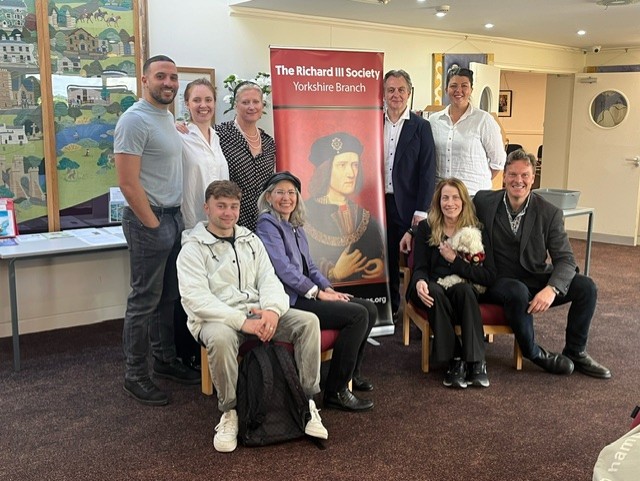
New Middleham Sign Unveiled
A new sign outside Middleham Castle was unveiled by Philippa Langley on 6th July (the anniversary of King Richard’s coronation) as part of the Middleham Richard III Festival.
The new sign, which features the National Portrait Gallery portrait of King Richard was paid for by the Richard III Society.


New Society plaque unveiled
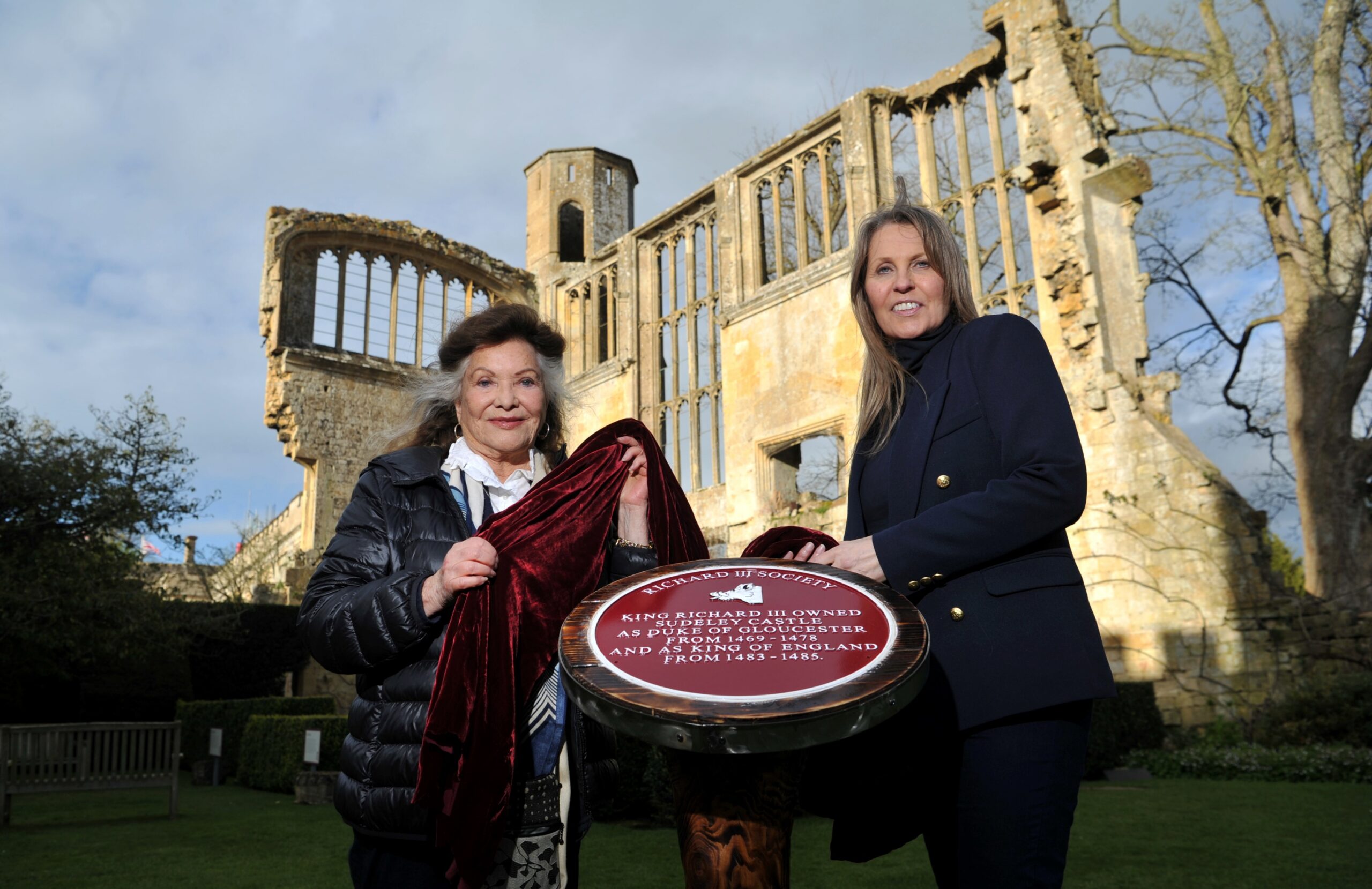
A new Richard III Society plaque was recently unveiled at Sudeley Castle in Gloucestershire by Philippa Langley alongside the owner of the Castle, Lady Ashcombe. The plaque commemorates King Richard’s ownership of Sudeley.
Also present at the unveiling were friends of Sudeley Sir David Suchet and his wife Lady Suchet (actor Sheila Ferris).
York Prize Recipient
We are delighted to announce that the Richard III Society has awarded its £500 prize for the best dissertation of 2022/3 in the University of York Centre for Medieval Studies to Eleanor Johnson, for her MA dissertation on ‘Recreating Paradise: A Study of Contemporary Experiences of Designed Landscapes in the Late Medieval Period.’
Eleanor’s dissertation investigates the experiences of various social groups interacting with designed landscapes during the late medieval period. A case study of Kenilworth Castle (Warwickshire) in the early fifteenth century is used to provide analysis of human interactions within a known designed landscape, achieved through the use of map visualisations, access analysis and application of information from related literature. Physical interactions with the landscape are studied through analysis of resource management, regular routes of travel and restrictions to movement and access for three groups in the landscape (‘elites’ ’employees’ and ‘labourers’). Experiences widely differed by social group, with labourers most often excluded from recreational areas, which were exclusive to elite groups and the employees required for service and maintenance.
This dissertation – which is one of the first to consider multiple social groups within the same designed landscape – presents further analysis of designed landscapes across England and into Europe as a way of contextualising Kenilworth, and suggests the presence of a shared European elite culture which defined elite actions and connected designed landscapes across borders.
Eleanor has generously provided a digital copy of her dissertation, which will be accessible to Society members via the Barton Library.
Richard III Society acquires rare Royal Grant of King Richard
This historic 540-year-old vellum document is returning to the UK after acquisition at an international auction. Richard III issued the Royal Grant in January 1485, making a key appointment to the strategic role of Lieutenant of Guînes Castle, Calais. At this time, King Richard was preparing the defence of his realm against the threatened Tudor invasion that would end his reign a few months later, at the battle of Bosworth.
Bearing an almost intact example of the King’s Great Seal, this is far from being a clerical copy: it’s the original grant delivered into the hands of the King’s appointee, Sir James Tyrell.

The name of Tyrell, like that of Richard himself, received harsh treatment by the pen of Shakespeare, whose play imagined the murder of the so-called ‘Princes in the Tower’ and gave Sir James the role of chief murderer. In another document recently discovered – and publicised in a Channel 4 documentary – Sir James Tyrell is named as one of the team that arranged the Princes’ extraction to safety from the Tower of London.
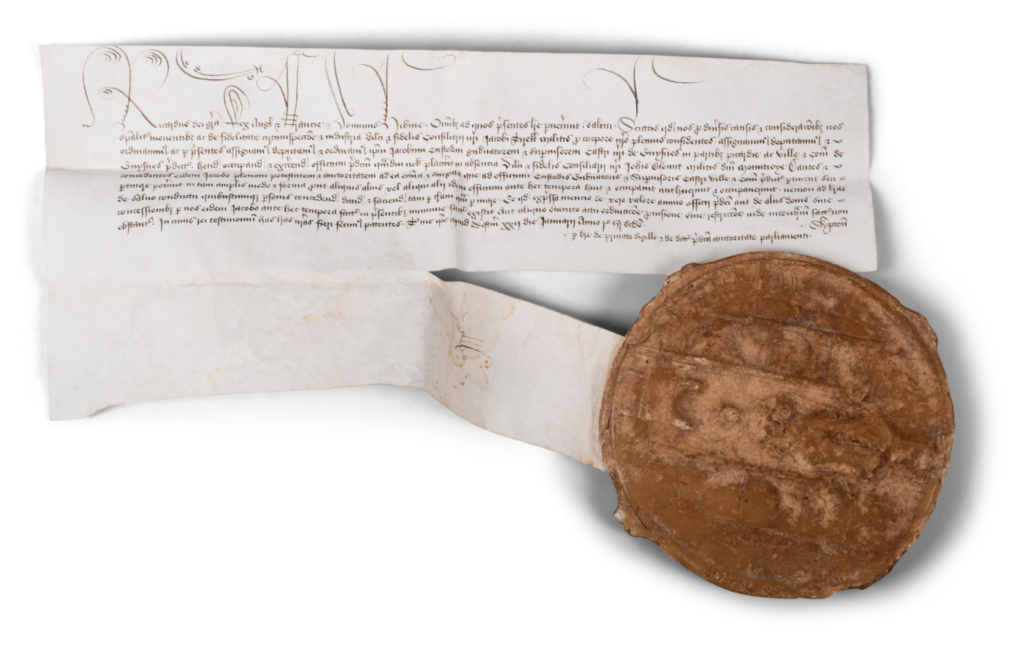
The successful bid was made on 30th November 2023 and the document is presently in the US. The Society is planning to display the grant this year, which marks the centenary of its founding in 1924. Society Chair, Matt Lewis, said ‘This is a significant new departure for the Richard III Society. It’s an important document issued by Richard at a time of growing crisis, but the document itself, and particularly the seal, are things of beauty too.’