
(hereafter called Richard of England)
King Edward and Richard of England
The Yorkist Claimant Richard
by Philippa Langley MBE
The story of Richard of England (aka ‘Perkin Warbeck’), as put out by Henry VII, became widely spread and accepted by posterity, owing to his misfortune of falling into the Tudor king’s power. Interrogated, brutalised and probably tortured, the young challenger who claimed the crown as the brother of Edward V was forced to sign a confession under duress. of which the original no longer exists. Faced with such circumstances in our modern age, most people would look elsewhere when seeking the truth. But the winner writes the history, an art for which Henry Tudor showed great aptitude. For these reasons it is unwise to accept without question any narratives that appear (or claim) to be official reports from Henry VII’s authorities.
To begin with what we confidently know, a sketched portrait of him from 1492 has survived which, having originated on the Continent, was beyond Tudor reach. The face shows a remarkable resemblance to Edward IV.
In 1491, having made his way to Ireland, he had been welcomed by the Irish lords of Yorkist allegiance, some of whom had already met him in December 1479. They acclaimed him as Richard of England, the Yorkist prince who now assumed the mantle of claimant after the defeat of King Edward in 1487. After four years of silence it was evident that King Edward, even had he survived the Battle of Stoke, would not be renewing his challenge to Henry VII.
We have evidence that while in Ireland and following intimations of friendship from King Charles VIII, he received and accepted an invitation to France where the sketch may well have been made. Though later accused of having been trained and taught courtly manners by his aunt Margaret, Dowager Duchess of Burgundy, he had in fact not yet become her protégé. It was only after French co-operation was terminated, by Henry VII’s demands in the Treaty of Étaples in late 1492, that Richard arrived at Margaret’s Burgundian court in Malines.
With her assistance a well-known document was penned on 25th August 1493, being a letter written at Dendermonde, Flanders, to Queen Isabella of Spain. Though historians argue about the identity of the Claimant, they are content to recognise this as his official claim to the English throne. Until recent research it has been seen as Richard’s earliest statement of his own bona fides, and it seeks the support of Queen Isabella and King Ferdinand to restore him to his hereditary kingdom.
It claims that his brother, Edward V, was put to death and that he himself, being aged about nine, was ‘delivered to a certain lord to be killed’. Happily he was spared by that lord and, after being sworn to secrecy, was sent to Europe where he wandered for nearly eight years in the charge of two persons. Scarcely had he emerged from childhood (he reached 16 in August 1489) when one of these men died and the other ‘returned to his country’. After remaining for a time in Portugal, Richard then sailed to Ireland where (as mentioned above) he was welcomed by those Yorkist lords.
It names heads of state who have now promised him friendship and alliance, including Maximilian I and his son Archduke Philip, the Duke of Saxony, and the kings of Denmark and Scotland together with ‘great nobles of the kingdom of England…who execrate the proud and wicked tyranny of this Henry of Richmond.’
Most historians have observed that it lacks sufficient explanatory detail to shake the accepted tradition that he was the imposter Henry VII claimed he was. In fact there was good reason for the letter to be cagey at this stage, because the good-will of the Spanish was by no means guaranteed, and the letter’s contents could have been revealed to Henry VII. Which, as it turned out, they were. It has also been pointed out how unlikely it was for a murderer to spare Richard, to his own great peril. If these have been considered the letter’s main flaws, it will come as a pleasant surprise to hear they have been resolved by the emergence of new evidence.
But before we leap ahead, let us examine a few well-documented corroborative facts. For example, Richard mentions being in Portugal. In early 1488 Henry VII sent spies to Portugal, followed by Richmond Herald being sent there in August 1489. Connections with Portugal and Portuguese individuals crop up regularly in records that recount Richard’s movements.
Richard of England’s presence in Ireland in 1491 is well recorded as are the overtures from Charles VIII which resulted in his visit to France that summer, departing at the end of the year for Burgundy.
Yet still, as Francis Bacon attested – and despite Henry VII’s profusion of spies – no one at this time had put forward any connection between Richard of England and a certain boatman of Tournai named Warbecque. The ‘Perkin Warbeck’ story, which alleged he came of this Werbecque family, would not emerge until later (July 1493): just as the alleged ‘Lambert Simnel’ identity, given to the Yorkist claimant King Edward, hadn’t emerged until five months after Stoke Field.
Again the world was told that an imposter lad had suddenly appeared in Ireland with all the graces and lineaments of a prince, speaking perfect and unaccented English. The argument was that all this, together with his intimate childhood recollections of Edward IV’s court, had been taught him by Margaret of Burgundy; even though she had in reality left England before he was born and returned only once on a brief visit to conduct trade negotiations in 1480.
Meanwhile support for the Yorkist Claimant Richard was gathering in England, and in early 1493 men including Lord Fitzwalter and Sir Gilbert Debenham started planning rebellion on his behalf – among them, surprisingly, Sir William Stanley, the instrument of Henry Tudor’s success at Bosworth. Richard, as we know, is first recorded at Margaret’s Burgundian court around the end of 1492/early 1493. And this brings us full circle to just before the Dendermonde letter of August 1493.
Our new evidence, the result of research by Philippa Langley’s Missing Princes Project, is a four-page statement in the Gelderland archives which seems to have been written upon his arrival in Malines. Its dating to the period has been authenticated as to the materials, the language and the handwriting. Its aim is evidently to set out exactly how he came to leave the Tower of London in 1483 and make his way in the world during the intervening years.
Because it is written in Middle Dutch, rather than the international language of Latin of the Dendermonde letter, it appears to be a personal statement meant strictly for home consumption. being so full of detail, this information would be imparted to trusted allies only, who would not reveal the identities of the individuals involved, some of whose lives and families stood in peril should their involvement become known in England.
For anyone who doubted the killing of one boy while sparing the other, it is now clear the brothers were merely separated and Edward was taken to an undivulged location, by people whose identities are also undivulged. For reasons of security, neither brother would have been given information about the other, and to say Edward had been killed was probably a way of blocking unanswerable questions. The individuals Richard does identify include many personal aides and retainers of Richard III in 1483, whose names could not possibly have been sufficiently known to Margaret for her to have cast them in their designated roles.
This aside we also see the main outlines given in Richard’s Dendermonde letter fleshed out with a wealth of detail. Locations in and near the Tower are specified with accuracy, plus a string of destinations visited on the Continent right up to his taking ship for Portugal – with names also given for the two companions of his wanderings, the departure of one and death of the other. We learn of his taking ship for Ireland, his sojourn with Charles VIII, and his welcome by his aunt on arrival in Malines, when he expresses hopes that ‘in a short time I will obtain my right to which I was born.’
Not to be overlooked are the tokens of authenticity he cites, which would later play an important role in cementing the heartfelt support of Maximilian, King of the Romans. Records attest that Richard possessed certain distinguishing physical features (two of them visible on his face) which could be recognised by anyone who knew him in childhood; and that Maximilian examined them to his complete satisfaction, to the extent that he reported them to Henry VII. They were also identified by Margaret of Burgundy and even confirmed by the turncoat Sir Robert Clifford.
Richard of England remained a prolonged and serious threat to Henry VII, first with armies provided by European crowned heads, and even more so when James IV of Scotland joined and provisioned his persistent campaigning. But his challenge ended with failure in battle, whereupon the world believed the Tudor stories because there was no other option. Inevitably, when called upon to testify after Richard’s defeat and death, those of his allies who survived would have faced ruin had they not disclaimed that he was the real thing.
The Gelderland testimony is a strikingly straightforward narrative, and its verifiable details of names, dates and places stand in its favour, especially since there are now even more researchers actively discovering new supporting evidence. It is eminently more believable than the tortuous stories put out by the Tudor regime that alleged Richard of England to be a foreign boy of menial class with a pretty face, who was ‘taught’ all the attributes necessary to be accepted as a prince by European and English nobility.
Further archival discoveries regarding the Yorkist claimant Richard of England were published in 2025.
Philippa Langley MBE is the founder of the Looking For Richard Project who discovered the lost grave of King Richard III, and the founder of The Missing Princes Project research initiative. She is the honorary President of the Scottish Branch and Fellow of the Richard III Society.
Articles with named authors reflect the views of the author and do not necessarily reflect the views of the Richard III Society.
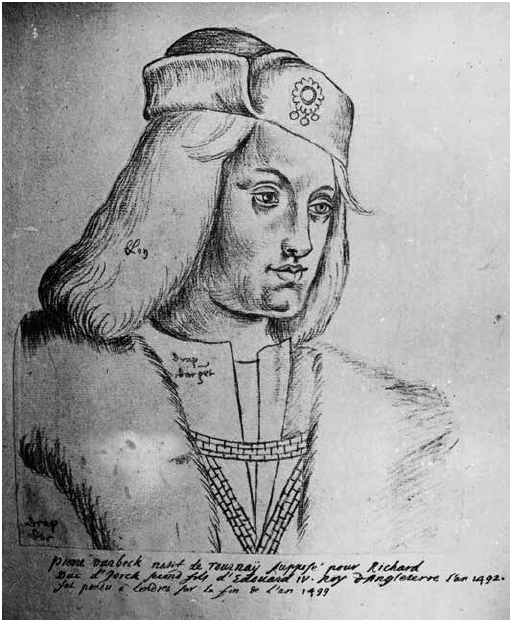
Richard of England

Richard of England signature, 1493 (photo courtesy of Philippa Langley and Nathalie Nijman-Bliekendaal
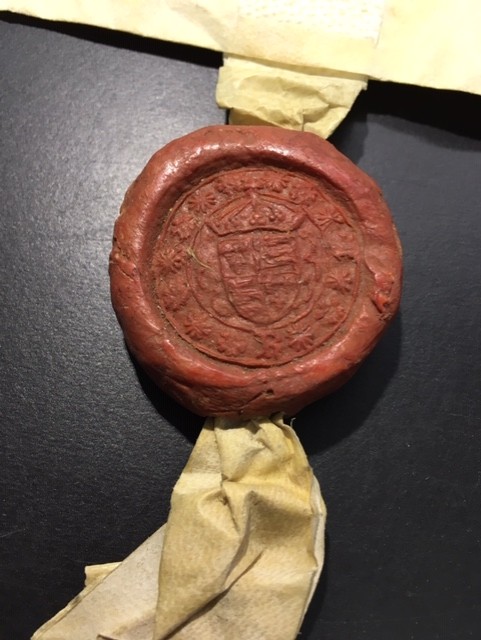
Richard of England's royal seal (photo courtesy of Philippa Langley and Nathalie Nijman-Bliekendaal