The Battles
The Battle of Tewkesbury
4th May 1471
Result of the Battle – Yorkist victory
Queen Margaret landed at Weymouth, with her son Edward, Sir John Langstrother, the Prior of St John of Jerusalem, and a small army of Frenchman on 14th April, the same day that her ally, the Earl of Warwick, was defeated and killed at the Battle of Barnet. When this news reached Queen Margaret she must have been devastated but she was not deterred. With her generals, the Duke of Somerset and the Earl of Devon, she and her army had already moved north-west. Her aim was to recruit a substantial army from the west country and Wales as quickly as possible and then to engage with the Yorkists. King Edward left London in pursuit of the queen on 24th April. He reached Cirencester on the 29th and almost caught up with her near Sodbury but she carried on north towards Gloucester, racing to get across the River Severn and into Wales to continue her recruitment campaign. Gloucester closed its gates to her and she was forced further north to the next possible crossing of the river – Tewkesbury. Knowing how close the Yorkist army was, she did not have sufficient time to make the crossing so she deployed her exhausted army south of the town, choosing the most advantageous ground.
King Edward, having marched some thirty-six miles that day, camped at Tredington, 3 miles from Tewkesbury, on the night of 3rd May. As daylight appeared the following morning, he broke camp and moved towards the rebel army deploying his own army into three divisions led by the Duke of Gloucester, himself in the centre and Lord Hastings. Again, the king kept his untrustworthy brother Clarence with him but his younger brother, Gloucester, was assigned great responsibility, facing the division led by the experienced Lancastrian fighter – Somerset. The centre of the Lancastrian army was commanded nominally by Edward, Prince of Wales but in reality by Lord Wenlock and the other flank was commanded by the Earl of Devon. Compared to the recently fought Battle of Barnet the armies were smaller, with Edward possibly having 5,500 men and the Lancastrians numbering 6,000.
The Yorkists began the engagement with gunfire and arrows on Somerset’s division. The duke responded but his gun power was inferior and he was soon forced to make a charge. He did not head straight towards the opposing division but swung left towards the king’s central one, no doubt expecting support from Wenlock in the centre. This was not forthcoming and he was pushed back by Gloucester and King Edward, with many of his men running from the field towards Bloody Meadow. (Edward Hall claimed that on returning to the fray Somerset turned on Wenlock and killed him with a blow to the head from his battleaxe).
The Lancastrian line was now giving way and the soldiers fled. The leaders were killed – Somerset’s brother John Beaufort, the Earl of Devon, Wenlock and, during the flight, Edward, Prince of Wales. The Yorkists pursued the rebels to the bridge crossing the River Swilgate, to the mill, the weir and the town. Some rebels, including Somerset and Langstrother took sanctuary in the abbey but they were removed and brought to trial and execution on Monday 6th May.
Closely following his success at Tewkesbury, King Edward learned of problems in the north which required his attention. Whilst at Worcester, he heard of the capture of Queen Margaret. She was to remain a prisoner in England for four years until Louis XI of France paid a ransom for her release. The northern uprising came to nothing but London was now under attack by the Bastard of Fauconberg and the king turned back to his capital which he entered on 21st May. That night King Henry VI died in the Tower, most likely by command of King Edward.
Contemporary Sources
- Part 5 of the Anonymous History of the Arrival of Edward IV in England and the Final Recovery of his Kingdom from Henry VI.
- Historie of the Arrivall of Edward IV in England and the Finall Recouerye of his Kingdomes from Henry VI edited by J Bruce, Camden Society, 1838.
- Memoires by Philippe de Commines, edited by D Godefroy and Llenglet du Fesnoy, 4 vols, Paris, 1747.
- The Great Chronicle of London edited by A H Thomas and I D Thornley, 1938.
- A Chronicle of the First Thirteen Years of the Reign of King Edward IV by John Warkworth, edited by J O Halliwell, 1839.
- Edward IV’s Memoir on Paper to Charles, Duke of Burgundy. The so-called ‘short version of the Arrivall‘ edited by Livia Visser-Fuchs, Nottingham Medieval Studies, Vol 36, 1992.
- Anchiennes Croniques d’Engleterre by Jean de Waurin, edited by E Dupont, 3 vols, Societe de l’Histotoire de France, Paris, 1858-63.
- Recuell des Chroniques D’Engleterre by Jean de Waurin, edited by W Hardy and E Hardy, 1891.
Further Reading
- ‘The Battle of Tewkesbury’ by Alan Baker in British History Illustrated, vol 1, no 1, 1975.
- ‘The Battle of Tewkesbury AD1471’ by the Rev Canon Beazeley, 1904. From Transactions of the Bristol and Gloucestershire Archaeological Society, vol 26, 1903.
- ‘The Battle of Tewkesbury’ by Lt-Col J D Blyth in Transactions of the Bristol and Gloucestershire Archaeological Society, 1961.
- Extract from a ‘Chronicle of Tewkesbury Abbey’ on the battle, with a list of those slain in C L Kingsford’s English Historical Literature in the Fifteenth Century, 1913.
- ‘Battle of Tewkesbury May 1471’ by Hubert Collier in Lloyds Log, May 1971.
- ‘Account of King Edward the Fourth’s Invasion of England in 1471 drawn up by one of his followers, with the king’s letter to the Inhabitants of Bruges upon his success.’, Archaeologia, vol 21, 1927.
- Tewkesbury: Eclipse of the House of Lancaster 1471 by Steven Goodchild, Battleground, Wars of the Roses series, Pen and Sword, 2005.
- Tewkesbury 1471: The last Yorkist victory by Christopher Gravett, Osprey Publishing, 2003.
- Battle of Tewkesbury 4th May 1471 by P W Hammond and H G Shearing, 1990.
- The Battle of Tewkesbury Saturday 4th May 1471 by B Linnell.
- Descriptive Particulars of the Battle of Tewkesbury and of all known local Scenes and Memorials of the Battle, printed and published by William North (undated, probably late 19th century).
- ‘A May Day in Tewkesbury When a Crown was Lost and Won’ by Dorothy Kendall Pearson in Cotswold Life, June 1994.
- ‘The Burials of Lancastrian Notables in Tewkesbury Abbey after the Battle AD 1471’ by GMcN Rushforth in Transactions of the Bristol and Gloucestershire Archaeological Society, vol 47, 1925.
- ‘Battle of Tewkesbury: Museum Diorama’ by Geoffrey Wheeler in Airfix Magazine vol 13 No 8, April 1972.
- Battle of Tewkesbury 1471: a roll of arms by Geoffrey Wheeler 1471.

Somerset's advance at Tewkesbury. Artwork from 'Campaign 131: 'Tewkesbury 1471: The 1st Yorkist Victory' by Graham Turner ©Osprey Publishing Ltd

The Royalist March. Reproduced by kind permission of Peter Hammond and David Scuffam.

The Battle of Tewkesbury. Reproduced by kind permission of Peter Hammond and David Scuffam
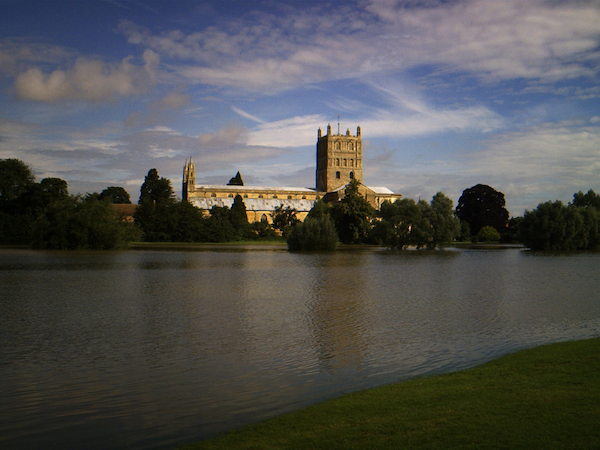
Tewkesbury Abbey, where some of the Lancastrians sought refuge