
News Archive
News Archive 2014
11th February - 2nd Battle of Tewkesbury 2014
A lot has happened since the last report, though we’re still not the owners of the Gastons! The bid date has been and gone, though we don’t know what happened as there’s been silence. This isn’t a bad sign. The Governors have to abide by the Charity Commission rules, and they have to demonstrate that they’ve achieved best value in the sale. An independent surveyor has to audit what they’ve done and confirm this. We’re hoping that the Governors will agree that there is sufficient common ground between their objectives and ours for a different set of rules to apply, and that we can jointly apply to the Charity Commission to agree an independent valuation for sale to Tewkesbury Battlefield Society.
We’ve had lots of local coverage, in the press, radio and television. We’ve also had national coverage on the BBC News on Sunday 2nd February. The latter has produced a number of quite significant, and potentially very useful contacts, plus a great deal of support. We’re hoping that all this translates into donations! We’ve set up a Just Giving site with two options: to donate to the purchase fund, where money will be returned if we’re unsuccessful, or the fighting fund (the photo half way down the page) for funds to help with expenses in making the bid. You can also donate by cheque: Cheques should be made out to ‘Tewkesbury Battlefield Society’, with either ‘Fighting Fund’ or ‘Gastons Fund’ written on the back, with your name and address. We have collecting boxes in premises all over Tewkesbury, or send your cheque to The Tewkesbury Battlefield Society, PO Box 147, Tewkesbury, GL20 9AP. Alternatively, people will be setting up fundraising events, and making use of the generous offers we’ve had. Matching dates and venues is taking a bit of time!
It must be stressed that to date we’ve spent nothing. Everything has been done by volunteers or donated. And thanks to supporters, we’ve got quite a few leads to grant-giving bodies which we’ll be sifting through shortly and deciding which to apply for, for what purpose and when. Some of these will be for work after the purchase, and some to support the purchase. Big among these is the potential to get a grant from the Heritage Lottery Fund, who we’re in contact with. As the six months moratorium is ticking away, this is work we need to get on with quickly. We desperately need an experienced fund-raiser to co-ordinate all the fund-raising activities, and to decide where our efforts are best directed. The use of the fields once they’re in the hands of the community is something else we’re working on. This will be important for grant applications. Uses fall into four main categories; historical, ecological and the creative arts. There are lots of possibilities in all these areas. We intend to establish a representative management committee to co-ordinate both the work needed to restore and maintain the fields and make sure that the various informal and formal uses don’t conflict. An appropriate low intensity agricultural use has to be the principle use, an this can easily be made compatible with other things.
Every organisation we’ve spoken to has been enthusiastic about the potential for the Gastons. This is reassuring, but we’ve a lot to do yet to find the money and to buy the site!
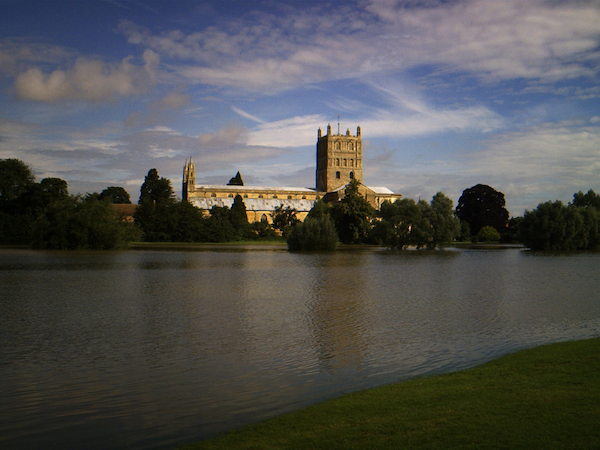
Courtesy of Simon Fogden
27th February - On the geonome sequencing of Richard III
Earlier this year, the University of Leicester announced that it plans to sequence the geonome of Richard III’s DNA. In time, this will mean that we can all know more about the man – his eye and hair colour, the nature of his scoliosis, and something about his family.
Inevitably, members of the Society are divided on the issue of further testing on the remains of King Richard. Messages have been received expressing both concern and approval. Whether one approves or disagrees, it must be remembered that, once the excavation began and the subsequent events were started, the Society no longer had any control. The Richard III Society is not the custodian of the remains and the Society funds paid only for the dig and the facial reconstruction The scientific testing has been paid for by others, including Leicester University.
The Chairman has now spoken with the team from the University and has been assured that the amount of material required for the geonome testing was ‘very small’.
An analogy can be made with the bones in an urn in Westminster Abbey, the alleged Princes, and the fact that further testing has not been made available. Many people have been asking for them to be the subject of modern analysis on the basis that it is owed to future generations to discover as much as possible. It hasn’t been allowed for the Abbey bones, but it can be done for King Richard.
Understandable concern has been expressed about the ethics of the project because it involves the remains of an anointed king, but whether king or peasant, it makes no difference provided the remains are treated in a serious and respectful way.
Michael Ibsen, the named living collateral descendant who gave one of the samples of DNA used to confirm the remains as being those of Richard III has not objected to this further testing on his late sixteen times great uncle. Indeed, he is participating in the project.
For those who are against the further testing, there are at least two on-line petitions which can be accessed for you to express your choice.
There are many arguments for and against further testing but it should be remembered that, according to its aims, the Richard III Society is ‘to promote in every possible way research into the life and times of Richard III’. It is our responsibility to uphold this aim and to secure a reassessment of his life and reputation.
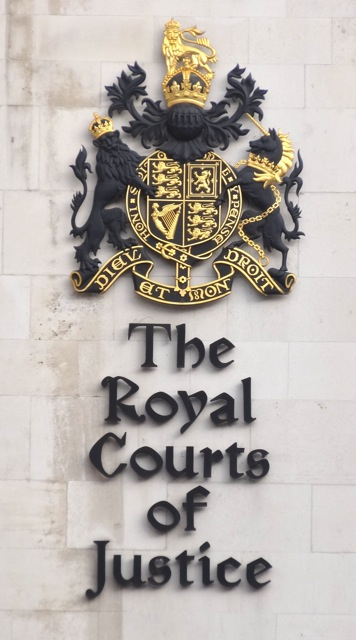
13th - 14th March Judicial Review, Royal Courts of Justice, London
©Wendy Moorhen 2014
The Judicial Review, postponed from 26th November 2013, was again heard before Lady Justice Hallett, Mr Justice Ouseley and Mr Justice Haddon-Cave. The proceedings were not about where King Richard III should be buried but whether the defendants, the Secretary of State for Justice and the University of Leicester, had a duty at common law to consult about where and how the King’s remains should be reinterred. The action had been brought by the Plantagenet Alliance, a group of fifteen collateral descendants of the king, who believed they should have been consulted and in August 2013 Mr Justice Haddon-Cave judged their case was arguable and granted permission for the proceedings.
The Alliance specifically challenged the decision of the Secretary of State for Justice who, on 3rd September 2012, granted the Exhumation Licence without any consultation, their subsequent decision on 4th February 2013 not to re-visit the grant of the Licence after the identification of King Richard and the decision of the University on 4th February 2014 to begin making arrangements for the reburial of the remains of the King in Leicester Cathedral. Counsel for the Claimant, Gerard Clarke, spent Thursday morning making his submissions and outlined his thoughts on the type of consultation that could be undertaken and emphasised his client was only asking for the right to be consulted. Lady Justice Hallett an Mr Justice Ouseley frequently questioned Mr Clarke and in some instances pressed him for specific answers. Unfortunately some of Mr Clarke’s statements were considered dubious and which provoked a protest from the public gallery by Philippa Langley. Lady Justice Hallett asked for a written statement from Philippa and the Judges retired for a short interval and on their return announced they would accept the statement but no further submissions would be allowed. Lady Justice Hallett graciously acknowledged that the Court was only sitting because of Philippa’s endeavours.
After lunch it was the turn of James Eadie QC on behalf of the Secretary of State for Justice. Mr Eadie dealt with five legal principals of common law and whether or not there was a duty for his client to consult. For an hour he cited case after case, precedent after precedent, point of law after point of law and appeared to demolish the Claimant’s case. He concluded that there was no statutory duty to consult and no established practice to consult.
The final submission of the day was from Anya Proops on behalf of the University of Leicester. Ms Proops stated that the University should not have been named as a defendant and had no duty whatsoever to consult. She allowed that if there was a duty to consult it rested with the Secretary of State for Justice.
The final submission was made on Friday morning by Andrew Sharland QC on behalf of Leicester City Council. The council had, as reported in the December Bulletin, applied to be an interested party in the Judicial Review and during the proceedings on 26th November they were made a third defendant and the Review was subsequently adjourned to await the new submission but not before the City Council undertook to hold a consultation. In a surprise move a few weeks later the Council abandoned their undertaking to consult. This was frustrating as the whole matter could have been concluded by a judgement after the November hearing and without the considerable extra costs of the present hearing. Lady Justice Hallett commented there would be monetary repercussions! Mr Sharland’s submission was that the City Council had no role in the reburial of King Richard. They had no statutory right to consult. The University of Leicester had the Licence and rights and they had been charged to keep the remains safely, privately and decently, which they had done.
As Counsel for the Claimant, Mr Clarke concluded the hearing with his response to the Defendants’ submissions and there was discussion with the Judges regarding who could be consulted and it was recorded, in no particular order, HM The Queen, the collateral descendants of King Richard, the Church of England, the Catholic Church, the citizens of Leicester and York, and those members of the public who were interested. The proceedings were closed with the announcement by Lady Justice Hallett that they would consider the submissions and would hope to reach a judgement in the next four to six weeks. This is not an enviable task, especially considering the several hundred, if not thousands of pages of documents contained in the lever arch files which sat in front of the several legal teams.
What might that judgement be? It would be wrong to speculate but perhaps just the observation that Mr Eadie’s defence was awesome in terms of legal precedent and point of law but at the end of the day the Judges are faced with an absolutely unprecedented, and probably unique occurrence, how and where do you reinter the remains of an anointed king of England? Perhaps you just throw out the rule book!
I would like to share one personal reflection after listening to the submissions and arguments. The Counsels for the Secretary of State for Justice, the University of Leicester and Leicester City Council all denied their clients’ duty to consult and yet, at one stage or another, they had all considered consultation!
I should perhaps mention that it would be challenging to provide a more in-depth summary of the Judicial Review due to the difficulties of hearing the speakers from the public area, the incessant and disruptive arrivals and departures of visitors to the public areas (although the opportunity to wander in and out of sitting courts is a wonderful facet of our heritage) and the fact that many of the submissions and arguments related to documents in the ‘bundles’ which the Counsels frequently referred to and which were, of course, not available to the general public.
Where does this leave the Society? In limbo for a while? However, we are no further behind than we were before the review resumed and we can now look forward to a possible conclusion to the legal arguments. After that, who knows? We continue to wait and see.
23rd May - Judicial Review Judgement
At 10am this morning (23rd May) in Court 3, Royal Courts of Justice, London, Lady Justice Hallett handed down the Judgement of the Judicial Review held on 13th and 14th March this year before herself, Mr Justice Haddon-Cave.
The application by the Plantagenet Alliance challenged
- The Secretary of State for Justice that the Exhumation Licence granted on 3rd September 2012 was issued ‘without consulting, or attaching requiring the licencee to consult, as to how (or where) the remains of Richard III should be appropriately re-interred in the event that they were found.
- The Decision of the Secretary of State for Justice on 4th February 2013 and subsequently ‘not to re-visit the grant of the Licence once it became clear the University would not carry out an appropriate consultation.’
- The Decision of the University of Leicester on 4th February 2013 ‘to begin making arrangements for the reburial of the remains of Richard III at Leicester Cathedral.
The judgement reads ‘there are no public law grounds for the Court interfering with the decisions in question. In the result, therefore, the Claimant’s application for Judicial Review is dismissed.’
A postscript was added:
‘Since Richard III’s exhumation on 5th September 2012, passings have been roused and much ink has been spilt Issues relating to his life and death and place of reburial have been exhaustively examined and debated. The Very Reverend David Monteith, the Dean of Leicester Cathedral, has explained the considerable efforts and expenditure invested by the Cathedral in order to create a lasting burial place ‘as befits an anointed King’. We agree that it is time for Richard III to be given a dignified reburial and finally laid to rest.’
This judgement upholding the original licence granted to the University of Leicester by the Ministry of Justice now means that it is in the hands of the university to follow through the requirements of that licence and they confirm that the reburial of King Richard III will go ahead as planned in Leicester Cathedral. The Society will work constructively with the Cathedral to help bring this about. Consideration, however, should also now be given to the need for his remains to be removed to an appropriate place of sanctity before their re-burial.
The full judgement is available online.
The Richard III Society’s Chairman, Phil Stone, commented ‘I am very pleased that there has been a clear cut decision. It means that we can now move forward and reinter King Richard with the dignity and sanctity that is due to an anointed King of England. Understandably, the judgement will be a disappointment to the Plantagenet Alliance and its supporters, and indeed to many of our own members, but I hope that we can now all put the disagreements behind us and join together to honour King Richard when he is laid to rest in Leicester Cathedral.
Executive Committee
17th June - Leicester Cathedral's Tomb Design
We are pleased that plans for the honourable reburial of King Richard III in Leicester Cathedral next spring are progressing.
We also note the latest design for the planned tomb, which shows the replacement of the large white rose motif inlay with a dark Kilkenny stone plinth. Some of our members will have reservations about the design, and whilst we understand the rationale behind the tomb’s design its starkness will not appeal to all. There is a particular need for clearly identifiable white roses within its design. However we welcome the fact that King Richard’s coffin will be made by Michael Ibsen, a direct collatoral descendant of the king.
We hope that some of the issues we have with the latest tomb design can be resolved amicably, and a meeting with the Cathedral authorities to discuss these matters is scheduled.
It is inevitable that there will be conflicting views about the design of the tomb, but it is important these do not detract from the solemnity and dignity of the reburial. To this end we will continue to work positively with Leicester Cathedral. The announcement of Leicester Cathedral.
- The BBC News website quotes Marion Hare, who is the Vice-Chairman of the Leicestershire Branch of the Society – not the Vice Chairman of the Society as a whole – and therefore her views are personal and should not necessarily be attributed to the Society.
Marion Hare has recently been distressed by being misquoted on the BBC website. Marion made it very clear to the interviewer that she is the Vice Chair of the Leicestershire Branch, not of the Society as a whole. Her views on the tomb have also been misrepresented. She liked the design of the tomb that the Cathedral first put forward with a simple cross on thee top, feeling that the modern design reflected the era in which Richard was discovered. She would rather that design had been used than the tomb with the deeply cut cross.
23rd June - Meeting with Reburial Project Team in Leicester
A meeting took place on Monday 23rd June at the request of the Richard III Society and the Looking for Richard Project, with members of the King Richard III Reburial Project Team. The meeting was constructive and conducted in a spirit of mutual goodwill, co-operation and reconciliation. The Reburial Project Team undertook to look in further detail at a number of the points raised and to respond back in due course.
If can, however, be confirmed that the design of the Swaledale fossil stone tomb with the incise cross on will go ahead as stated by the Cathedral on 16th June and as approved by the Cathedral Fabrics Commission. Discussions about the design did reveal that the lettering around the plinth, King Richard’s name, dates, and motto Loyaltie me lie, together with four small boars, will be cut out of the Kilkenny marble stone and will appear white, not black as shown on the CGI image. Of course, the incised cross will remain a disappointment to some but it was emphasised that the deep cut of the cross will allow light to flood through it, achieved through specially designed lighting in the newly created ambulatory. This is an interesting concept, which does require some imagination to visualise, but we are assured it will work.
Phil Stone and Wendy Moorhen
7th August - Reburial Dates Announced
Leicester Cathedral have confirmed the dates for King Richard’s reburial in a week-long programme which will begin on Sunday 22nd March when the king’s body, duly coffined, leaves the University of Leicester for Bosworth ‘remembering the life the King lose and his journey in 1485. Villages related to Richard III’s last days will be included’, remembering key moments of those days. The cortege will arrive at the Cathedral in the early evening and the king will be received into the care of the Church.
King Richard will lie in the Cathedral for three days for the public to pay its respects. The reburial will take place on the morning of Thursday 26th March. The following day the tomb will be revealed and on Saturday a service will be held marking the end of Richard’s journey.
The Cathedral have also announced that HRH The Duke of Gloucester will be patron of the Cathedral’s Appeal in support of their plans to reinter King Richard.
The Society is also planning its own events in and around Leicester during the week. There will be brief details in the September Bulletin but we can confirm that there will be a special service held at the Cathedral for members on Monday 23rd March 2015. You can also see the Society’s Press Release.
The Society is not responsible for the organisation of the arrangements for the reburial of the remains of Richard III or the services taking place other than the service on the 23rd. Attendance at the other services will be by invitation of the Dean. At this stage, we do not know whether any places will be made available to the Society for any of these services. If places do become available to the Society we will advise all members worldwide via a special postal mailing and inviting applications which will be subject to a ballot. At the same time we will give details of our own programme and how to apply for places. Until such time, we are unable to take names for inclusion of any waiting list regarding allocation of tickets and would ask you to wait for our further communication,
If you are not a members of the Society, we regret that we are unable to assist you but suggest that your enquiry could be redirected to the authorities at Leicester Cathedral.
Read the Leicester Cathedral announcement.
22nd August - Richard Remembered
Two events took place in Leicestershire on Friday 22nd August: In the morning there was a short service at Ambion Hill; and in the afternoon, a choral Evensong at Leicester Cathedral.
Service at Ambion Hill
In a short, but moving service on Ambion Hill, the Bishop of Leicester welcomed those present:
We meet in the presence of God to remember and commemorate those who died on this day in 1485 at the Battle of Bosworth,
We remember in sorrow those lives ended at this place and those whose families were torn apart through death and suffering. We pray for our nation whose story was altered at this place; we repent of our continued need for armed conflict, and war, and commit ourselves to work in pentitence and faith for reconciliation between the nations, that all people may, together live in freedom, justice and peace.
Richard Knox of Leicestershire County Council spoke of the events of 22nd August and the response was made by Dr Phil Stone:
History was made near here that August morning in 1485. With the death of Richard III, the last English king to die in battle, the reign of the royal House of York came to an end.
There are several contemporary accounts of the battle we now call Bosworth and all agree that Richard III was no coward. Instead of calling for a horse, he fought with great courage to the very end and fell fighting on the field like ‘a most spirited and courageous prince, after receiving many mortal wounds.’
We can imagine that others who fell, including John Howard, the Duke of Norfolk, Richard Ratcliffe, Robert Brackenbury and Rob Percy, as well as others unnamed, also suffered terrible wounds, though it is to be hoped that, unlike King Richard, they weren’t subjected to the humiliations that we learn were heaped upon him.
War is never pretty, never noble, no matter how some might try to depict it. It’s brutal, barbaric and inhuman. In a couple of hours, over a thousand were slain on that terrible summer’s day. As we lay our roses, both the white and the red, let us remember them all. They were men just like us. That August morning as the sun shone, they suffered and they died, fighting for a cause, though some, perhaps, may not have understood what that cause was. For many, as we have just heard, their names are lost but they would have been fathers, husbands, brothers and, certainly, they were all somebody’s son. They left loved ones somewhere to mourn their passing and grieve for their loss.
This year, 2014, we also remember the start of the First World War. Let us pray that one day soon there will be an end to war, if not in our lifetime, perhaps, but in that of our children. We will lay our roses for the fallen of Bosworth, but, as we do, let us remember everyone, man, woman or child who has ever died because of war or conflict.
Evensong at Leicester Cathedral
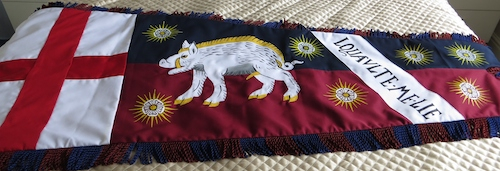
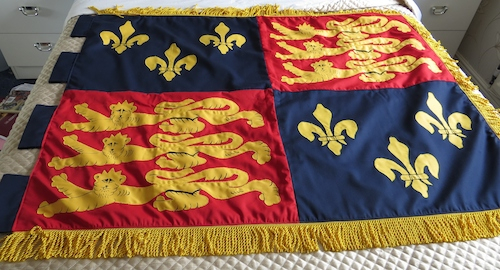
At 3pm on Friday afternoon, many of those at Bosworth in the morning, met again at Leicester Cathedral for a choral Evensong to mark the anniversary of the death of King Richard. Towards the end of the service, Richard Smith and Sally Henshaw, Chairman and Secretary respectively of the Leicestershire Branch of the Society presented the flags, designed by the College of Arms, to the Cathedral. As the presentation was being made, Society Secretary, Dave Wells, read to the congregation whilst his wife Susan, also Secretary, laid white roses:
On this day 529 years ago, Richard, monarch of this realm, yielded his crown, his kingdom and his life in battle at Bosworth Field.
We are gathered now to remember that day, to commend again to God’s keeping both Richard and all who gave up their lives, and to commit ourselves to live peaceably, bound by all due loyalties.
Bequests by the late Margaret York, a Leicestershire teacher, who died in 2011, to both the local branch and the parent Society, together with an additional amount from the Society, funded the flags. Philippa Langley, founder of the Looking for Richard Project, whose campaign led to the discovery of the king’s remains in 2012, suggested the idea of this gift to Leicester Cathedral as the most appropriate utilisation of Margaret’s generosity.
At both services, although the emphasis was the commemoration of King Richard and all who fell at Bosworth, there were prayers for all those who have suffered, and who sadly, continue to suffer through military conflict.
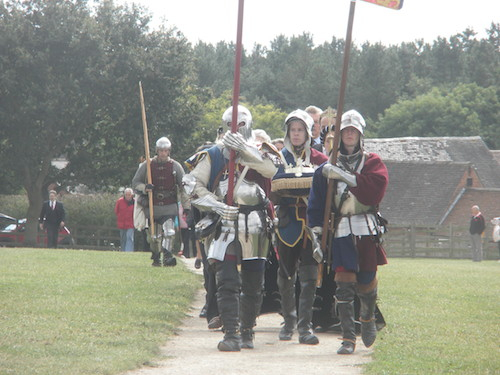
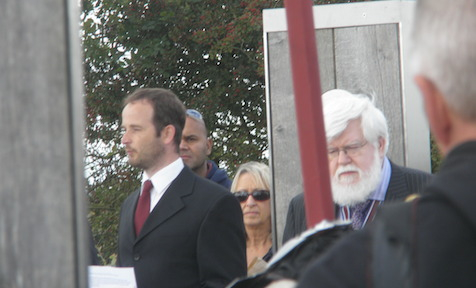
Guard of Honour leading the party to the sundial on Ambion Hill. Centre, carrying the crown, is Dominic Smee, who recently featured in the Channel 4 programme 'Richard III: The New Evidence', and who acted as the king's 'body double'
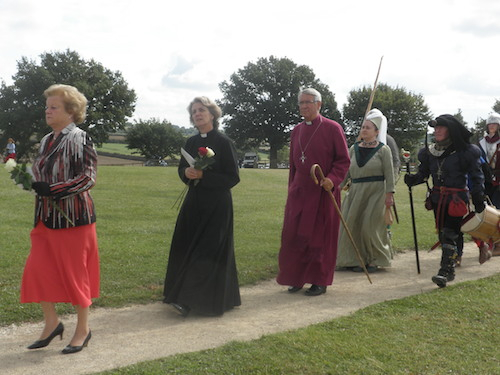
Jennifer, Baroness Gretton, the Lord Lieutenant of Leicestershire, followed by the Revd Julia Hargreaves, Team Vicar of the Bosworth & Sheepy group of churches and the Rt Revd Tim Stevens, Bishop of Leicester.
Richard Knox and Phil Stone at the sundial
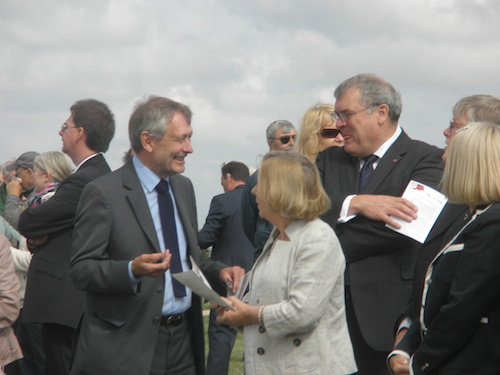
Sir Peter Soulsby, Leicester's City Mayor (left) and archaeologist Richard Buckley (right).
31st October - Reburial of King Richard III
We are pleased to announce that following on-going discussions the final details for the reburial of Richard III have been agreed and a number of our concerns addressed.
These concerns were raised at a meeting with Leicester Cathedral and the reburial management team in late June, In some cases our view did not prevail, but in others we were more successful. In particular we were able to secure the support of the Cathedral Fabric Commission for England on a number of significant issues.
We can confirm that three key matters where we sought clarification have been successfully resolved as a result of our discussions. Firstly, the white rose of York will be engraved onto four tiles on the floor at strategic points around the tomb, Secondly, King Richard’s mortal remains will be laid out in an articulated manner within the lead lining of the coffin. A rosary will also be placed within the coffin. Thirdly, the Roman Catholic Church is to have representation at significant points during the reburial week, including the presence and prayers of Cardinal Vincent Nichols, the Archbishop of Westminster.
The funeral crown commissioned and donated by John Ashdown-Hill will feature during the reburial services. Details here are awaiting final confirmation.
Regrettably, one key issue for us did not reach a satisfactory conclusion. Our request that the king’s remains be placed in their coffin in a place of sanctity was not agreed and we remain unconvinced by the argument that the bones are too fragile to be moved. This will be a disappointment to the many who feel that this would have been the proper ritual for a late-medieval king.
However given that many of our concerns have been addressed we will continue to work in a constructive manner with Leicester Cathedral. We look forward to working with and supporting all those involved with the events of next March to help ensure that King Richard is reinterred with the dignity and honour due to an anointed king of England.
The Looking for Richard Project will be making a separate statement.
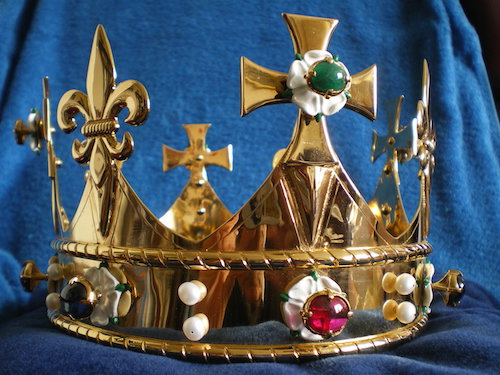
The funeral crown commissioned and donated by John Ashdown-Hill