
Richard’s Family
Elizabeth, Duchess of Suffolk (Sister)
by J L Laynesmith
Elizabeth, Duchess of Suffolk, is probably the least well known of Richard III’s siblings, although her sons are familiar as pretenders (and supporters of pretenders) to Henry VII’s throne. Elizabeth was born in Rouen on 22nd September 1444.* She was the fifth child and second daughter of Richard, Duke of York and Cecily Neville. Elizabeth’s family moved back to England in 1445, after which she probably spent much of her childhood at Fotheringhay and Ludlow.
Marriage
Discussions about Elizabeth’s marriage seem to have begun in February 1457, when she was twelve years old (the legal age at which girls could marry). Her proposed husband was John de la Pole, Duke of Suffolk, who was just two years older than her. John’s father had been a favourite advisor of Henry VI, and the most powerful man in the kingdom, but he had been dramatically disgraced over his policy in France and was lynched on his way into exile in 1450. Many of the grants that had been made to John’s father were resumed back into royal hands, so John was unusually poor for a duke. His mother, Alice Chaucer, was a granddaughter of the poet Geoffrey Chaucer and a close confidante of Queen Margaret. It is surprising that Alice was willing to allow her only son to marry Elizabeth for a comparatively meagre dowry (£1,533): she ought to have been trying to find an heiress who could support John’s ducal status. However, the King and Queen were eager to forge peace with the Duke of York after several turbulent years and it seems this marriage was meant to help achieve that. The wedding probably happened some time before the Loveday Procession in March 1458. That procession was meant to celebrate peace between the combatants at the First Battle of St Albans and their families.
The reconciliation proved shortlived and, as civil war erupted, Elizabeth’s husband initially seems to have avoided taking sides. In the spring of 1461, he decided to support her family and so fought for the Yorkists at St Albans and Towton. Yet he was never a major player in Edward IV’s England. Perhaps his father’s fate had made him wary of high office, but it seems more likely that Edward IV did not think he was sufficiently politically astute. Shortly after Edward became king, he granted Elizabeth and John together the offices of constable of Wallingford Castle and the stewardships of Wallingford and the Chiltern Hundreds.
John de la Pole took possession of his hereditary estates in 1463, but his mother remained an important influence on the couple’s life. She was very often in their company and records survive of the preparations she made for Elizabeth to give birth in splendour at her (Alice’s) home at Ewelme in 1466. Elizabeth and John’s principal home was Wingfield Castle, not far from Diss, in Suffolk.
Motherhood
Elizabeth was the only one of Richard’s sisters to share their mother’s impressive fertility: she had eleven children in total. She also brought into her household two of the daughters of her husband’s illegitimate half-sister, Jane Stonor. The Stonor family’s letter collection gives a few glimpses of Elizabeth’s personality – her eagerness not to spend too long away from her children and her annoyance that the Stonor girls waiting on her were not provided with better clothing by their family. These letters also reveal her often peripatetic lifestyle. The Paston family letters include one written in Elizabeth’s own hand: it is an urgent request to John Paston to let her use one of his homes for a few days until she could find alternative accommodation near the court. Elizabeth’s relationship with the Paston family seems to have been much more supportive than her mother-in-law’s. Nonetheless, when they asked her to persuade her husband that his financial troubles could be alleviated by selling them some property that they believed was rightfully theirs, John resolutely refused.
Political Turmoil
At the time of Henry VI’s readeption, John, Duke of Suffolk cautiously avoided national politics. Elizabeth joined her mother and sisters in secret negotiations to persuade her brother George to abandon the Lancastrians. After Edward arrived back in England in 1471, John supported the Yorkists at Barnet and Tewkesbury. That July, Elizabeth and John were jointly granted the wardship of thirteen year old Francis Lovell. (Lovell had previously been the Earl of Warwick’s ward). Elizabeth may also have been given custody of Henry VI’s queen, Margaret of Anjou, although most historians believe this was granted to Elizabeth’s mother in law.
Together with her husband, Elizabeth attended most of the major ceremonial events of Edward IV’s reign, including Elizabeth Woodville’s coronation where she walked immediately behind the queen (apart from the Duchess of Buckingham who was carrying the queen’s train). At Anne Neville’s coronation, Elizabeth took the same position of honour and probably assisted on both occasions with the ceremonial removal of the queen’s gold circlet and gown. Although their son John was privileged by Richard III and perhaps designated as his heir, there is no indication that this impacted on the status of Elizabeth and her husband.
Her eldest son fought at Bosworth, but her husband did not and he immediately accepted Henry VII as king. In 1487, despite her son John’s recent death at the Battle of Stoke, Elizabeth took a prominent role at the coronation of her niece, Elizabeth of York. The family were, nonetheless, still disgraced so that when her husband died in May 1492 her next son, Edmund, received a much reduced inheritance. Edmund eventually accepted demotion to the status of Earl in return for some of the family’s forfeited lands.
Mother of Pretenders
In 1499, Elizabeth’s son Edmund abandoned the Tudor court, apparently with a view to making his own claim to the throne with support from his aunt Margaret of Burgundy, but this came to nothing. In 1501 he left England again, this time with his brother Richard to seek support for his claim. Henry VII imprisoned their brother William and Elizabeth probably did not see any of them again before her death. She died some time between January 1503 and May 1504 and was buried at Wingfield with her husband.
*This is the date given in the Rouen cathedral register for her baptism as well as in her sister Anne’s Book of Hours. One later list of her family’s birthdates included various errors including the oft repeated claim that she was born on 22nd April. By a curious coincidence her godparents’ eldest daughters were Elizabeth Woodville and Eleanor Talbot – both women later identified as wives of Edward IV. (These godparents were Jacquetta, Duchess of Bedford and John Talbot, Earl of Shrewsbury).
Further Reading
References under Suffolk in The Complete Peerage.
Rachel M Delman, ‘Gendered viewing, childbirth and female authority in the residence of Alice Chaucer, Duchess of Suffolk, at Ewelme, Oxfordshire’, Journal of Medieval History 45:2 (2019)
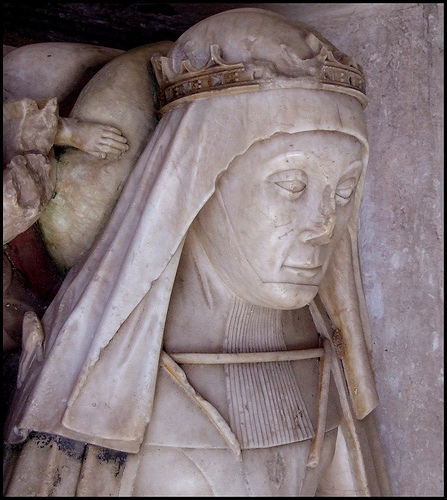
Detail from Elizabeth's tomb
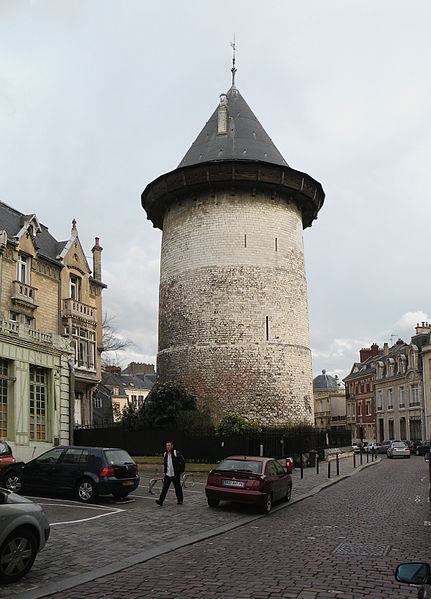
All that remains of Rouen Castle where Elizabeth was born

Rouen Cathedral where Elizabeth was baptised
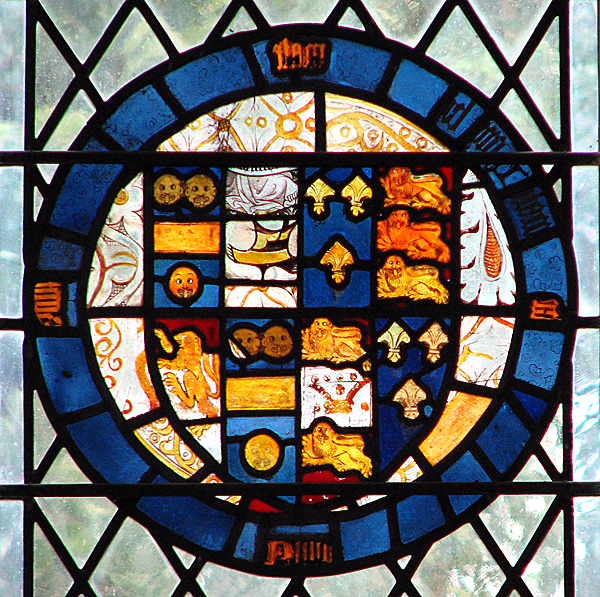
Reconstructed heraldic glass which may include the remains of Elizabeth's coat of arms

Ewelme today
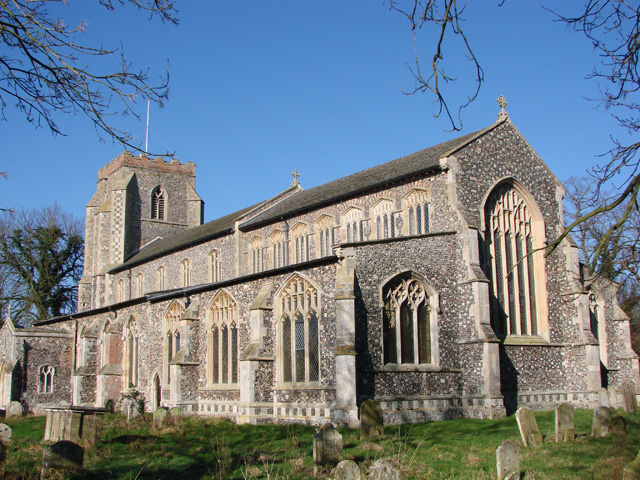
Wingfield Church, where Elizabeth is buried