
His Life & Death
Burial
Ricardian Burial Myths and the Discovery of Richard III's Body
by Dr John Ashdown-Hill
How do you find the body of a medieval monarch? First, you need to know…
…where he was buried!
There are five different fifteenth century accounts of where he had been buried:
- in a ‘little hermitage’ (Mosen Diego de Valera)
- at the Newark (the Frowyk chronicle)
- in the choir of the Friars Minor in Leicester (John Rous)
- in ‘a dyke like a dogge’ (Sir William Burton of York)
- in ‘a village church’ (Jean de Molinet).
But which account – if any – was true?
Although Rous’ account was backed up a few years later by Polydore Vergil’s History, until 2008 it was not certain that Richard was buried at the Leicester Greyfriars. Prominent historians had questioned this, therefore more evidence was needed.
In 2008 I discovered a previously unpublished key sentence in a source at The National Archives. This stated that the royal tomb commissioned for Richard III by Henry VII in 1494 and erected in 1495 was to be set up ‘in the church of Friers in the town of leycestr where the bones of King Richard IIIde reste.’
On this basis I concluded that Richard III’s body certainly lay at the Greyfriars in Leicester by 1494 at the latest.
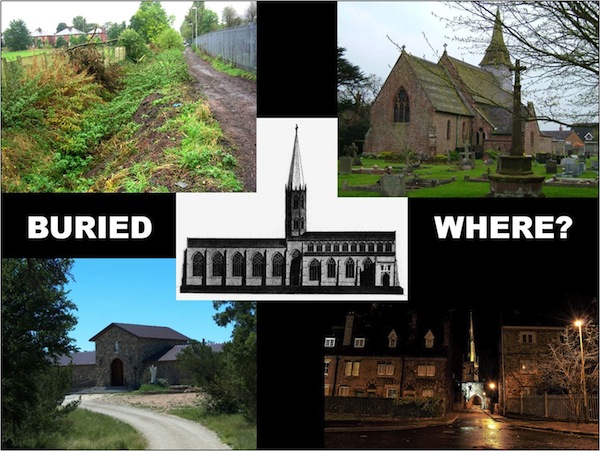

A widely-believed Ricardian story reported that his body had later been moved...
Even on the day the dig started in August 2012, people in Leicester told me ‘You won’t find him – he was dug up in 1538 and thrown into the River Soar’.
Was this story true? Back in 2004, the BBC commissioned me to research it. I discovered
- The earliest written version of the story was by map maker John Speede and only dated from 1611;
- Speede’s version said he could not find any trace of Richard’s grave at the Greyfriars, only ‘weeds and nettles’;
- He then produced a story that the body had been dug up in 1538 and reburied under Bow Bridge;
- Only in the 18th century did this story develop into the better-known and more lurid version in which Richard’s body was thrown into the river;
- Old Bow Bridge was very low. Pictures of it show low arches, all filled with water. It would have been difficult to bury anything under it;
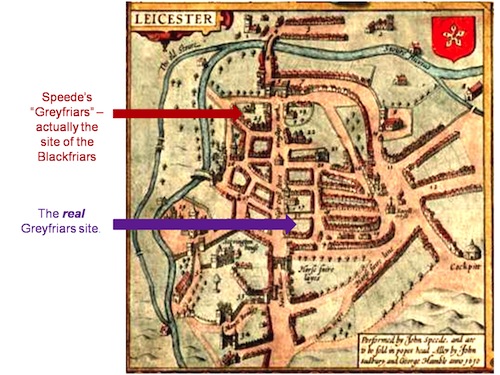
- But the most important point was that Speede’s map of Leicester showed he had looked in the wrong place for Richard’s grave. What he thought was the Greyfriars was really the Blackfriars. Strangely, in 400 years, no-one else had ever noticed this!
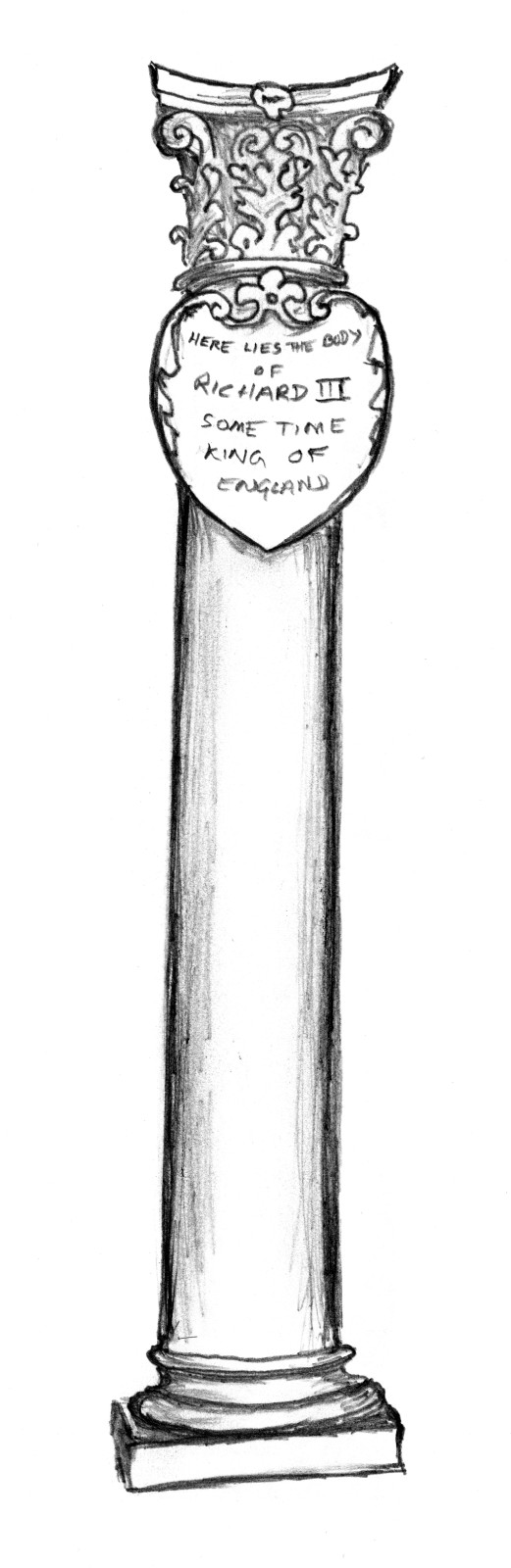
- Thanks to a publication by David Baldwin in 1986, we already knew that if Speede had gone to the right priory site, he would have found a grave marker still existing. A letter written in 1612 records that in Alderman Herrick’s garden – which covered the real grave site – there stood a 3 foot high column inscribed ‘Here lies the body of Richard III, some time King of England’.
I concluded from all this evidence that Richard III’s body had never been moved, and it therefore still lay at the Greyfriars site.
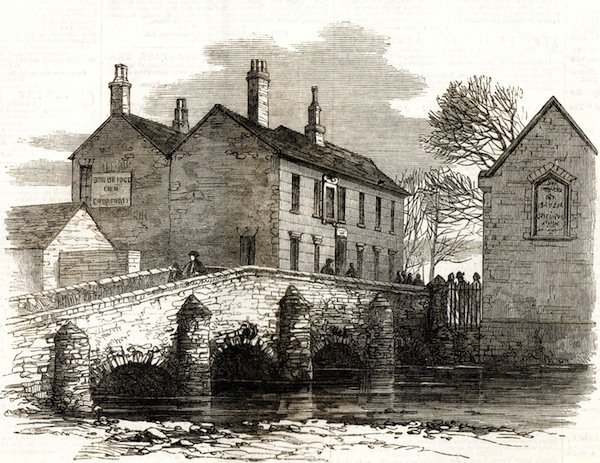
Bow Bridge, Leicester
Where should we look for the lost church and would it be possible to find it?
The Greyfriars site is today covered by three modern car parks and later buildings in some areas. Where should we look for the lost church and would it be possible to find it?
Leicester archaeologists published a reconstruction in 2011, showing the church on the south side of the Greyfriars site.
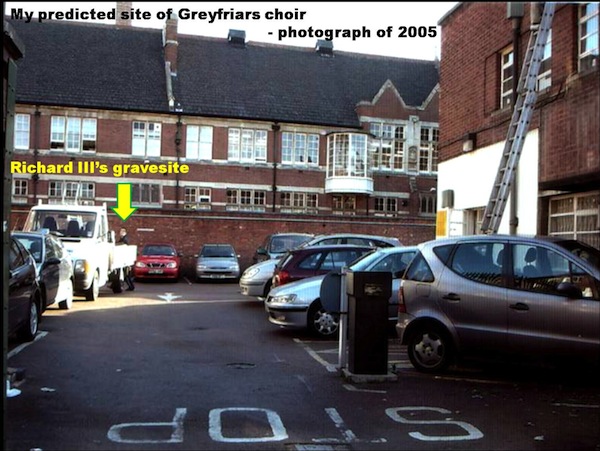
But my knowledge of medieval friaries (which all generally followed very similar plans) told me that this reconstruction must be incorrect. Why? Because it would have made the church inaccessible – located as far as possible from an important medieval road, and right next to the town wall! My conclusion was that the missing Greyfriars church was on the northern side of the site – near a medieval main road (to allow easy public access to the nave). It therefore probably lay under the northern side of the tarmac of the modern Leicester Social Services car park.
Encouraged by Philippa Langley, I had already sent a photograph – in 2005 – of this area in to the television programme ‘Time Team’ as part of a proposal for archaeology at the Greyfriars site. My photograph showed exactly the spot where Richard III’s grave was later found. Sadly ‘Time Team’ decided the chances of finding something within three days were too slim for them to take on the project. As it turns out, in 2012, Richard’s remains were discovered in only one day!
Thankfully, this evidence was the basis upon which Leicester City Council was finally persuaded to agree to the excavation of the Greyfriars site, following which ULAS was commissioned to carry out the dig, and the August 2012 dig confirmed that the answers which I had put forward to all three of the above questions were correct. Together with the excavation results, they showed that Richard III must have been buried directly at the Greyfriars. When found, his body was not coffined, but the skeleton was fully articulated, so it cannot have been moved after the body had started to decay.
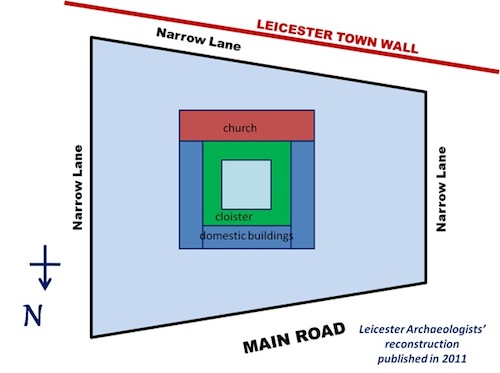
'Incorrect' reconstruction of burial site
When was Richard III buried?
No account survives which gives a date for Richard III’s burial. However, Polydore Vergil suggests that his body arrived in Leicester on the evening of 22nd August and was then put on display for two days before being buried on the third day. This implies that Richard’s body was on display on 23rd and 24th August, and was buried on 25th August. Since 25th August was also the day when Henry VII left Leicester to ride south to London, it seems likely that Richard was buried on this date. Of course, excavation could not confirm such a precise date as carbon dating is not that exact.
How was Richard III buried?
First we are told that Richard’s naked body was brought from the battlefield to Leicester thrown over the back of a horse. Generally this was taken as a sign of Henry VII’s nastiness.
There are various accounts of how Richard was actually buried.
- Vergil and others stated that there was no solemn ceremonial.
- Other accounts suggest that Richard was buried ‘like a dogge’.
But he was buried in a religious house so it is not possible that he was buried with no religious rites. Vergil also suggested that the Franciscan friars asked to bury Richard’s body.
- Richard himself had a Franciscan chaplain and his family had close links with the Franciscan order.
- Also his sister Margaret later chose to be buried in a Franciscan Priory choir in Mechelen (modern Belgium).
- The Leicester Greyfriars priory had a history of being Yorkist in politics.
Therefore it seems probable that the friars did make a request to bury Richard’s body.
The 2012 dig confirmed that Richard’s body was probably naked, and that it had suffered some post mortem ill-treatment. Of course the dig was not able to confirm precisely what religious rites were used at Richard III’s burial, but his body was correctly orientated east/west, with its head to the west, facing the high altar, and the hands were crossed over the pelvic region, so it was clearly a proper Christian burial of the period. It also showed that Richard was buried without a coffin, and in a grave which was slightly too small for him. The grave must have been dug without any opportunity to measure the body beforehand – probably by the friars themselves – before the body was handed over to them.

A 15th century Franciscan Friar
Richard III's Tomb
In August 1485 Richard III’s grave was obviously filled in after his burial, because it lay directly inside the entrance to the choir of the friars’ church. Since the floor of the choir was paved with small coloured tiles, it is unlikely that these were replaced after the burial. Perhaps just a stone slab was laid over the grave.
Nine years later, in 1494, Henry VII decided to commission a royal tomb for Richard. It was to be made of Nottingham alabaster and erected over the grave site (there was no question of a reburial). The tomb was probably set in place in the summer of 1495.
Traditionally, popular accounts of this tomb described it as a cheap memorial, but this was untrue. Full accounts for the cost of the tomb do not survive – but the accounts we do have showed that it cost at least as much as the tomb which Richard’s mother, Cecily Duchess of York, commissioned for herself.
However, alabaster does not weather well when exposed to the elements. Once the church of the dissolved priory became roofless in 1538, the alabaster royal tomb would have started to decay. Later, around the end of the sixteenth century the site was redeveloped by Alderman Herrick of Leicester as his garden. He must have removed any remaining traces of the alabaster tomb and erected his inscribed pillar in its place. No trace of either the Richard III’s alabaster tomb or of Herrick’s pillar was discovered during the 2012 excavation.

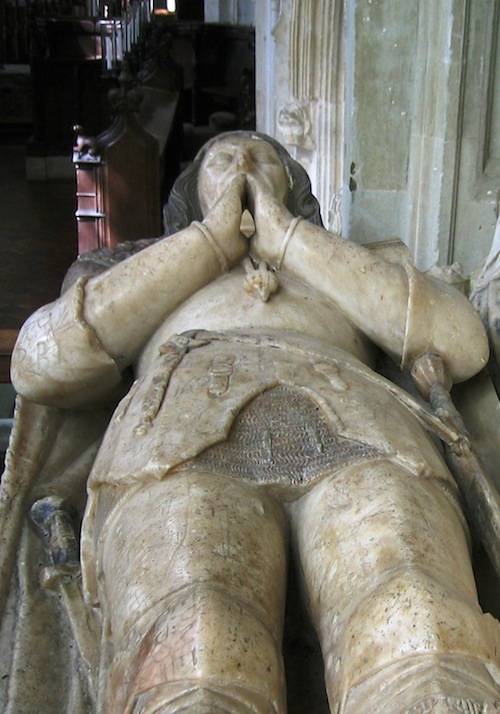
What Richard's tomb might have looked like
Richard III's Epitaph
Texts published in the seventeenth century claimed to be the epitaph from Richard III’s alabaster tomb. The texts were in Latin, but one of the publications included a somewhat inaccurate translation in seventeenth century English. Based on the language of the translation, many historians dismissed the epitaph as a fabrication.
In the course of my research I discovered that manuscript texts of the epitaph survived, one of which dated from before the Dissolution (so it could have been directly copied from Richard’s tomb). The epitaph concentrated on praising Henry VII’s generosity – but it was also fairly polite about Richard III, and acknowledged his bravery. The 2012 dig found no obvious trace of the epitaph. However, brass letters were discovered near Richard’s grave site, which probably came from a late medieval tomb inscription (or inscriptions).
- You can see Dr John Ashdown-Hill’s presentation at the Society’s Leicester Conference held on the 2nd March 2013 below.