
Reputation
A Man of the People: Richard III & the Pursuit of Justice
by Dr David Johnson
Throughout his adult life as Duke of Gloucester and King of England, Richard demonstrated a sincere commitment to justice, charity and mercy across all levels of society, protecting the poor, elderly, dispossessed and powerless. For Richard the impartial administration of the law, regardless of rank, wealth or social standing, was of paramount concern, together with a determination to ensure that the strong did not ride roughshod over the legitimate rights of the weak. Here are just a few examples of Richard’s good works, each drawn from contemporary documents.1
Richard, Duke of Gloucester
During the 1470s and early 1480s Richard’s ducal council acted as a court of requests in the north, providing legal redress for the poor.
Relief of the Oppressed
One such case involved the plight of an insignificant husbandman, John Randson, who complained to the Duke in August 1480 that Sir Robert Claxton, a prominent member of the Durham gentry, was preventing him working his land. Once Richard had determined Randson was in the right, he summoned Claxton to appear before his ducal council at Durham, where he personally ensured that justice was served and the issue settled in the husbandman’s favour.2
Impartial Administration of Justice
The same concern for justice was evident in April 1482 when Duke Richard sent his treasurer’s servant, Thomas Redhead, to the mayor of York to be tried and punished for a fracas with Roland Pudsey, a citizen of the city. Contemporaries would have expected a man of Richard’s status to obstruct justice and take his servant’s side, but as the offence was committed in York, Richard handed Redhead to the appropriate authority, This was ‘a public demonstration of a desire to see justice done impartially to all.’3
Mercy on the Field of Conflict
In the summer of 1482 Richard led a successful invasion of Scotland at the head of a 20,000 strong English army. As well as capturing the strategic border fortress of Berwick Castle, Richard also marched to Edinburgh where he peacefully occupied the Scottish capital. Edward IV immediately wrote to Pope Sixtus IV describing how ‘The noble band of victors spared the supplicant and prostrate citizens, the churches, and not only the widows orphans, and minors, but all persons found there unarmed’. Edward concluded by reminding the Pope that ‘the English, who, had not their compassion exceeded all human cupidity, would have instantly doomed the same to plunder and the flames’. Thus Richard brought to the field of human conflict the very same principles of mercy and justice.4
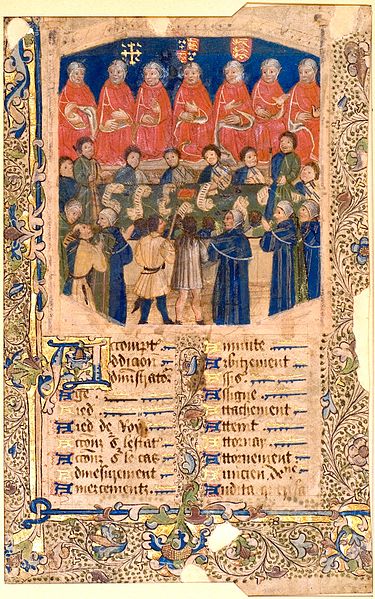
An illustrated manuscript of the Court of Common Pleas in session. Unknown author. Image in public domain, via Wikimedia Commons.
Protector and Defender of the Realm
Following the death of Edward IV in April 1483, Duke Richard became Protector and Defender of the Realm during the minority of the under-age heir, the twelve-year-old Edward V. Although government business was nominally conducted in the name of the young king, it was in fact the Duke who took control of affairs.
Care of the Mentally Ill
One example of Richard’s influence as protector concerned Isabel and Petronilla Bartlett, daughters of Thomas Bartlett deceased, and heirs of William Bartlett. Because the sisters were ‘not in possession of their mental faculties’ their inherited lands and possessions fell by royal prerogative to the crown. But on 20th May 1483 Edward V (that is Richard acting as protector) granted Isabel and Petronilla’s inheritance to Lord John Audley to be used for ‘their support for the term of their lives.’ Thus the two disadvantaged heiresses, despite their mental incapacity, were not denied what was rightfully theirs.5
King Richard III
When the sons of Edward IV were found to be illegitimate and unable to succeed to the throne, Richard, as next in line, was crowned at Westminster Abbey on Sunday 6th July 1483.
Charity for the Poor
The new king, upholding the strictures of the coronation oath, continued to provide the poor with justice and mercy. In September 1483, during Richard’s royal progress to the north, the King gave 3s 4d (£115 today) to an impoverished woman of Doncaster found begging at the road side.6
Provision for the Innocent
In December 1483, following the collapse of the autumn rebellion, Richard granted to Florence Cheney, wife of the rebel and traitor Alexander Cheney, possession of her husband’s forfeited lands. Thus Florence, by reason of her ‘good and virtuous disposition’, was taken into royal protection and thereby spared the repercussions of her husband’s treason.7
Care of the Aged and Widowed
In October 1483 Richard granted to Thomas Wandesford, a former servant of Richard’s father the Duke of York, an annuity of 60s 10d ‘towards his relief and sustenance now in his old and unwieldy age.’8 Similarly, in April 1484, Richard granted the tenancy of ‘the almshouse beside our town of Sittingbourne in Kent’ to one Arnold Childre, free of charge, for the duration of his life. And two months later at York, Richard granted Agnes Cowper, widow, an annual rent of 40s to be paid in two equal instalments at Michaelmas and Easter for the rest of her life.9
Legal Protection for Women
In September 1484 and March 1485 Richard personally intervened in the case of ‘our poor subject’ Katherine Bassingbourne, ordering the mayor of York to subject her ‘grievous complaint’ concerning her stepmother’s denial of her inheritance under the terms of her late father’s will to ‘the administration of justice whereunto we be professed.’10 And in June 1485 Richard took into his protection Agnes Parys and Avice Parys, respectively widow and daughter of John Parys deceased, granting them the customary freedom ‘to marry at their pleasure by the advice of their friends and kinsmen.’11
A Man of the People
By these and many other examples Richard III devoted himself to the pursuit of justice and the defence of the poor and the disadvantaged. His detractors have attempted to discredit these benevolent acts as a cynical ploy designed to buy popularity. However, such arguments do not stand the test of close scrutiny. Had Richard wished to buy political support at any price he would have devoted time and resources cultivating exclusively the rich and powerful, not assisting the lowly, the weak, and the underprivileged.
Contemporary proof of Richard’s good intentions is provided by Thomas Langton, Bishop of St David’s, who accompanied the King on his royal progress in the late summer of 1483. From York, Langton wrote a private letter to a friend describing Richard’s conduct on the progress and his manifest concern for justice:
‘He contents the people wherever he goes better than ever did any prince, for many a poor man that has suffered wrong many days has been relieved and helped by him…God hath sent him to us for the welfare of us all.’12

King Richard III
References
1. For an informed discussion of Richard’s pursuit of justice see A F Sutton, ‘A Curious Searcher for our Weal Public’: Richard III Piety, Chivalry and the Concept of the ‘Good Prince’, in P W Hammond (ed), Richard III Loyalty Lordship and Law (1986), pp 58-90; P M Kendall, Richard III (1955), pp 307-310.
2. A J Pollard, North-Eastern England during the Wars of the Roses (1990), pp 335-336.
3. L C Attreed, York House Books, 1461-1490 (1991), vol i,p 255; Pollard, North Eastern England, p 335.
4. Edward IV to Pope Sixtus IV, 25 August 1482, Calendar of State Papers Venice, vol i, 1202-1509 (1864).
5. R Horrox and P W Hammond (eds) British Library Harleian Manuscript 433, vol 1, p 21.
6. Harley 433, vol ii, p 25.
7. Harley 433, vol ii, p 43.
8. Harley 433, vol ii, p 29.
9. Harley 433, vol ii, pp 128 & 144.
10. York House Books, vol i, p 336.
11. Harley 433, vol ii, p 227.
12. J B Sheppard (ed), ‘Christ Church Letters: A Volume of Medieval Letters Relating to the Affairs of the Priory of Christ Church Canterbury’, Camden Society (1877), p 46.