
His Life & Death
As a great magnate
by Dr. Livia Visser-Fuchs
In his twenties Richard of Gloucester himself recorded that he had been ‘nakedly born into this wretched world, destitute of all possessions, goods and inheritance and that it had been God’s ‘infinite goodness’ that had granted him his ‘great possessions and gifts’. This claim was only party rhetorical, for he was born the fourth surviving son of his parents and had no grand titles to look forward to. It is, in fact, possible that he was destined for the church, and no one could have predicted that he would die king of England. It was only when his brother Edward took the throne and recalled his younger brothers, George and Richard, from exile in the Low Countries that Richard’s fortune changed dramatically: on 1st November 1461 he was created Duke of Gloucester and shortly after elected a Knight of the Garter.
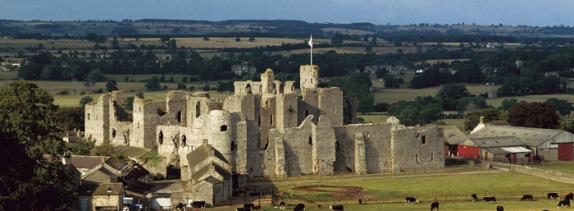
Middleham by Graham Turner. Reproduced by kind permission of the artist, www.studio88.co.uk
The Fruits of Loyalty
In the next eight years, up to the crisis of 1469-71, Edward IV granted his younger brother a number of lands forfeited by his opponents, but he was much more generous towards his elder brother George of Clarence, who was until 1466 the heir presumptive. The lands granted to Richard during these years were mostly returned to their former owners in due time, or even given to Clarence. However, Richard was made Admiral of England, Ireland and Aquitaine on 2nd October 1462, an office he retained until he became king. In 1469-71, and especially after Edward’s successful regaining of his crown, Clarence’s treason and Richard’s conspicuous loyalty meant that the latter’s star really began to rise. On 17th October 1469 Richard was created Constable of England and on 7th November Chief Justice of North Wales, receiving important offices in South Wales at the same time. To this was added. on 18th May 1471, Great Chamberlain of England and on 4th July Chief Steward of the Duchy of Lancaster in the north, offices formerly held by Warwick.

Signature with motto of King Richard, Redrawn by Piat Design
Powerbase in the North
Richard also obtained Warwick lands, among them the lordships of Middleham, Sheriff Hutton and Penrith; he was re-instated as Warden of the West March and made Keeper of the Royal Forests, north of Trent. He regained the forfeited lands of the De Vere earls of Oxford which he lost before. All these and many other grants, culminating in his being made a hereditary lord palatine of the counties of Cumberland and Westmoreland – together with any parts of south-west Scotland that he might conquer (!) – set Richard up as the most influential man in the North. After Clarence’s death in 1478, which finally resolved the running battle between the king’s brothers for the vast Warwick inheritance, Richard became a greater landowner than any brother of a king of England had ever been.
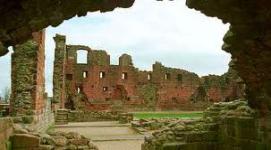
Penrith Castle obtained by Richard as part of the Warwick Inheritance
Influence Elsewhere
Richard’s ‘lordship of the North’, his paramount authority in that area in particular, meant that he more or less relinquished other possible power bases, such as East Anglia and Wales. His influence in those regions was fragmented and based on his position as the king’s brother, his role as that of a ‘national’ rather than a ‘local’ figure. In the North he had been accepted as the heir of the Nevilles, he was familiar with the area since childhood and the patronage he could dispense was immense. His position in the North enabled him, and perhaps forced him, to take the throne itself when his brother’s death left it virtually vacant and also deprived him of the support vital to maintaining his existing position.

Warwick the Kingmaker and his wife. Based on Rous Roll ©Geoffrey Wheeler
Acquisition of Lands
How did Richard obtain all this power and influence? Much has been written about the ruthlessness he displayed in disinheriting aged widows – seen as a premonition of his taking of the throne in 1483 – and there is no doubt that his methods were not always strictly legal or even gentle. The collection of documents, now BL MS Cotton Julius B xii, relating to his ownership of lands and offices, past and present, actual and potential, has been adduced as evidence of his unusual energy in acquiring what he wanted and of his ‘long memory’ as far as consolidating his estates was concerned. It can be said in his defence that there was nothing unusual about his activities: what was unusual was his position as the king’s (loyal) brother, which gave him better opportunities, including getting the best legal minds available, to still the ‘land hunger’ that all his peers suffered from.
The Use of Power
More important perhaps is the question: what did Richard do with his wealth and power? How did he use them, apart from appropriately maintaining his own status and that of his household? To take two examples: his use of some of the Oxford lands and his patronage in the North. In 1471 Richard had been granted, for the second time, the forfeited estates of John de Vere 13th Earl of Oxford, but in 1473, John’s mother Elizabeth Howard, under instructions from Edward IV, also conveyed the lands she possessed in her own right, and which were not legally forfeit, to Richard, who promised to pay her a substantial annuity and promote the career of her son Richard, a student at Cambridge. Of these lands the manor of Fowlmere in Cambridgeshire was granted to Queen’s College, Cambridge; six manors were used to endow Middleham College, and three for St George’s Chapel, Windsor. Whatever the manner of their acquisition, at least the income of these lands was put to a more general and commendable use.

Queen's College Cambridge which received the manor of Fowlmere from Richard
The Council of the North
The North, especially the north-east and the city of York itself, looked for and successfully obtained the ‘good lordship’ of the powerful Duke of Gloucester. The citizens of York were consistently supported by him in their plans for economic development and this benefitted the whole region; details of his welcome intervention survive. He was also concerned to improve the administration of local justice and, whatever his ulterior motives, he displayed a clear desire to have justice done impartially. Most famous is his establishment, when he was king, of the Council of the North, which created a precedent of ‘impersonal’ control not dependent on an over-mighty local magnate – such as he himself had been – that later kings were to follow.
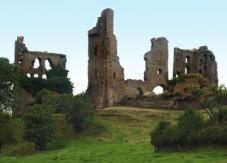
Sheriff Hutton became the HQ of the Council when Richard became King
Sources
- Michael Hicks, ‘Richard III as Duke of Gloucester: a study in character’, Richard III and His Rivals, London 1991
- Rosemary Horrox, Richard III: A Study in Service, Cambridge 1989, ch. 1, ‘The creation of an affinity’
- A. J. Pollard, North-Eastern England during the Wars of the Roses, Oxford 1990, ch. 13, ‘The hegemony of Richard of Gloucester, 1471-1483
- Charles Ross, Richard III, London 1981, pt. 1, ‘The Duke of Gloucester’
- Anne F. Sutton, ‘Richard of Gloucester and his East Anglian Lands’, and
- Anne F. Sutton and Livia Visser-Fuchs, ‘As dear to him as the Trojans were to Hector’; Richard III and the University of Cambridge’, both in Richard III and East Anglia. Proceedings of the 8th Triennial Conference of the Richard III Society held at Queen’s College, Cambridge, 15th-17th April 2005.