Reputation
A Difficult Birth?
by Dr Joanna Laynesmith
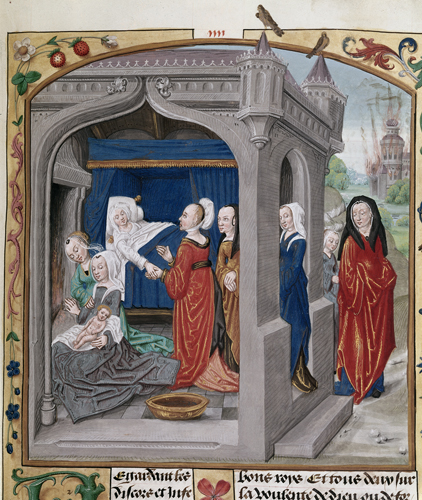
It is commonly asserted that Richard’s was a difficult birth, yet the evidence for this is highly dubious. The first suggestion occurs in the work of the Warwickshire antiquary John Rous who famously wrote a glowing report of Richard during the king’s lifetime and then a vitriolic attack shortly after Richard’s death. According to Rous, Richard remained in the womb for two years, emerging with teeth and hair to his shoulders. This was clearly nonsense.
Thomas More reported something similar: ‘It is for truth reported that the duchess his mother had as much ado in her travail, that she could not be delivered of him uncut: and that he came into the world with the feet forward…and (as the fame runneth) also not untoothed’. With an unusual degree of scepticism for More, he acknowledged that the report may have been the product of men’s ‘hatred’. More connected this troubled birth with the idea that ‘nature changed her course in his beginning, which in the course of his life many things unnaturally committed.’ This strongly suggests that More was right to suggest that it was mere malicious propaganda.
In the middle ages it was not permitted to cut a child from their mother’s womb unless the mother was already dead because Caesarian section was expected to be fatal. It is not wholly impossible that the ‘cut’ actually referred to an episiotomy but there is scant evidence for this practice in the middle ages. Advice to midwives was usually restricted to sewing up tears, although there seems to be a possibility in one case that an author recommended using the midwife’s fingernail to cut a larger space. The tenor of More’s description seems to suggest something rather more serious and it was very likely More’s knowledge of Cecily’s longevity that caused him to doubt the story. Nonetheless, Shakespeare of course picked up on the idea that Richard was born feet forward.
Most historians discounted the story. Nonetheless, a parallel tale that Richard was weak as a child seemed to reinforce the idea. That story is without foundation. It derives solely from a poem in the Clare Roll listing all of the children in Richard’s family. The relevant passage runs:
John after William next born was,
Which both be passed to God’s grace;
George was next, and after Thomas
Born was, which soon after did pace
By the path of death, into the heavenly place;
Richard liveth yet; but the last of all
Was Ursula, to him who God list call.
The phrase ‘Richard liveth yet’ was taken out of context to suggest that it was feared he might not continue to live. In context it clearly means only that he was alive while four of his siblings were not.
In 1987, Carole Rawcliffe published one of Cecily’s letters, written to Margaret of Anjou in the summer of 1453, in which Cecily referred to ‘encomerous labour, to me full painful and uneasy’ that was connected with her inability to meet the queen at that tine. Rawcliffe speculated that Cecily had taken some time to recover from the ‘ordeal’ of Richard’s birth the previous year. This also seemed to reinforce the earlier stories of a difficult birth. However, Cecily mentioned meeting Margaret earlier in 1453, She explained that ‘since my being in your high presence’, ‘disease and infirmity (is) not hid upon my wretched body’. It is unlikely that sickness that developed between the spring and summer of 1453 could be attributed to a birth the previous October. In fact, Cecily seems to be saying that it was actually the journey she made to visit Margaret that was a painful ‘labour’ and had prompted her sickness, aggravated by her anxiety about her husband’s political position. We cannot discount the possibility that the reason the journey was difficult was that she had not recovered from Richard’s birth, but that is not what the letter says.
In conclusion, the only accounts of Richard’s difficult birth were produced by men explicitly trying to depict Richard as monstrous and most of the difficulties they describe are impossible.