
News Archive
News Archive 2013
4th February - King Richard III's Remains are Confirmed as Found
At an historic press conference on the morning of 4th February, the University of Leicester revealed evidence from the Greyfriars dig and confirmed that the human remains of King Richard III had been positively identified. They revealed a range of supporting evidence, including DNA analysis, radiocarbon dating and skeletal examination – proving the identity of the skeleton. Key points are:
- DNA from skeleton matches two of Richard III’s maternal line relatives. Leicester genealogist verifies living relatives of Richard III’s family.
- Individual likely to have been killed by one of two fatal injuries to the skull – one possibly from a sword and one possibly from a halberd.
- Ten wounds discovered on skeleton – Richard III killed by trauma to the back of the head, Part of the skull sliced off.
- Radiocarbon dating reveals individual had a high protein diet – including significant amounts of seafood – meaning he was likely to be of high status.
- Radiocarbon dating reveals individual died in the second half of the 15th or in the early 16th century – consistent with Richard’s death in 1485.
- Skeleton reveals severe scoliosis – onset believed to have occurred at the time of puberty.
- Although around 5ft 8in tall (1.72 metres), condition meant King Richard would have stood significantly shorter and his right shoulder may have been higher than the left.
- Feet were truncated at an unknown point in the past, but a significant time after the burial.
- Corpse was subjected to ‘humiliation injuries’ – including a sword through the right buttock.
- Individual had unusually slender, almost feminine build for a man – in keeping with contemporaneous accounts.
- No evidence for ‘withered arm’ – as portrayed by Shakespeare – found.
- Possibility that the individual’s hands were tied.
- Grave was hastily dug, was not big enough and there was no shroud or coffin.
Richard Buckley, the lead archaeologist for the Search for Richard III project said: ‘It is the academic conclusion of the University of Leicester that the individual exhumed at The Greyfriars in August 2012 is indeed King Richard III, the last Plantagenet King of England.’
For more information visit the University’s website.
4th February Press Release.
5th February - 528 Years After His Death, Face of Richard III is Unveiled
The Richard III Society today unveiled the world’s only facial reconstruction of the human remains found at the Greyfriars in Leicester, yesterday confirmed as belonging to Richard III. The reconstruction project, led by Professor Caroline Wilkinson, Professor of Craniofacial Identification at the University of Dundee, was commissioned and funded by the Richard III Society.
To those who have seen so many portrayals of Richard III with contorted body and facial features, this calm and apparently thoughtful face could be a shock. After his death, many portraits deliberately added narrowed eyes and mean lines. We have already discovered that he had no kyphosis or withered arm – now we know he had a warm face, young, earnest and rather serious. How many scales will drop from how many eyes! This likeness is so real, it is a remarkable tribute to Professor Wilkinson and her reconstruction team. Congratulations and thanks are in order, but these words somehow don’t seem adequate to recognise such art, skill and loving craftsmanship.
Dr Phil Stone, Richard III Society Chairman, said: ‘It’s an interesting face, younger and fuller than we have been used to seeing, less careworn, and with the hint of a smile. When I first saw it, I thought there was enough of the portraits about it for it to be King Richard but not enough to suggest they have been copied. I think people will like it. He’s a man who lived. Indeed, when I looked him in the eye, ‘Good King Richard’ seemed alive and about to speak. At last, it seems, we have the true image if Richard III – is this the face that launched a thousand myths?’
5th February Press Release

© Getty

© Getty
6th February - Prime Minister's Questions
At Prime Minister’s Question Time Michael McCann MP asked David Cameron if he could confirm that Atos, the private contractor used by the government to assess whether people claiming benefits are eligible for a job, had declared Richard III fit for work. The House laughed and the Prime Minister replied that the case had not come his way.
Despite his passing 528 years ago this is not the first time King Richard has been mentioned in the British Parliament. In November 1980 the Broadcasting Bill became law; it had originally contained a clause that allowed for complaints to be made on behalf of those who were already dead, on unfair treatment in TV and radio.
As the Bill was debated in the House of Lords, it became clear that the clause was in conflict with the laws of libel that do not permit such action to be taken on behalf of the dead. The example of adherents of Richard III objecting to his characterisation by William Shakespeare in his much performed play was quickly established.
As a result an amendment was tabled by the government which stipulated that such complaints, on behalf of the deceased person, could only be made within five years of their death. The Chairman of the British Broadcasting Corporation, shortly after the bill had received royal assent, referred to the amendment as the Richard III clause.
8th February - Richard III will be Reinterred in Leicester Cathedral
At the opening of Leicester City Council’s new exhibition in the Guildhall, Richard III: Leicester’s Search for a King on the evening of 7th February, Sir Robert Burgess, Vice Chancellor of the University of Leicester and the Right Reverend Tim Stevens, Bishop of Leicester, confirmed that King Richard III would be reinterred in Leicester Cathedral.
Sir Robert quoted from a letter he had just received from the Ministry of Justice confirming the terms of the Exhumation Licence which had stipulated that the remains, if proved to be King Richard’s, should be reinterred in Leicester Cathedral. They also confirmed that their role was limited to ensuring the correct procedures were followed with regard to burials. Sir Robert confirmed that it was the wish of the University that Richard III be reinterred in Leicester Cathedral.
The Bishop spoke of a message he had received from York Minster which confirmed the Dean and Chapter supported the terms of the Ministry of Justice Licence and accordingly they commend ‘Richard to Leicester’s care and to the Cathedral community’s prayers.’
In respect of the nature f the service, the Bishop acknowledged the changes in the church in the 16th century, but confirmed that the form of service would follow that of the established church, however he was in consultation with the Roman Catholic Church through the Bishop of Nottingham who was willing to take part in the service. Bishop Stevens also spoke of his intention to work with the Richard III Society with regard to an appropriate memorial for King Richard. Finally he indicated the timing of the ceremony would be in the spring of 2014.
The choice of Leicester Cathedral will disappoint some and that is understandable. However it is important that the burial of King Richard III is not surrounded by controversy, his posthumous reputation has had more than enough of that over the past five hundred years. We should all be grateful that his remains have been found and are now to receive the honour and dignity that is due to an anointed English King. We might also take comfort from the fact that King Richard will now lie in peace and honour in the very heart of his kingdom, almost equidistant between York and Westminster.
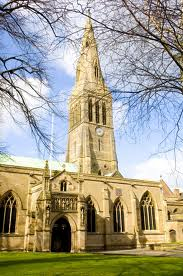
Leicester Cathedral
13th February - Society Unveils Designs for Proposed Tomb of King Richard III
Following confirmation that the human remains of King Richard III are to be reinterred in Leicester, the Richard III Society today reveals plans for how it would like his tomb to look.
The tomb design was commissioned by Philippa Langley in September 2010 at the very beginning of the Looking for Richard III Project. It is based on Richard’s life, and what was important and meaningful to him, and the design was undertaken by a team of specialists with over 40 years of research into Richard III.
The Richard III Society is working in partnership with Philippa Langley, the Originator of the search for King Richard III, together with Sally Henshaw (secretary) and Richard Smith (chairman) of the East Midlands Branch, under the leadership of the Society’s Chairman Dr Phil Stone.
The objective of the proposed tomb is to honour the king’s mortal remains with a memorial in keeping with the Cathedral’s interior space and ambience, while reflecting medieval royal tomb designs.
The proposal includes the following:
- The royal tomb will be sited inside the Cathedral in a light and bright area suited to the Cathedral’s revised design and layout, such that it will not impact on services nor will pedestrian flow be impeded through the Cathedral and around the tomb itself.
- The tomb’s structure has been designed with local input to ensure its appropriateness and historical accuracy.
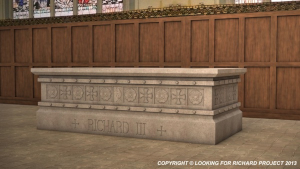
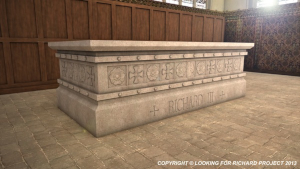
- The full cost of the rectangular tomb, which is to be 7ft long, 3ft 6in wide and 2ft 3in high and executed in a light honey-coloured stone (Magnesian Limestone is proposed), will be funded by the Society via an appeal for donations (65% of the cost has already been donated).
- The tomb is a gift to the people of Leicester and as a tribute to them following the earlier gifts by the Society of the Richard III Statue in Castle Gardens (1980), the memorial stone in the Cathedral (1982), and Richard’s standard and banner, proposed to hang above the tomb (2013).
Leicester Cathedral have issued a press release.

Richard III's tomb - proposed design
15th February - A Tomb for Richard III, A Magnificent Project
How you can donate to the project
Now that Richard III has been found and his remains identified, the Society would like to see him reinterred with honour in a tomb befitting his noble status.
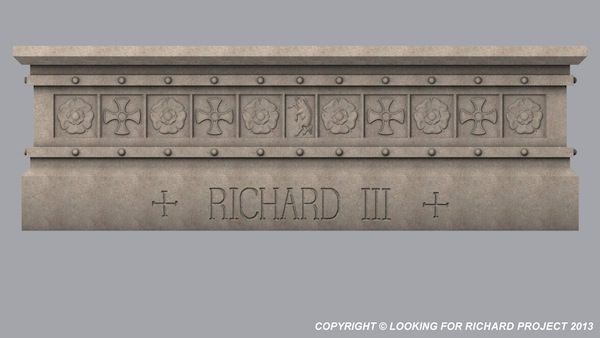
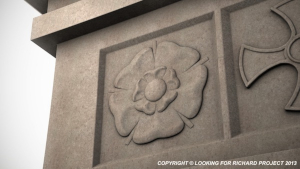
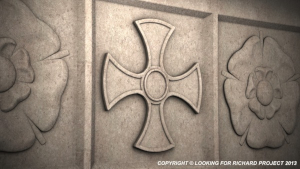
The design commissioned for the Society is for a free-standing table tomb and features Richard’s boar, the white rose for the House of York and the cross of St Cuthbert this being a symbol of Richard’s piety.
If built, the tomb will be made in a pale honey-coloured stone, the colour representing Richard’s emergence from the obscurity of the unknown grave into the light of recognition and honour.
If you would like to make a donation towards the cost of the tomb and its installation, there are a number of ways to do so:
- Send your cheque, made payable to ‘The Richard III Society’ and marked ‘Richard III tomb’ on the back to the Society’s Chairman: Dr Phil Stone, 181 Rock Avenue, Gillingham, Kent ME7 5PY.
- Alternatively, please use the Society’s PayPal account and put ‘for Richard III’s tomb’ in the comment column. The Society’s PayPal account email is: ricardianfunds@yahoo.co.uk
- If you wish to make a direct bank transfer, please contact the Society’s Chairman or details.
Thank you.

Boar Crest on the proposed tomb
27th February - What are 'Ancestors' and 'Descendants'?
Since the discovery of Richard III’s remains there has been some rather odd use in the press and elsewhere of the words ‘ancestor’ and ‘descendant’, which indicate family relationships over what is usually a long time gap.
Ancestor
There are no living ancestors of Richard III – despite claims which have been made to this effect! An ancestor is someone further back in the family tree (parents, grandparents, great-grandparents and so on backwards) of the person named.
Descendant
As far as we know there are no living descendants of Richard III.
A descendant is a child, grandchild, great-grandchild, and so on forwards in a direct line from the person named.
Richard III had only three recognised children, all of whom died childless.
There are many living collateral descendants of Richard III.
A collateral descendant is the descendant of a brother or sister of the person named.
28th February - The proposed tomb for King Richard III
Introduction
The design of a new tomb for King Richard III presents a number of interesting yet problematic challenges. Firstly, we are confronted by the inescapable fact that this will be the second time Richard has been buried, and that the two occasions are separated by more than five hundred years. So how can we produce a design that reconciles the funerary requirements of a fifteenth century English monarch with reburial in the twenty first century? How can we bridge the gap of half a millennium in a single monument that encapsulates both the distant past and the present day? And secondly, to what extent are the tombs of medieval kings – strictly contemporary with the deaths of their respective monarchs – an appropriate precedent for the modern reburial of King Richard?
We have to accept that had Richard had any control over his own funeral he would almost certainly have been commemorated with a substantial tomb chest surmounted by a recumbent effigy in the robes and regalia of state. But as we are all painfully aware, Richard’s burial was placed in the hands of monks who were probably acting under duress, compelled to dispose of the king as quickly as possible once it had been decided that the corpse had been displayed for long enough. The treatment meted out to Richard in 1485 fully justifies the recovery and honourable reburial of his remains.
Thus a dark past suddenly becomes a much brighter future. Richard is rescued from the darkness of his original resting place and reburied in the light of Leicester Cathedral Of course Richard was initially interred in consecrated ground, but the dissolution of the monasteries, followed by the redevelopment and reuse of the former Greyfriars site, means that since the mid sixteenth century the spiritual environment in which Richard was laid to rest has been totally destroyed. A grave beneath a local authority car park sharing contaminated ground with the leaking foundations of a Victorian toilet is no place for anyone – let alone an anointed king.
Consequently Richard’s spiritual and physical transition from darkness to light is an important consideration in the design of a new tomb. The first challenge surrounded the material in which the tomb would be constructed, for it had to symbolise this dark to light transformation. But it was also felt that the chosen material should reflect something of Richard’s personal history.
It was therefore decided that the new tomb should be constructed of Magnesian Limestone, not only because its smooth, bright, honey-coloured appearance enshrines the light and optimism of Richard’s future, but also because it is the stone in which York Minster is built, and is still used to this very day for repairs, maintenance, and rebuilding. Thus Magnesian Limestone represents Richard’s journey from darkness to light and also his important connections with Yorkshire and the City of York.
Having selected an appropriate building material the next challenge was to create a design that incorporated both the medieval past and the present day, something that would acknowledge Richard’s life as a fifteenth century nobleman and king without imprisoning him in a medieval style tomb in the twenty-first century. Thus, as the detailed description presented below will make clear, the design incorporates features representing Richard’s family (White Rose of the House of York), Richard’s devotion to the Christian faith (Cross of St Cuthbert), and Richard’s personal emblem (White Boar). These personally significant motifs are depicted in medieval style; decorating the sides and end of the monument, and creating the impression of a fifteenth century tomb in both feel and appearance.
However, a more modern aspect has been attempted with the upper surface of the monument; for it is here that the design departs radically from what one might expect of a royal medieval tomb. Instead of a recumbent effigy the design presents a smooth open plane of bright honey-coloured stone, punctuated by a royal coat of arms inlaid in gold metal at the head, and a gold metal plaque and carved motto at the foot. The resulting effect is one of harmonious and peaceful repose, a symbol of kingship in the form of a royal coat of arms, and a representation of Richard himself in his personal inscribed motto. In addition the gold metal plaque serves to bridge the gap between the king and the man by including Richard’s full name and his title as Duke of Gloucester, thereby telling the story of a human being, and nor merely recording the final resting place of one who later in life became Richard III.
What we have tried to achieve is a tomb that firstly encapsulates Richard’s physical and spiritual elevation to a brighter and more optimistic future, and secondly emphasises that the remains which will lie beneath if are those of a man who lived a different life before becoming king. This, of course, is not to disparage Richard’s kingship or his right and title to that high office ordained by God. It is merely to state that he was also a heart-broken son, a loyal brother, a loving husband, and a devoted father. He as a family man who found his true place in life as a duke in the north of England, before being compelled to abandon all that made him happy in the constitutional crisis of 1483 and subsequent acceptance of the crown.
I hope that we have made clear that the design of this tomb has set itself a demanding agenda. The result is a sincere and deeply genuine attempt to commemorate a man who finally has a chance to truly Rest in Peace.
The Tomb in Detail
The relative simplicity of the design is intended to reflect important surviving evidence concerning King Richard’s personal religious preferences.
Richard’s Book of Hours, dated to the 1420s, may have been sixty years old by the time it came into his possession (A F Sutton and L Visser-Fuchs, The Hours of Richard III, p. 39). As a reigning monarch Richard could have commissioned the finest artists in Europe to illustrate a new and magnificent Book of Hours, yet he chose to use a second hand volume lacking the lavish illuminations known to have been in circulation at the courts of France and Burgundy.
As an example of the king’s private and personal piety, this relatively modest and understated book can reasonably be assumed to reflect the king’s wider religious tastes.
The proposed tomb is therefore similarly modest in scale and decoration, consisting of a plinth supporting a chest surmounted by a rectangular slab (length 7ft, width 3ft 6ins, height 2ft 3ins). The original design has been extended by the addition of a plinth following concerns over the low height of the tomb chest. The intention has always been to permit an easy appreciation of the upper surface of the tomb as well as the sides, hence the elevation of the monument to approximately desk height.
The rectangular slab surmounting the chest has been carefully designed to incorporate three important features, each personally significant to the king;
At the head of the slab the Royal Coat of Arms of King Richard III is inlaid into the stone in gold coloured metal.
The coat of arms depicted here is based on a drawing in Thomas Willement’s Regal Heraldry of an illuminated initial letter taken from Richard’s manuscript version of Vegetius’ De Re Militari (On the Art of War), which, it has been suggested, was commissioned for Richard’s son Edward of Middleham (Hammond & Sutton, Road to Bosworth, p. 163; Jones, Psychology of a Battle, plate 12).
Then, beneath the coat of arms, in the lower half of the slab an inlaid gold-coloured plaque inscribed in simple capital lettering:
RICHARD PLANTAGENET
1452 – 1485
DUKE OF GLOUCESTER
KING OF ENGLAND
And finally, at the foot of the slab, Richard’s personal motto cut into the stone in unembellished capital lettering:
LOYAULTE ME LIE
The significance of inscribing the king’s motto directly into the stone is vitally important. It is a physical representation of the fact that loyalty was deeply ingrained into Richard’s personality and was an intrinsic part of his character.
The plaque and motto are intentionally placed in close proximity, one above the other, following the example of Richard’s signature and motto as evidenced by a surviving document, dated to May 1483 (Hammond & Sutton, The Road to Bosworth, p. 98).
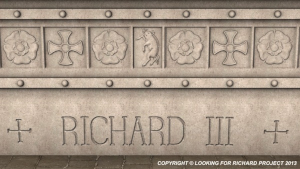
The careful positioning of the coat of arms, plaque and carved inscription are intended to leave an expanse of plain smooth stone, thereby ensuring that the final effect is one of proportion and harmony, conveying a sense of dignity, serenity, and tasteful simplicity. Similarly, the side and end panels of the tomb chest are delicately adorned with personally important commemorative imagery that has been carefully researched and chosen: a three-motif sequence consisting of a rose, a cros, and a boar.
The rose depicts Richard’s family, the House of York.
The medieval heraldic rose used here, consisting of an inner and outer circle of petals, is taken from Julian Rowe’s illustration of King Richard’s battle standard (P W Hammond & A F Sutton, The Road to Bosworth, p.216). The white rose of York as used in the middle ages had various orientations, with the single point sometimes at the top (as in the rose in the arms of Edward IV’s illegitimate daughter Isabella, Henry Bedingfield and Peter Gwynn-Jones, Heraldry, p.62) and sometimes at the bottom of the drawing. Examples of each can be found, as well as some where the rose has been given only four petals instead of five so that there is no top or bottom point as in Writhe’s Garter Book, (Richard Marks and Anne Payne, p.38). Richard’s standard as flown at the Bosworth Battlefield Centre on Ambion Hill has a white rose with the point uppermost.
In addition there are numerous examples of mid-fifteenth century Yorkist roses orientated in precisely the same fashion as the tomb. Our intention from the outset has been to assemble a selection of motifs which can be clearly shown to be personally associated with Richard.
The cross symbolises the king’s devotion to the Christian faith.
The example represented here is based on the pectoral cross of St Cuthbert housed in Durham Cathedral. Richard’s statutes bestowing collegiate status on the church of Middleham in Wensleydale demonstrate that St Cuthbert was particularly venerated by the king. (J M Melhuish, The College of King Richard III Middleham, p. 7; A J Pollard, Richard III, p. 178).
And the boar is Richard’s personal heraldic emblem.
The example depicted here is very loosely based on a carved white boar taken from the pulpit of Fotheringhay Church in Northamptonshire, the family mausoleum of the House of York. Appropriately, the ornate pulpit was a gift to the church made by Richard’s elder brother King Edward IV in the mid 1470s (M K Jones, Bosworth: Psychology of a Battle, plate 10; J Wilkinson, Richard, the Young King to be, plate 21). The rampant beast shown on the tomb is intended to represent Richard fighting back against Tudor propaganda.
Finally the plinth upon which the decorative panels stand is adorned with capital lettering and two crosses:
+ RICHARD III +
Richard’s regna number is given here so that the gold metal plaque on the surface of the tomb (described above) can stand as a more personal tribute.
Before the design was extended to include a plinth two local specialists quotes for construction and placement of the tomb ranging from £15,000 to £20,000. An up-to-date quote from award-winning sculptor and stonemason, Graeme Mitcheson (see details below), and which includes the plinth, is £28,000 – £30,000 (incl VAT). However, quotes could also be obtained from local master craftsmen who have previously worked with the Cathedral. It is anticipated that the tomb will take approximately four months to construct.
The Design Team
In September 2010, at the very beginning of the Looking for Richard Project, Philippa Langley, originator of the Looking for Richard Project, commissioned historian David Johnson and artist Wendy Johnson to design a tomb for Richard III. Together David and Wendy have been members of the Richard III Society for more than forty years and have contributed letters and articles to the Ricardian Bulletin. The design and CGI images of the tomb have taken over two years to complete.
- Wendy Johnson specialises in portraits of people and animals. She has exhibited and sold her artwork, and has also received commissions. Wendy has held a deep interest in Richard III since childhood, and has been a member of the Richard III Society since 1986.
- David Johnson, BA Hons, MA, received a PhD in History from the University of York in 2012. His Adwalton Moor 1643: The Battle that Changed a War (2003) is regarded as the definitive work on this pivotal English Civil War battle. David has been a member of the Richard III Society since 1995, and is in the process of preparing a new book exploring the political controversy surrounding Richard’s accession to the throne in 1483.
- CGI Images of the Tomb Design Produced by Joseph Fox of Lost in Castles. Lost in Castle specialises in historical computer reconstructions. Joe Fox, graphics specialist, worked with the designers of King Richard’s tomb to realise their vision in CGI form. A family business, their previous reconstructions available on DVD include: Middleham Castle in Wensleydale, Sandal Castle in Wakefield, and Houdan and Etampes in France. The current project is Conwy Castle in North Wales. For further information, visit their website.
- Award winning Sculptor and Stonemason: Graeme Mitcheson ARBS. Special mention is made here of Graeme Mitcheson. Graeme is an award-winning sculptor and stonemason from Northumberland in northern England. Graduating from Loughborough College of Art, he lives in Castle Donington, Leicestershire, and this represents both the northern and local people. Over 20 years, Graeme has created many large scale public artworks all over the UK and has several sited in Leicestershire. Graeme is an elected member of the Royal British Society of Sculptors For further information, visit Graeme’s website.
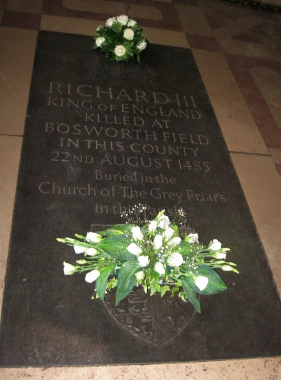
The memorial stone to Richard III, located in the chancel floor of Leicester Cathedral


12th March - An Adjournment debate held in Westminster Hall
An Adjournment Debate was held in Westminster Hall beginning at 11 am on 12th March 2013. In his opening remarks, the MP for York Central, Hugh Bayley, paid tribute to the leading archaeologist Richard Buckley for his work and the Richard III Society for proposing the project.
Mr Bayley then asked that a fair and independent process be created for arbitrating when, how and where King Richard III should be reinterred. He felt it was the responsibility of the State to make the decision and it should not be delegated to a group of academics and archaeologists from Leicester University.
David Tredinnick, MP for Bosworth, pointed out that the majority of people in Leicestershire wanted the king’s remains to stay in Leicester, and Mr Bayley confirmed that 7,500 signatories had been collected to this end, but that 24,000 had signed a petition in favour of York. The member for Selby, Nigel Adams, contributed that the views of the ‘descendants’ of the late king’s family should be taken into consideration.
Jon Ashworth, MP for Leicester South, quoted from the application for the Exhumation Licence which is explicit in that in the unlikely event that the remains of King Richard III are located, ‘the intention is for these to be reinterred at St Martin’s Cathedral Leicester which is good archaeological practice’.
Chris Skidmore, MP for Kingswood, suggested a compromise that King Richard lay in state in York for a week before reburial in Leicester, and pointed out that a tomb proposed by the Richard III Society had been privately funded and that £30,ooo had been raised, and therefore, there would be no cost to the state.
Mr Bayley continued that the terms of the Exhumation Licence should be reviewed as the remains had been confirmed as those of King Richard, and that such licences had been amended in recent years. He referred to a letter he had received from the chair of the Advisory Panel for Burial Archaeology, Professor Holger Schukowski, who wrote that the final decision lay with the Ministry of Justice who can vary the terms of the Licence. Mr Bayley proposed to the MoJ that an independent committee of experts should examine the historical record, scientific analysis, good archaeological practice, ethical and religious issues, and then advise how, where and when the reburial takes place. He continued that notice should be given to the University of Leicester that the Government could amend the licence and therefore plans for the reburial should temporarily cease. He also felt that this proposed advisory committee should, in the national interest, wait for the full scientific results. He commented on the split public opinion and called for the matter to be concluded with remarks that history is written by the victors, referred to Richard’s ‘reputation being trashed by that pesky playwright from Stratford-upon-Avon and that the king was ‘Good King Richard’ and who in his lifetime requested to be buried in York.
Julian Sturdy, the MP for York Outer, supported Mr Bayley saying the call was strong for Richard to be buried where he was loved. He suggested that the Government and the University of Leicester had come to an agreement behind closed doors and there had been no public consultation. His statement that the King Richard wanted to be buried in York was challenged by Jon Ashworth who said that there was no evidence that King Richard wanted to be buried there.
Finally Jeremy Wright, Parliamentary-Under-Secretary of State and Minister for Prisons, responded to the proposals and arguments and began by saying it was a matter of national pride and excitement that the remains of King Richard had been found and referred to the joint venture between the University, Leicester City Council and the Richard III Society as an outstanding research project.
He continued by stating that the MoJ’s jurisdiction covered burial law and policy. He confirmed that there was wide discretion in the conditions of the Exhumation Licence but also confirmed that the responsibility for carrying out the terms of the Licence rested with the University of Leicester – that was the law. He stated that York Minster supported the reburial of King Richard at Leicester Cathedral. He continued that conditions of an exhumation licence can be changed but that it is unusual and that the University of Leicester could make such a request. He concluded that the University is happy to receive representations to take into account what Mr Bayley had said and that the MoJ could facilitate a meeting of those interested parties.
The Chairman of the debate, Edward Leigh, concluded with the statement that ‘King Richard III was as controversial in death as he was in life.’
Read the Daily Hansard record.
What is an Adjournment Debate?
An adjournment debate is simply a way in the Commons of having a general debate without requiring the House to vote. There are several different types of Adjournment debates. Some allow the Commons to hold a general open-ended debate on a subject or a government policy without reaching a formal decision about it. Others provide an opportunity for backbench MPs to raise constituency issues or other matters relating to government administration or policy – and to obtain a response from a government minister. This debate fell in to the latter category.
Setting the record straight: Where did King Richard want to be buried?
During the debate there were several references to King Richard’s desire to be buried in York Minster. An article written by the historian Peter Hammond, its President, and published in the December 2012 issue of the Ricardian Bulletin, details the basis for the speculation/interpretation of the known facts.
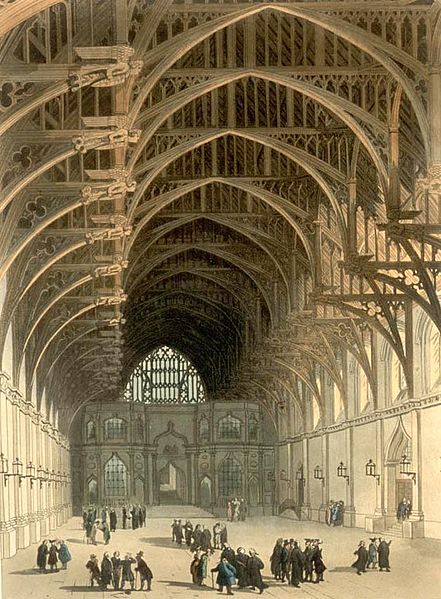
Westminster Hall
23rd May - New Orchestral Composition for the Society
The Society is delighted to host a new composition, Richard III, by Robert Draper who has been inspired by the remarkable discovery of the remains of King Richard III in Leicester last year.
This orchestral piece is scored for two flutes, two oboes, English horn, two bassoons, 4 French horns, 2 trumpets, 3 trombones, timpani, pipe organ, and strings. The opening oboe theme has a tinge of sadness, but this fuses to connect with the drama of Bosworth Field as the music develops.
Robert Draper is a refreshing and individual sounding modern day English classical composer. He writes engaging music which is dramatic, passionate and direct. A composer and pianist, he read music at the University of London Goldsmith’s College, where he studied composition. He studied piano with Russian virtuoso Evgenia Chudinovich. He has written major works for orchestra, choir, piano, string quartet and other instruments. He is 49 and lives in the East Sussex countryside of southern England.
Images shown during the presentation are courtesy of Geoffrey Wheeler, Studio88, Gerry Hitch, Osprey Publishing Ltd and Peter Hammond. Click the ‘play’ button below to listen to the music.

Robert Draper, composer
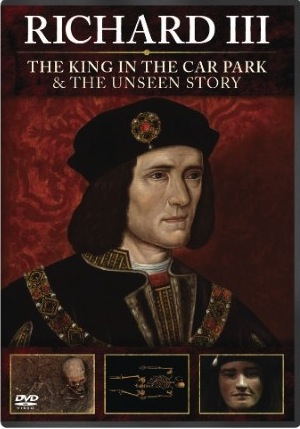
23rd May - Richard III: The King in the Car Park and The Unseen Story
When a skeleton was found under a Leicester car park in September 2012, the news broke around the world. Research began, involving dozens of specialists in the fields of archaeology, osteology, history, forensic pathology, genealogy and DNA analysis; could this skeleton be the remains, lost for 500 years, of England’s most infamous king? Philippa Langley, an Edinburgh based screenwriter and secretary of the Scottish Branch of the Richard III Society, was the main advocator of the project, and together with the University of Leicester they embarked on a journey to discover the medieval monarch’s lost bones. Presented by Simon Farnaby, ‘Richard III: The King in the Car Park’ tells every step, twist and turn of the story. It unveils a brand new facial reconstruction made from the skull and reveals the results of the final tests that confirm or deny the body’s identity. Additionally, ‘The Unseen Story’ features exclusive footage of the dig, forensic tests and fresh interviews with the lead scientists, piecing together the critical steps in the archaeological excavation. We see how the Greyfriars Church was uncovered and witness the painstaking exhumation of the lost King’s grave from the first indications of human remains to the exposure of the body’s twisted spine revealing a new dimension to the hunt for England’s long-lost king.
The Channel 4 documentary on the discovery of King Richard’s remains will be available on DVD from Monday 27th May. Total running time is 150 minutes. The DVD will be available from all good DVD retailers and from Amazon.
23rd May - New Society Publication
English Wills in the Prerogative Court of York, 1477-1499 edited by Heather Falvey, Lesley Boatwright and Peter Hammond. The Richard III Society’s latest contribution to fifteenth century research and scholarship. ‘The York Wills’, has now been published. This book, the product of a group project organised by the Research Committee of the Richard III Society, contains the 89 wills written wholly or mostly in English, providing full transcripts and also translations of any Latin sections.
The introduction discusses the form of a medieval will and uses examples from these wills to illustrate the points being made. Appendix I is a list of all entries in York Probate Register, Volume V , in the order in which they appear. Appendix II summaries the burial requests of the 89 testators. There is a comprehensive glossary and also indexes of persons, places and subjects.

English Wills proved in the Prerogative Court of York, 1477-1499
23rd May - Richard III by Andrew Jamieson
The Society has commissioned this artwork by the Queen’s Scribe, Andrew Jamieson, depicting Richard III mounted on his horse, armoured as a warrior, but holding a sceptre denoting his kingship. Richard’s armorial bearings are shown on the horse trappings and in his banner, while his crowned shield is surrounded by the Garter. Alongside him runs his white boar, while the grass is powdered with forget-me-nots, white roses for York and broom flowers and pods for the Plantagenets.
A new range of merchandise featuring the design is now available:
- Crested image A4 prints (stock no. 175) – on good quality card and presented in a card protective envelope. Cost will be £7.00 per print, plus p&p per item of £1 for UK orders, £3 for EU orders, and £3.50 for RoW orders.
- Crested image Notelets (stock item 176) – which can also be used as greetings cards: on good quality card with an envelope, banded & sold in packs of 10. Cost will be £7.50 per pack, plus p&p per item of £1.50 for UK orders, £3.80 for EU orders, and £5 for RoW orders.
- Crested image Postcards (stock item 177) – cost will be 50p per postcard, plus p&p per item of £0.50 for UK orders, £0.75 for EU orders, and £0.85 for RoW orders.
Please contact our Sales Liaison Officer to order.
Find out more about Andrew Jamieson.

Richard III by Andrew Jamieson, © Richard III Society
30th June - Richard III at the Battle of Bosworth by Graham Turner
On Saturday 29th June, in the Heritage Room at the Bosworth Battlefield Centre as part of an exhibition of his work and in front of a group of invited friends, Graham Turner, the acclaimed historical artist – and member of the Society – unveiled his latest painting of King Richard III. For once, Graham had not been showing progress reports on his website, so his audience had only a vague idea as to what to expect. They were not to be disappointed! This depiction of Richard is quite stunning.
The king is fully armoured, mounted on his horse just before the Battle of Bosworth. Alongside him is his friend, Sir Robert Percy, while other knights of the household can be seen in the background, Richard’s armour is gilded and he wears the jewelled circlet crown, with fleur-de-lys upon its helm. He is every bit the king about to do battle for his throne.
Although Graham had started the painting before the finding of the remains of the king, he was able to incorporate the findings into the final picture. King Richard’s face is based upon the reconstruction commissioned by the Society.
Prints on paper or canvas are available from Graham’s website at www.studio88.co.uk

Richard III at Bosworth by Graham Turner. Reproduced by kind permission of the artist - www.studio88.co.uk
16th August - Plantagenet Alliance Judicial Review
The Richard III Society acknowledges the decision handed down in the Queen’s Bench Division (Administrative Court) by The Honourable Mr Justice Haddon-Cave to grant permission for the Plantagenet Alliance to bring a Judicial Review hearing against the Secretary of State for Justice and the University of Leicester – and others – over the decision to reinter King Richard in Leicester Cathedral.
The matter must now be left to the due process of law, but we hope it will be resolved amicably and quickly so that King Richard’s remains can be reinterred with honour and dignity and without controversy. The Judicial Review hearing will take place on 26th November 2013.
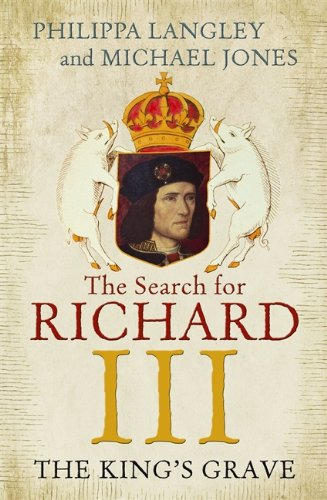
2nd October - The Search for Richard III: The King's Grave
Philippa and Mike’s book, The Search for Richard III: The King’s Grave, was published on 2nd October. They have concluded an extremely successful country-wide book tour with packed audiences who were interested to learn more about the real Richard III.
Philippa gave an interview to the Daily Mail which appeared in their You Magazine on 22nd September.
26th November - Judicial Review (adjourned)
© Annette Carson, 2013
Important Note: The following summary is a personal impression of the events in the High Court which the writer attended as a member of the public. They are by no means a verbatim transcription, and indeed from my seat at the back it was quire difficult to hear the arguments. Please accept my apologies for any inaccuracies, and do not quote this account as authoritative.
Heard before:
Lady Justice Hallett
Mr Justice Ouseley
Mr Justice Haddon-Cave
For the Plantagenet Alliance (Claimant): Gerard Clarke
For the Secretary of State for Justice (first defendant): James Eadie, QC
For the University of Leicester (second defendant): Anya Proops
For Leicester City Council: Norman Palmer, QC
The proceedings opened, to our surprise, not with arguments for the Plantagenet Alliance’s case but with a wholly unexpected application by Mr Clarke, acting on their behalf seeking the Court’s permission to join Leicester City Council to the existing two defendants in the case. It was only later in the course of the morning that Mr Clarke spoke the words which he had doubtless originally prepared as his opening remarks: that this was the most extraordinary Judicial Review in modern times, and practically unrepeatable. As such it was probably non-precedential. The Court was being asked to decide whether the defendants had failed to conduct the due consultation that was called for in the case of the reburial of the human remains of a King of England.
The first business of the day, however, concerned itself with the request by the Plantagenet Alliance (PA) to have Leicester City Council (LCC) joined as co-defendant. The Council had very recently made a written submission to the effect that it considered itself to be the custodian of the remains. Mr Clarke said that the LCC had a reasonable case to claim custody, but had been persuaded by the University of Leicester (UoL) to take a background role. The Council now says it merely suspended its decision-making process, and proposes to return to it after the conclusion of the Judicial Review.
The PA’s concern was that in returning to its decision-making role once the Court had given judgment, there was no reason to suppose that the Council would then carry out the consultation sought by the claimants. What if, after the judicial process, the LCC simply maintains that it has legal control of the disposal of the remains? This was the PA’s main argument for not leaving the LCC merely as an interested party, but for wishing to have it joined as a co-defendant – so that it, too, would be bound by the ruling of the Court, (There are already two named interested parties in the case: Leicester Cathedral and York Minster.)
Interestingly, at this point the LCC was observed to have clearly broken ranks with the University, in that it disputes the UoL’s role and claims to have overall direction of the matter, in its capacity both as the land-owner and as a public authority.
Given that this submission was received only on 19th November, the PA needed to hear the LCC’s arguments in full in order to determine whether the target of the Judicial Review should rather be (or should include) the LCC. Asked why this was not considered at the outset, Mr Clarke stated that they could not have know of the LCC’s role because the public position on the remains was adopted by the UoL in February 2013.
Lady Justice Hallett sought for other remedies as she was well aware that to consider the joining proposal now would almost certainly prevent the conclusion of the hearing, for which only this one day had been set aside. She added that there was now further disagreement relating to how the remains should be laid out – whether they should be placed in their anatomical position in the coffin.
There was considerable discussion as to the LCC’s history in the matter and its stated willingness to conduct consultations with various parties, some of whom were mentioned. Mr Justice Ouseley evinced an ongoing interest in what consideration it had given to other reburial locations: he had noticed that the LCC’s early intentions to consult on them had been dropped. In the end Mr Palmer, acting for the LCC, stated that the Council was firmly committed to a policy of consultation in respect of the remains.
Discussion also centred on the exhumation licence issued by the Ministry of Justice (MoJ). The PA was surprised that an expedition order had been made, i.e. an order to expedite compliance with the terms of the licence. For readers who are unaware, the licence, issued in September 2012, permits the exhumation of remains and gives the licensee responsibility to arrange for their reburial within two years. It was applied for by University of Leicester Archaeological Services (ULAS) but issued to the UL as licensee.
The question was asked whether the Secretary of State has the power to amend the order as to the two-year deadline. Mr Eadie, acting for the Ministry of Justice, replied that the MoJ does not assert the power to do anything other than to issue such a licence in the proper form.
Mr Clarke envisaged that in the event that the PA succeeded, the Secretary of State would probably issue a fresh licence. The problem facing the Court was: what if the LCC then objected to it? The PA wanted to avoid any further legal challenges in the future. The LCC’s statement said that it had ceased its own consultations because they were not required by the MoJ’s licence. It had also made its position clear that it was in favour of reburying Richard III in Leicester.
The Justices then decided to take a brief adjournment, the issue to be determined being whether the LCC has a role to play in the case and whether it is appropriate to join them as co-defendants. On returning they ruled that the LCC would now be co-defendants, which meant that the hearing must be adjourned to await new submissions. Lady Justice Hallett wanted to schedule the hearing for as early as possible in the new year, but they were looking at two days in the Court calendar as well as time to prepare, so they could not predict how soon this would be.
It was established that there would be no problem amending the original exhumation licence to provide a slightly longer time. Mr Eadie did not appear to have been briefed as to several aspects relating to the licence, and answered ‘Pass’ when asked by Mr Justice Ouseley whether the phrase ‘burial ground’ had any geographical limits, and whether it signified an exterior burial site or one within a building.
Meanwhile Mr Palmer had taken new instructions from the LCC and gave the Court an undertaking that the Council was prepared to embark on consultations – now. Ms Proops, for the UoL, said the University was bound by the terms of the licence as issued and had no room for manoeuvre, otherwise they would be in breach of the law. Mr Palmer for the Council disagreed on this point of law.
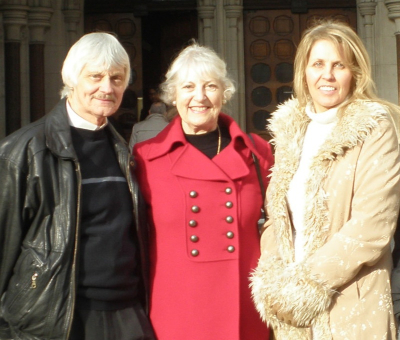
John Ashdown-Hill, Annette Carson and Philippa Langley outside the Royal Courts of Justice following the adjournment of the Judicial Reivew