
The Battles
The Battle of Barnet
14th April 1471
Result of the Battle – Yorkist victory
King Edward IV’s ten-year reign was interrupted by the defection of his cousin, the Earl of Warwick, which eventually led to the latter giving his allegiance to his erstwhile enemy, the Lancastrian Queen Margaret, and her son. Edward IV was driven into exile on 3rd October 1470 but he returned to England on 14th March the following year, landing at Ravenspur in Yorkshire. The city of Hull refused to open its gates to the Yorkists so they marched on to York where they were received with only a little less reluctance. The king’s reception in Yorkshire was generally cool so rather than proclaim that he had returned to reclaim his kingdom, he told the Yorkshiremen that he was only claiming his rights as Duke of York, an adaptation of the claim made in 1399 by Henry Bolingbroke (future Henry IV) upon his return from exile.
Edward left York on 19th March and marched to Nottingham via Wakefield, all the while being shadowed by Montagu who failed to attack, probably due to lack of resources, whilst the king attracted support. At Leicester a force of 3,000 under the command of Sir William Norris joined him, raised from the estates of William, Lord Hastings. Meanwhile, the Earl of Warwick was frantically recruiting in the midlands but as the king approached, Warwick retreated into the city of Coventry and refused Edward’s challenges to meet and fight. The king impatiently by-passed the city and made for the town of Warwick where he proclaimed himself king once again. George, Duke of Clarence, who had been recruiting in the west country, ostensibly for the Earl of Warwick, now met with his brother three miles outside the town of Warwick and the two were reconciled.
The king again challenged Warwick to fight, who, although he was now reunited with his brother Montagu and his army, was not happy with the odds; and again refused. Edward then took the decision to leave Coventry in enemy hands and made for London, which he entered on Thursday 10th April. He was briefly reunited with his wife and saw his son and heir for the first time. The next day, Good Friday, fresh support for the king began to arrive and on Saturday Edward’s preparations for the forthcoming military engagement were complete. He left London later that day heading towards St Albans, the last reported sighting of Warwick. Earlier in the day Warwick had reached Barnet and took up a defensive position across the St Albans road, in the area now known as Hadley Green, on the plateau overlooking London. The Earl of Oxford led one division, Montagu the centre and the Duke of Exeter, the other flank. It was late when Edward reached Barnet but he was determined to end the matter the next day, Easter Sunday. In the dark he deployed his troops, the van led by the young Duke of Gloucester, the centre by himself with Clarence, the left by Lord Hastings. The divisions of the opposing forces were not aligned to the Yorkists which was to the advantage of Gloucester and Oxford but to the disadvantage of Hastings and Exeter. During the night Warwick sought to frighten his opponents by firing volleys but due to the close proximity of the two armies the artillery overshot their marks.
Very early in the morning, as it became light, and in a thick mist, Edward engaged his enemy. Inevitably the misalignment of the wings caused problems for both armies. Oxford swiftly overwhelmed Hastings’ division. Hastings’ line broke and his soldiers ran off, hotly pursued by the Lancastrians who halted their chase to plunder the town. Some of Hastings’ men made it to London where they claimed the Yorkists had been defeated, and that Gloucester and Clarence were both dead. Meanwhile Oxford eventually managed to rally a force of about 800 men and return to the battle but his luck for the day now ran out. The battle lines had shifted as Gloucester had exerted his tactical advantage against Exeter, and Warwick had been forced to deflect men to Exeter’s aid. So, according to Warkworth’s Chronicle, the first men Oxford encountered were those in Montagu’s division and in the poor visibility Montagu’s men mistook Oxford’s estoile badge for King Edward’s Sun in Splendour badge, attacking what was left of Oxford’s division until the earl fled the field. Cries of treason were now heard as the Lancastrian army began to disintegrate. Montagu was killed and with the death of his brother and his army in disarray, Warwick tried to escape. It appears he was taken prisoner, but when a group of soldiers recognised him he was killed.
With the death and wounding of the Lancastrian leaders, the battle was over by 7 or 8 o’clock in the morning. The Duke of Exeter was seriously wounded and Gloucester and Earl Rivers had also suffered injuries. Among the nobles dead, apart from the Neville brothers, were the Lords Cromwell and Saye and the heir of Lord Berners, Sir Humphrey Bourchier. Casualties have been put between 1,500 and 3,000. The strength of armies has been estimated at around 15,000 for the Lancastrians and between 10,000 and 12,000 for the Yorkists.
King Edward rested briefly at Barnet before returning to London but, unbeknown to him, Queen Margaret with her son and army landed at Weymouth the same day.
Contemporary Sources
- Historie of the Arrivall of Edward IV in England and the Finall Recoueyre of his Kingdomes from Henry VI edited by J Bruce, Camden Society, 1838
- Memoires by Philippe de Commines, edited by D Godefroy and Llenglet du Fesnoy, 4 vols, Paris, 1747.
- The Great Chronicle of London edited by A H Thomas and I D Thornley, 1938
- A Chronicle of the First Thirteen Years of the Reign of King Edward IV by John Warkworth, edited by J O Halliwell, 1839.
- Edward IV’s Memoir on Paper to Charles, Duke of Burgundy. The so-called ‘short version of the Arrivall’ edited by Livia Visser-Fuchs in Nottingham Medieval Studies, Vol 36, 1992
- Anchiennes Croniques d’Engleterre by Jean de Waurin, edited by E Dupont, 3 vols, Societe de l’Histoire de France, Paris, 1858-63.
- Recueil des Chroniques D’Engleterre by Jean de Waurin, edited by W Hardy and E Hardy, 1891.
Further Reading
- ‘A Hanseatic merchant’s account of Edward’s campaign to regain the crown, up to the battle of Barnet’ from The Newsletter of Gerhard von Wessel 17th April by John Adair in Journal of the Society for Army Historical Research, 1968.
- ‘Chronicles of the Battle of Barnet’ by P Bernard and B Grafton Green in Hendon & District Archaeological Society Occasional Papers, No 1, 1971.
- ‘A Review of the Sources for the Battle of Barnet’ by Peter Watson, The Ricardian, June 2000.
- ‘The Battle of Barnet’ by Frederick Charles Cass in Transactions of the London and Middlesex Archaeological Society, Vol 6, 1882.
- ‘Battle on Easter Day’ by Hubert Collier in Lloyds Log, March and April 1971.
- Battle of Barnet Quincentenary Commemorative Brochure edited by David Hicks, 1971.
- The Battles of Barnet and Tewkesbury by P W Hammond, Gloucester, 1990.
- ‘The Battle of Barnet’ by Sheila Hutchison in The Lady, 8th April 1971.
- The Battle of Barnet by Fiona Jones (revised ed), Barnet Museum, 2017.
- ‘A Ricardian Riddle: The Casualty List for the Battle of Barnet’ by Livia Visser-Fuchs in The Ricardian, March 1988.
- ‘Reappraisal of the Battle of Barnet 1471’ by B. Warren in Potters Bar and District Historical Society, 2009.

Challenge in the Mist by Graham Turner. Reproduced by kind permission of the artist. www.studio88.co.uk

The Royalist March. Reproduced by kind permission of Peter Hammond and David Scuffam.
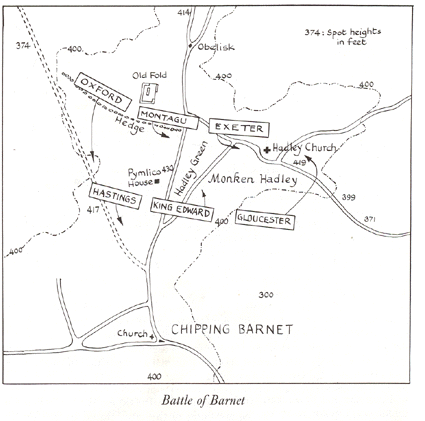
The Battle of Barnet. Reproduced by kind permission of Peter Hammond and David Scuffam.