
The Battles
The Battle of Wakefield
30th December 1460
Result of the Battle – Lancastrian victory
After the success at Northampton, the Duke of York returned to England in September 1460 and moved to London where he laid claim to the throne. However, this was not acceptable to the assembled nobility who baulked at the idea of deposing an anointed king to whom they had sworn oaths of loyalty. A compromise was agreed whereby York would succeed to the throne after the death of King Henry and the situation was formalised in an Act of Accord. The queen, understandably, was outraged at the disinheriting of her and Henry’s son. With the Earl of Northumberland she began raising forces to free the king who was still a prisoner following the Battle of Northampton. She travelled to Scotland and continued her recruiting campaign there. As the size of this army grew, York and Salisbury knew it could not be ignored and on 9th December they left London for the north together with Edmund, Earl of Rutland, the second son of the Duke of York, and Thomas Neville, one of Salisbury’s sons. The Earl of March was sent to Wales to manage any problems there and Warwick remained in London with the king.
York recruited on his march but was not nearly as successful as the Lancastrians. He was also hampered by bad weather and a run-in with Somerset’s men at Worksop but arrived at his castle of Sandal on 21st December. He was joined by Thomas Harrington, Thomas Parre and James Pickering. A faithful retainer, Edward Fitzwilliam, held nearby Conisbrough Castle. The royalist army, meanwhile, was based at Pontefract and as Christmas was approaching it appears a truce was negotiated which would run until Epiphany. In his haste to reach the north, York did not have the opportunity to victual his army properly, and was forced to organise foraging expeditions to find supplies for his several thousand men, which meant large groups leaving the comparative safety of the castle precincts.
Exactly what happened next is uncertain. The various contemporary sources for the battle are contradictory but the reports do agree that the Yorkists were outnumbered. Estimates of York’s army vary between 5,000 and 12,000 men. The Lancastrian army has been put at between 15,000 and 22,000. In the event, York was persuaded, either by deception or by bad intelligence, to leave the castle and to ride out towards Wakefield where the royalist army was apparently waiting for him.
Keith Dockray comments, ‘the battle was fought later in the day than normal; it did not last very long; and it was a crushing Yorkist defeat.’ The Yorkist losses have been variously reported as between 700 and 2,500. Amongst the Yorkist leaders who died was the duke himself, his nephew Thomas Neville, James Pickering and Thomas Harrington. According to the Annales of William Worcester, the Earl of Rutland was killed by Lord Clifford as he tried to flee across Wakefield Bridge. Salisbury was taken prisoner and executed the next day. The victors decapitated the dead bodies of the leading Yorkists and placed their heads on Micklegate Bar in York. The head of the would-be king, Richard, Duke of York, was mockingly crowned with a paper diadem. Contrary to Shakespeare’s depiction, Margaret of Anjou was still in Scotland at the time.
Further Reading
- ‘The Battle of Wakefield’ by Keith Dockray in The Ricardian June 1992, pp. 238-258.
- The Battle of Wakefield: 30th December 1460 by P.A. Haigh, Alan Sutton Publishing, 1996.
- ‘The Battle of Wakefield: the Topography’ by Richard Knowles in The Ricardian, June 1992.
- From Wakefield to Towton: The Wars of the Roses in Battlefield Series: Britain 1460-1461, 2002.
- ‘The Battle of Wakefield’ by A.D.H. Leadman in Proelia Eboracensia, 1891 (first published in Yorkshire Archaeological and Topographical Journal, vol 11, 1891).
- ‘The Battle of Wakefield’ by Clements R. Markham in Yorkshire Archaeological and Topographical Journal, vol 9, 1886.
- The Battles of Wakefield: an historical narrative of the Battle of Wakefield in 1460 by George Tyas, 1854.
- 1460 – 1960: Catalogue of an Exhibition to Commemorate the Battle of Wakefield 1460 at the City Museum, Wakefield, 1960.

The Battle of Wakefield, 30th December 1460. Artwork from English Medieval Knight 1400-1500 by Graham Turner ©Osprey Publishing Ltd
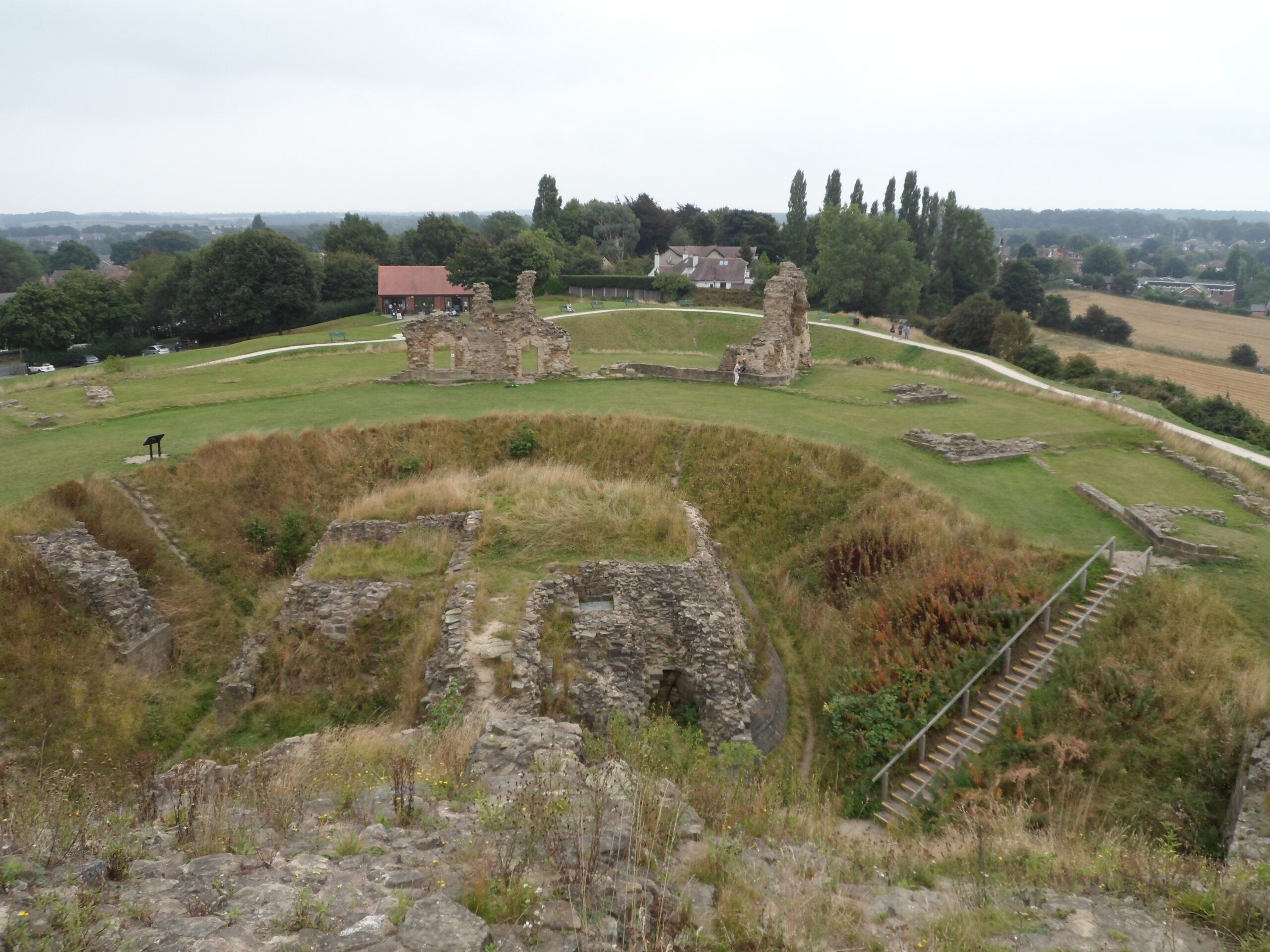
The remains of Sandal Castle

Sandal Castle, from where Richard, Duke of York, sallied forth