The Battles
The Battles of Ferrybridge and Towton
28th and 29th March 1461
Result of the Battles – Yorkist victory
Following their success at St Albans, the Lancastrian army moved south towards London but the city was chary of opening its gates to Queen Margaret’s army despite the fact she was reunited with the king. Margaret decided not to press the matter and withdrew with her army to the north. Meanwhile Edward, now Duke of York and the Earl of Warwick, following their respective victory and defeat, were reunited at either Chipping Norton or Burford and marched on the capital. The young duke felt sufficiently secure in his position to take the crown and on 4th March 1461 he was declared king. Edward knew that to make good his claim he had to defeat the Lancastrians once and for all. On the 5th March the Duke of Norfolk left London to raise an army in his base of East Anglia and on 7th March Warwick left for the midlands to the same end. Edward remained in London for another week and then marched north.
By 27th March Warwick, leading the vanguard of the new royal army, reached Ferrybridge, the crossing for the river Aire and just eight miles south of where the Lancastrians were encamped and preparing for battle. The bridge was badly damaged but repairs were made and Warwick crossed and made camp. Early on the morning of 28th March, Lord Clifford led a surprise attack on the Yorkists, who were driven back across the river. Warwick’s lieutenant, Lord FitzWalter, was killed and the earl himself was wounded in the leg by an arrow. Meanwhile King Edward advanced from Pontefract to find the bridge once again seriously damaged. Lord Fauconberg was sent westwards along the river to Castleford, three miles away, where he successfully crossed the river Aire. He immediately marched north, caught up with Clifford, killed him and scattered his force. By the evening of the 28th March the Yorkist host had crossed the river Aire and moved northward to meet the Lancastrian army.
The 29th March 1461, Palm Sunday, was a bitterly cold windy day with snow on the ground. The Lancastrian army, under the command of the 24-year-old Duke of Somerset, may have been 30,000 strong and was drawn up on heathland north of a ridge between the villages of Towton and Saxton. His two main ‘battles’, one under his own command and the other under the command of the Earl of Northumberland, were side by side with archers to the front and a small rear-guard behind them. King Edward, south of the ridge, ranged his archers, under the command of Lord Fauconberg, across the width of his two ‘battles’, one commanded by himself and the other by Warwick. As with Somerset, he had a small rear-guard but the young king’s major worry was the non-arrival of the Duke of Norfolk and the East Anglians. To the left of the northward-facing Yorkist army was the River Cock which meandered westwards and surrounded Castle Hill Wood on three sides. North and south of the wood, the heathland fell sharply to the river and to the right of the Yorkist army was a plateau. The battlefield was anything but spacious. There has been speculation that the Lancastrians hid a force within the woods to ambush the Yorkists but this has not been substantiated.
The battle began mid-morning and the first Yorkist volleys of arrows were aided by the wind to find their mark within the Lancastrian ranks. The Yorkist archers immediately moved back and the Lancastrian response fell on empty ground. Fauconberg’s archers were then ordered forward to retrieve the spent missiles. The first advance probably came from the Lancastrians with Somerset’s ‘battle’ moving towards King Edward at a greater speed than Northumberland upon Warwick’s ‘battle’. The clash between the armies was intense within the restricted arena of battle, the fighting was hand to hand and the whole battle became a melee. The turning point was probably the arrival of the Duke of Norfolk and his men who flung themselves onto the left flank of the Lancastrians. Gradually the Lancastrian line gave way until late in the day it eventually broke and the troops fled towards the river, their pathway later becoming known as Bloody Meadow. The River Cock was in full flood, and hundreds were drowned.
So ended one of the longest and bloodiest battles fought on English soil. Although claims that 28,000 were killed are almost certainly an exaggeration, casualties were heavy, particularly amongst the Lancastrians. The Earl of Northumberland, Lord Dacre and Sir Andrew Trollope were killed and the earls of Devon and Wiltshire were captured and executed although Somerset escaped. The former king and queen, who had stayed in York during the battle, fled to Scotland. The victorious young King Edward was now free to return to London and his coronation.
Further Reading
- Towton 1461: The Anatomy of a Battle by A.W. Boardman, Stroud, 2022.
- Walk Towton 1461: A visitor guide to battle-related sites by Helen Cox and Alan Stringer, Hershey Writing and Interpretation/York Publishing Services, 2012.
- Blood Red Roses: The Archaeology of a Mass Grave from the Battle of Towton AD 1461 edited by Veronica Fiorato, Anthea Boylston and Christopher Knusel, Oxbow Books, Oxford, 2000.
- Towton 1461 by Christopher Gravett, Osprey Publishing, 2003.
- From Wakefield to Towton: The Wars of the Roses in Battlefield Series: Britain 1460-1461, 2002.
- ‘Towton and Saxton: the story of a famous fight’ by Edward Bogg in Round about Leeds and the Old Kingdom of Elmet, the land twixt Aire and Wharfe, 1904.
- The Battle of Towton: Palm Sunday 29th March 1461 by Graham Hudson, 1985 (leaflet).
- The Battle of Towton 1461 by Patrick McGill, 1992.
- From Yorkshire Archaeological and Topographical Journal, vol 10, 1889.
- ‘The Battle of Towton’ by Cyril Ransome in English Historical Review Vol 4, 1889.
- Towton – the Battle of Palm Sunday Field 1461 by John Sadler, Pen & Sword Military, 2011.
- Killing Time: Challenging the common perceptions of three medieval conflicts – Ferrybridge, Dintingale and Towton by Tim Sutherland, Journal of Conflict Archaeology, Volume 5 No 1 2009 pp. 1-25.
- ‘Nasty, brutish and not that short’, The Economist, 16 December 2010, pp. 50-52.
- Fatal Colours by George Goodwin, Orion Publishing Group, 2011.
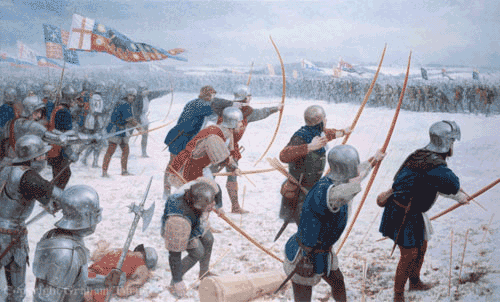
The Opening Barrage by Graham Turner. Reproduced by kind permission of the artist. www.studio88.co.uk
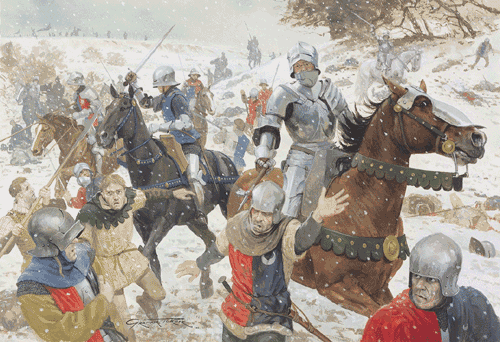
The Rout by Graham Turner. Artwork from 'Campaign 120: 'Towton 1461: England's bloodiest battle' by Graham Turner. ©Osprey Publishing Ltd.